Basis · Every deal
Pipeline
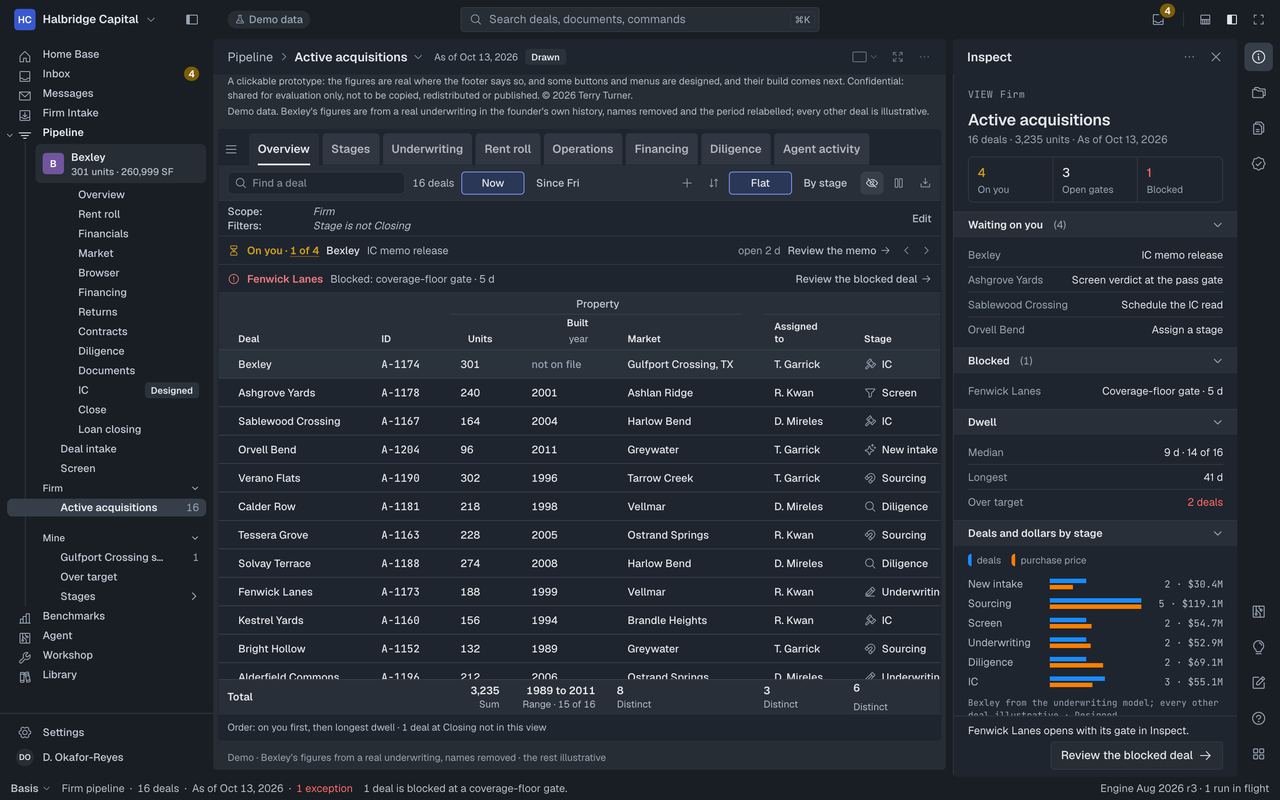
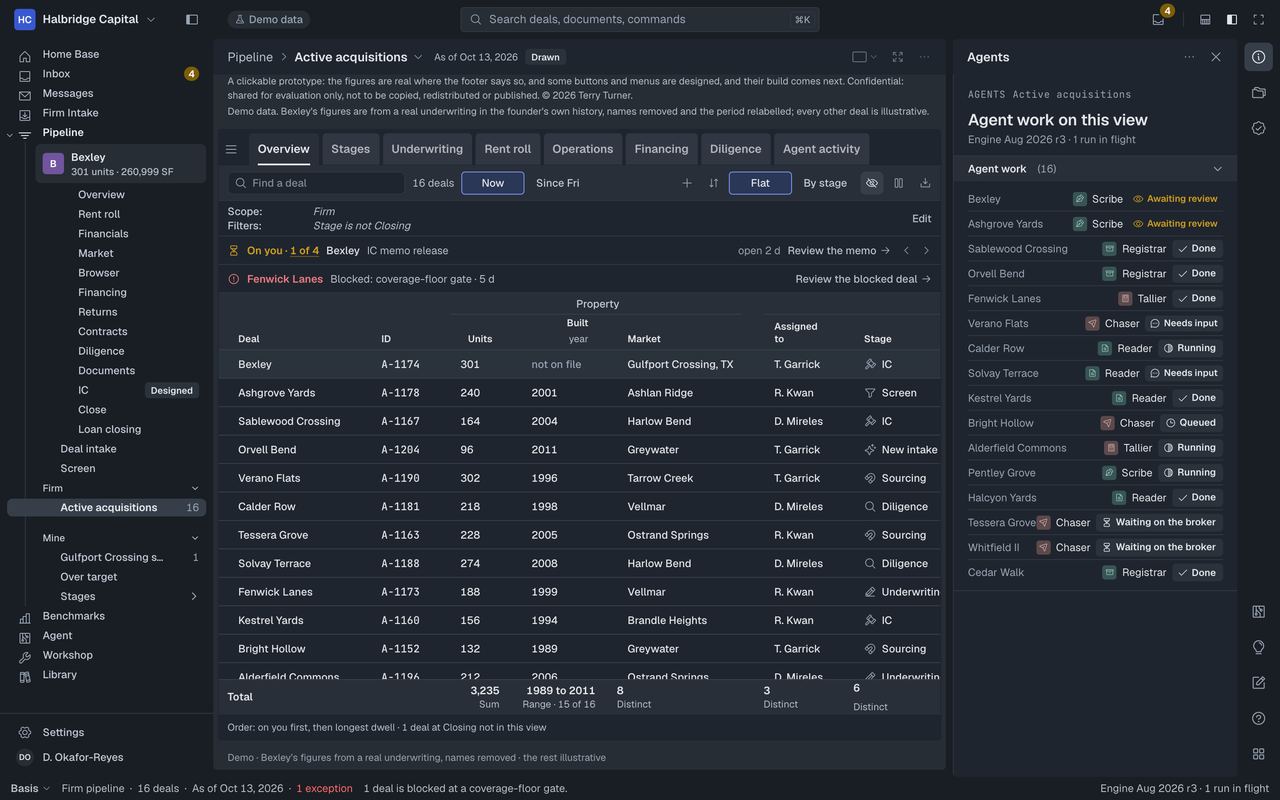
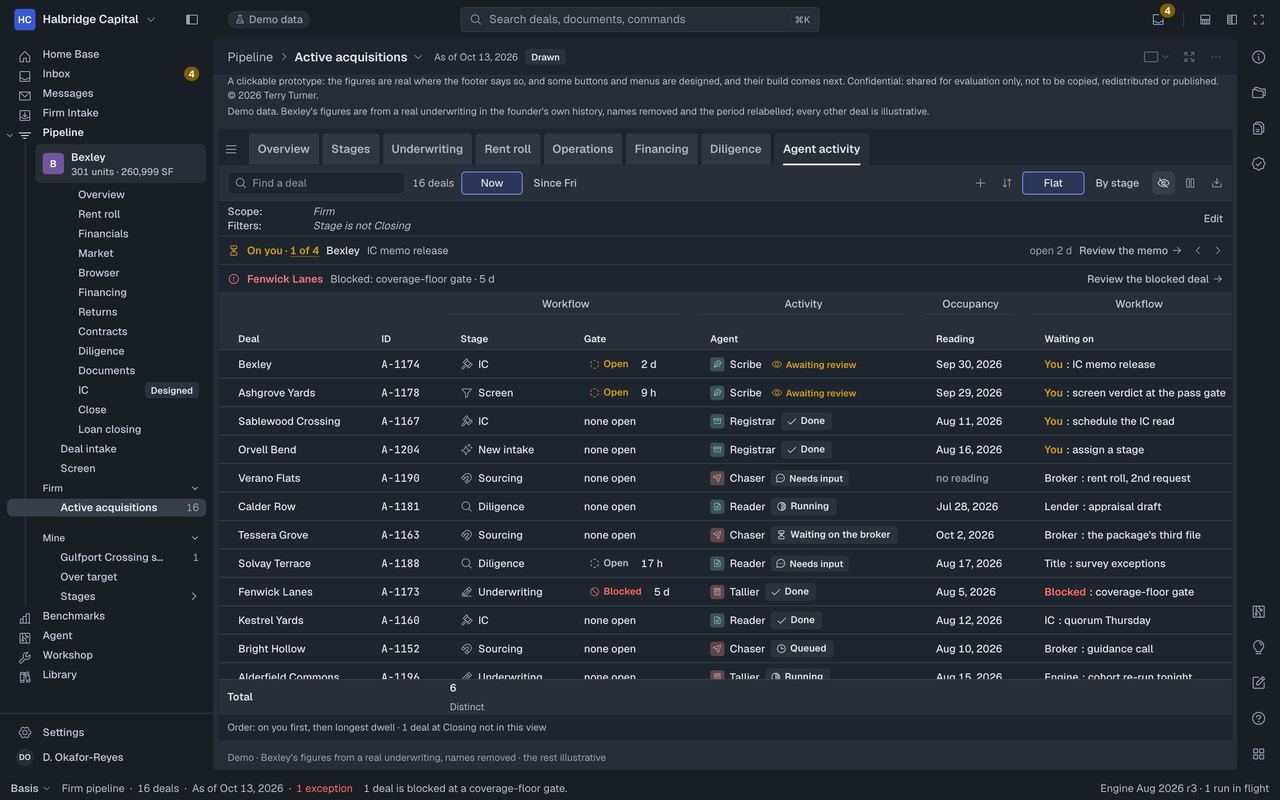
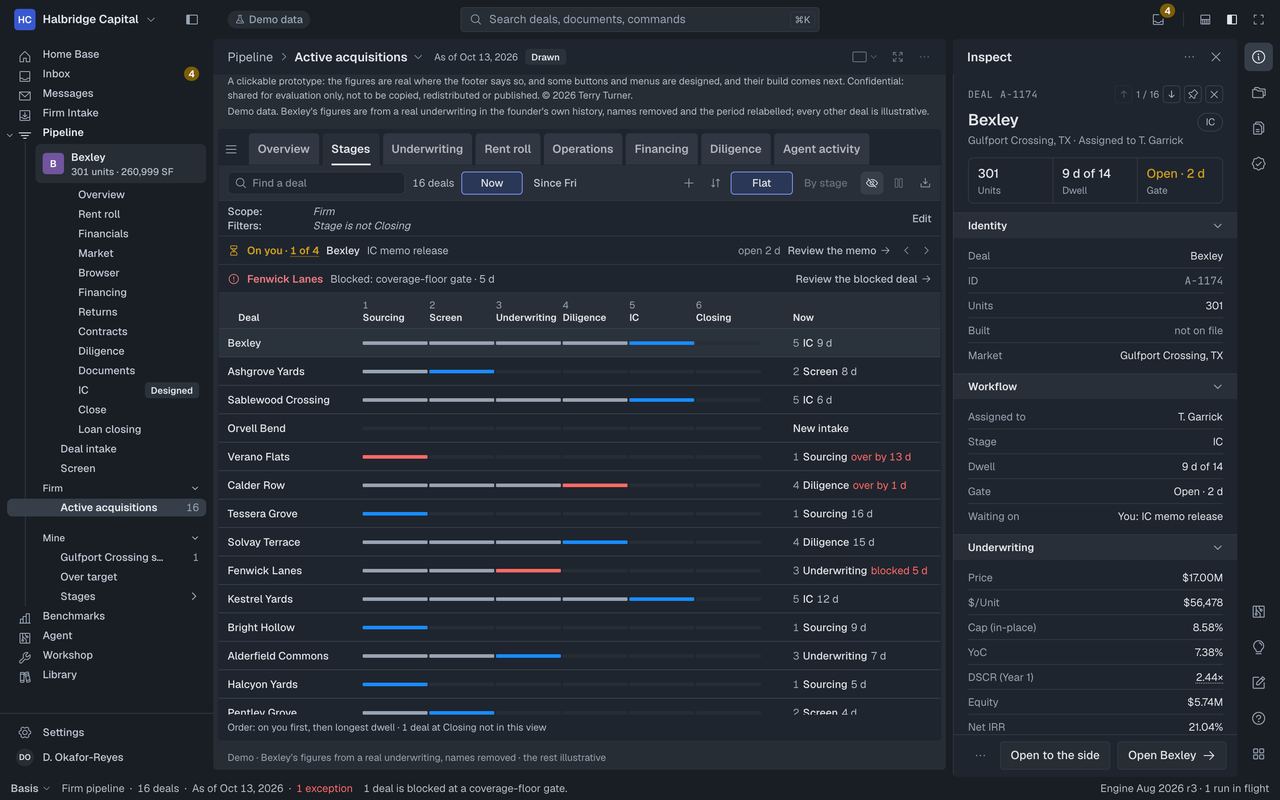
All 16 active acquisitions in one table, with what each waits on and which agent is on it. Bexley has sat at investment committee nine days, awaiting release by the deal lead.
Open it live , Pipeline, in a new tabEvery screen
Ten screens from Covenant, the servicer's app, and nineteen screens and two views from Basis, the underwriting app. A loan is underwritten once and serviced for years, and these are the screens that work moves to when it leaves Excel and the inbox. Each app stands alone. A third group shows what is designed next for Basis: one screen for each of the nineteen reasons an underwriter goes back to Excel, and two on a phone, each labeled Designed with what it rests on today. A clickable prototype of both apps: Covenant's figures are real reads from one loan where the screen says so, and Basis runs on demo data with Bexley as the deal. Some buttons and menus are drawn. Every picture of a built screen opens that screen live, in a new tab; a designed screen opens as a picture.
Covenant · 10 screens Clickable prototype
Corbett Mill's figures are real reads from one loan's closing documents and one quarterly package, with names replaced and dates moved forward to the current period; every other loan is illustrative.
 , opens live in a new tab
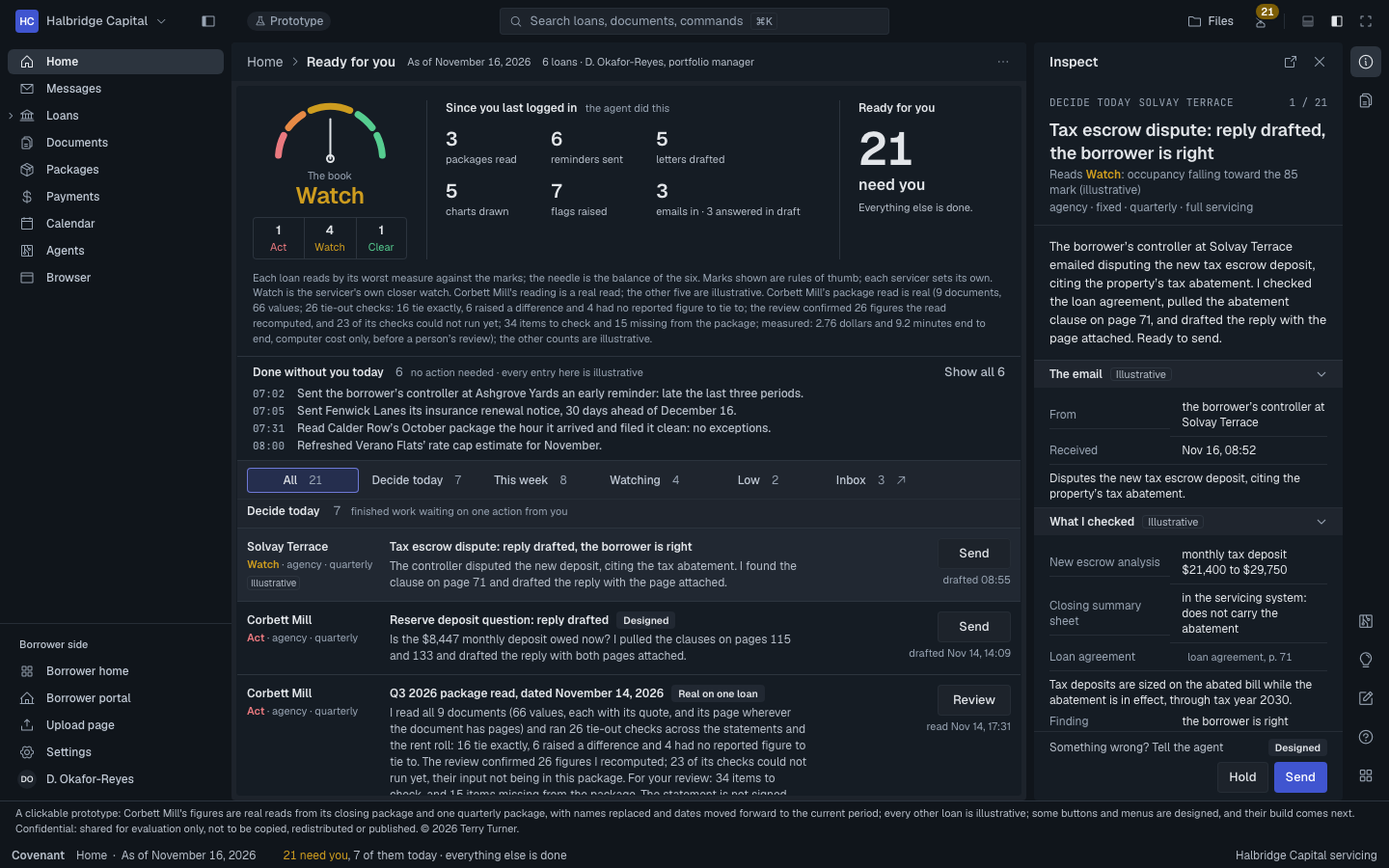
Work the agent finished since the last login, each waiting on one action. On Corbett Mill it drafted a letter: occupancy fell to 72.73%, short of the 85% line.
Open it live , The morning list, in a new tab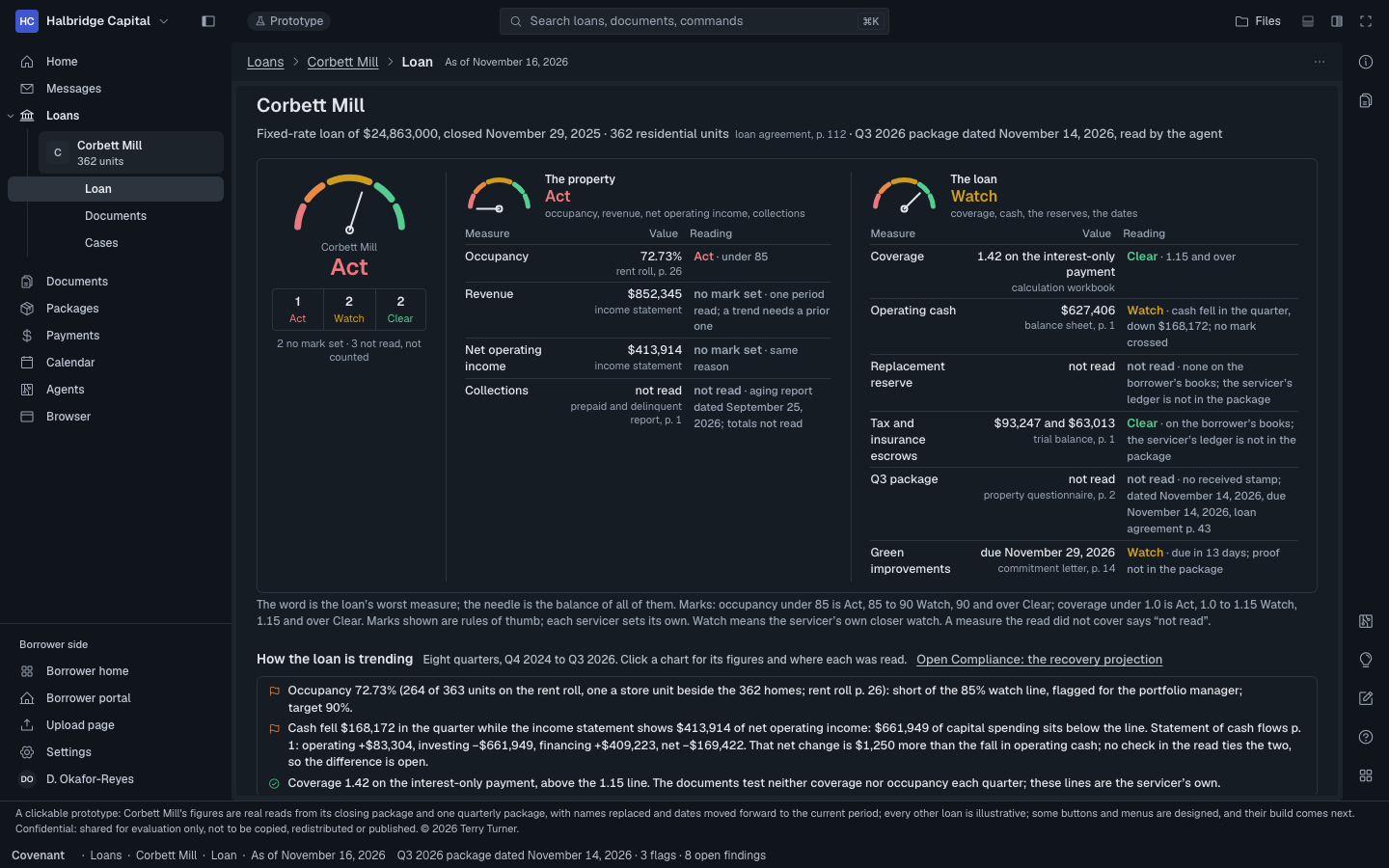 , opens live in a new tab
Corbett Mill on one page, every figure with its source. It shows why cash fell $168,172 in a quarter with $413,914 of net operating income: $661,949 of capital spending sits below the line.
Open it live , One loan, in a new tab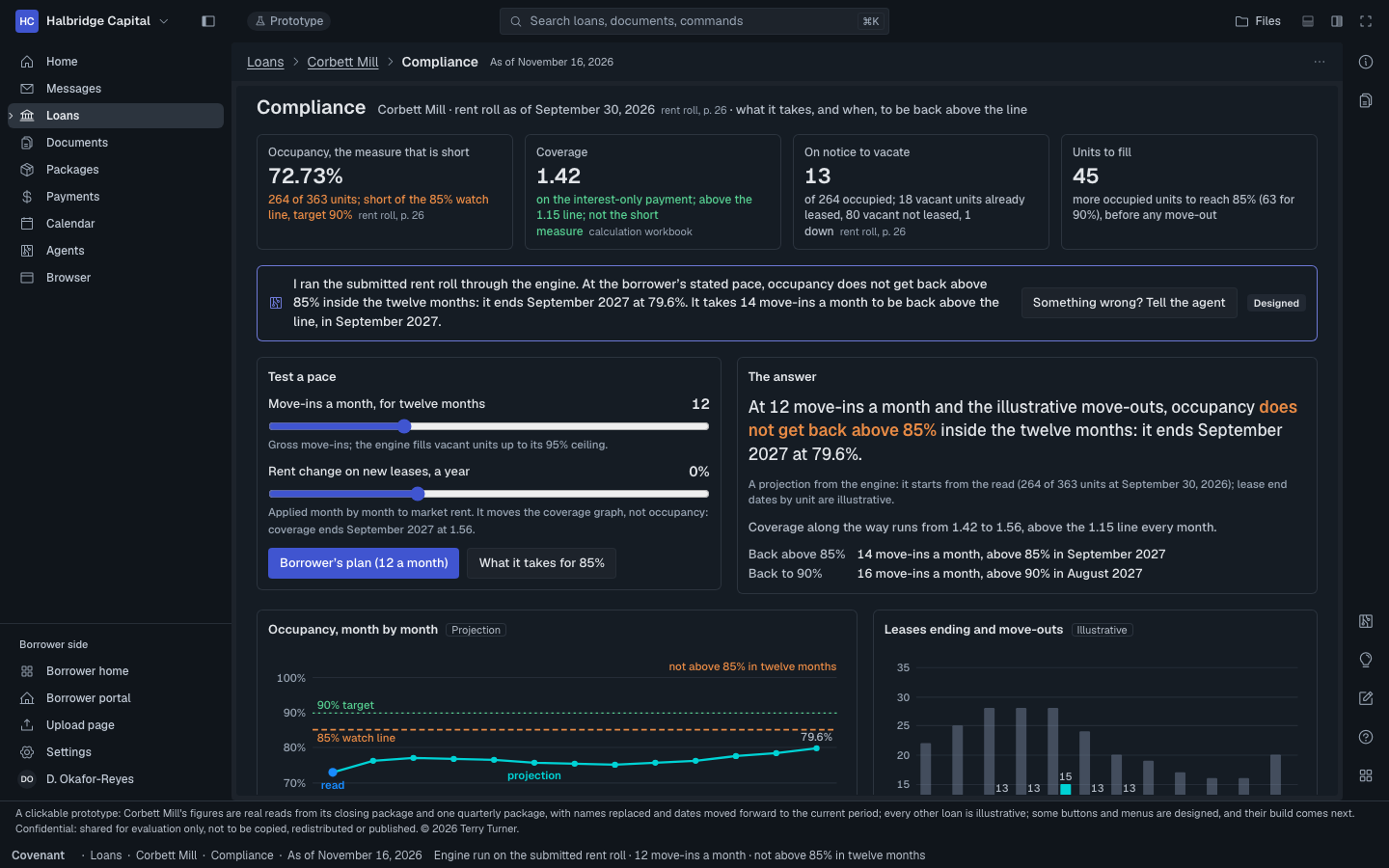 , opens live in a new tab
The agent runs Corbett Mill's rent roll through the engine. At the borrower's 12 move-ins a month and the illustrative move-outs, occupancy ends September 2027 at 79.6%; clearing the 85% line takes 14 a month.
Open it live , Compliance, in a new tab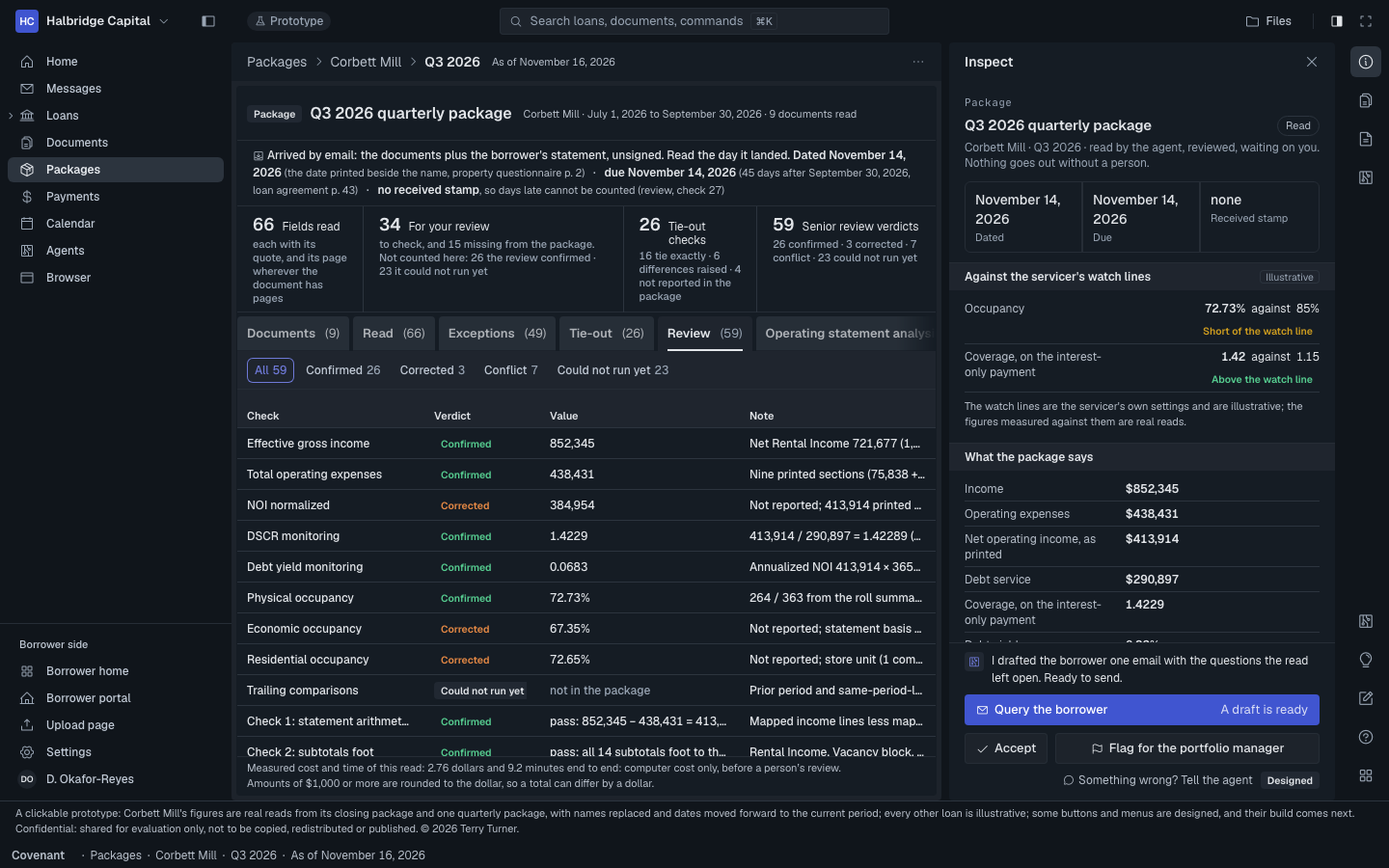 , opens live in a new tab
The agent read Corbett Mill's nine quarterly documents in 9.2 minutes, computer cost only, before a person's review, each of the 66 values with its quote, and its page wherever the document has pages. It caught a $28,960 cable rebate left in reported income.
Open it live , A package, read, in a new tab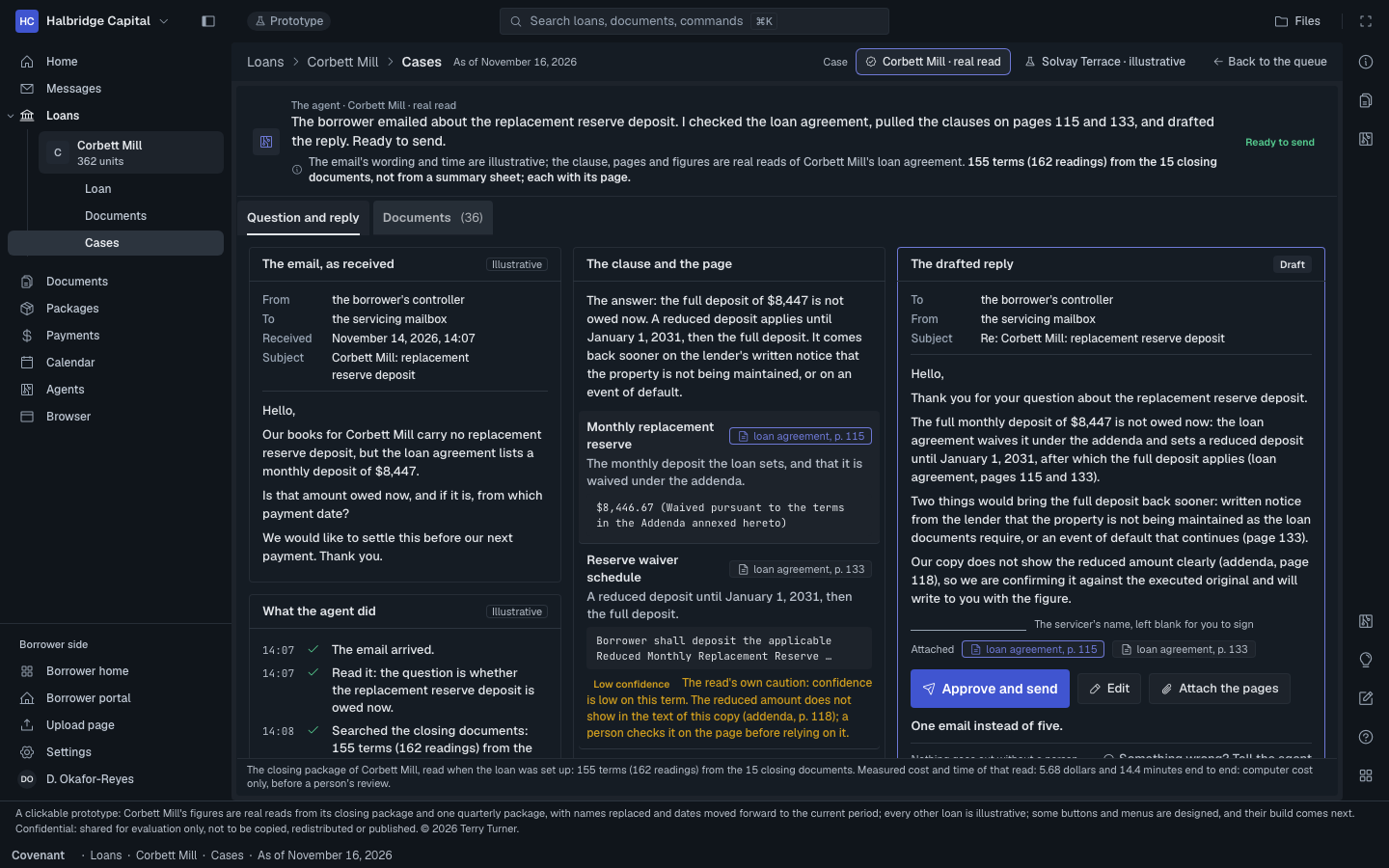 , opens live in a new tab
A borrower asks whether Corbett Mill's $8,446.67 monthly reserve deposit is owed now. The agent finds the answer on loan agreement pages 115 and 133 and drafts the reply.
Open it live , A question, answered, in a new tab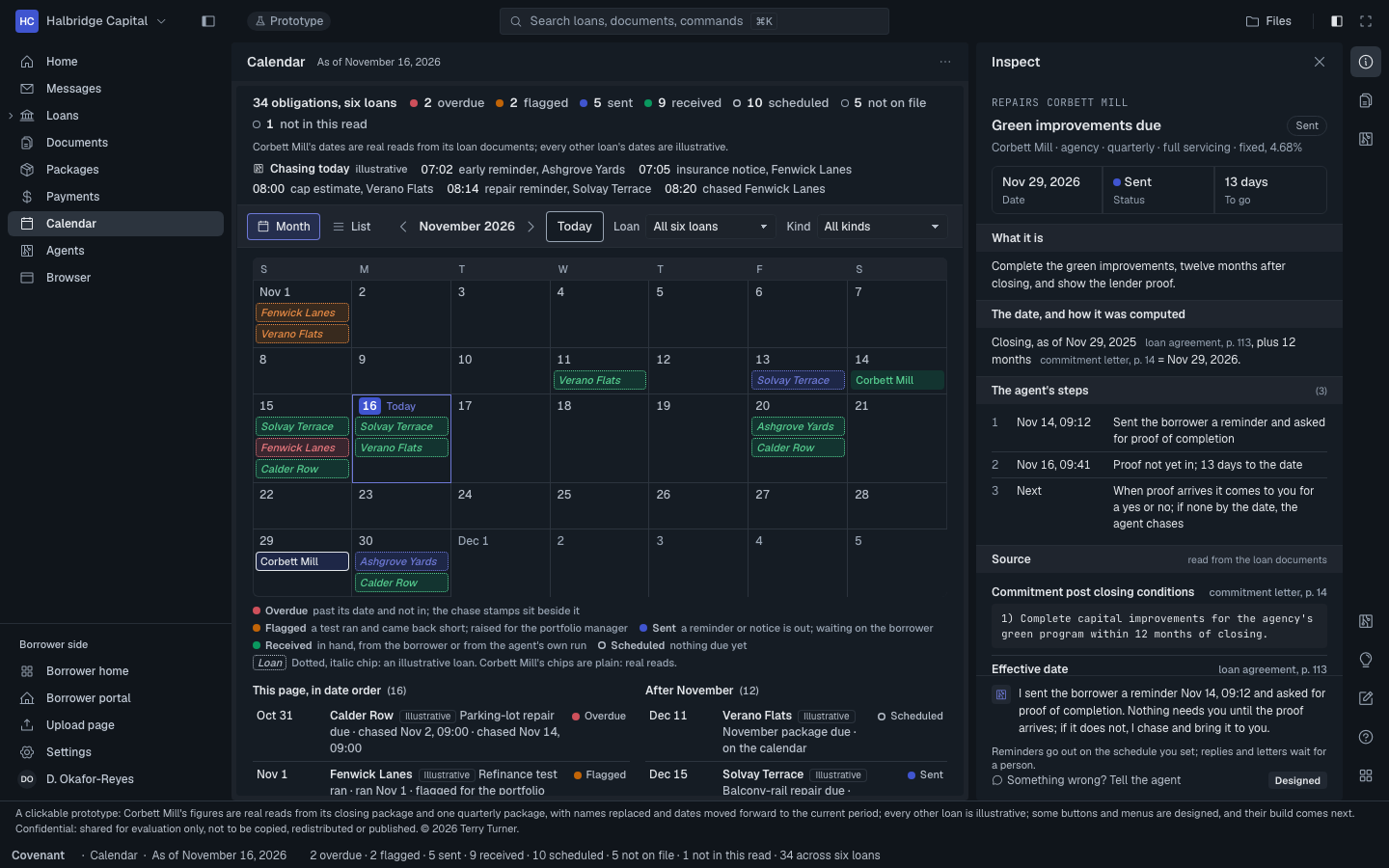 , opens live in a new tab
All 34 dated obligations across six loans, each with its status, such as sent, received, scheduled, flagged or overdue. The agent sent Corbett Mill's green-improvements reminder November 14, ahead of the November 29 due date. A reminder the servicer has set to go by itself, like the one shown, is designed.
Open it live , The calendar, in a new tab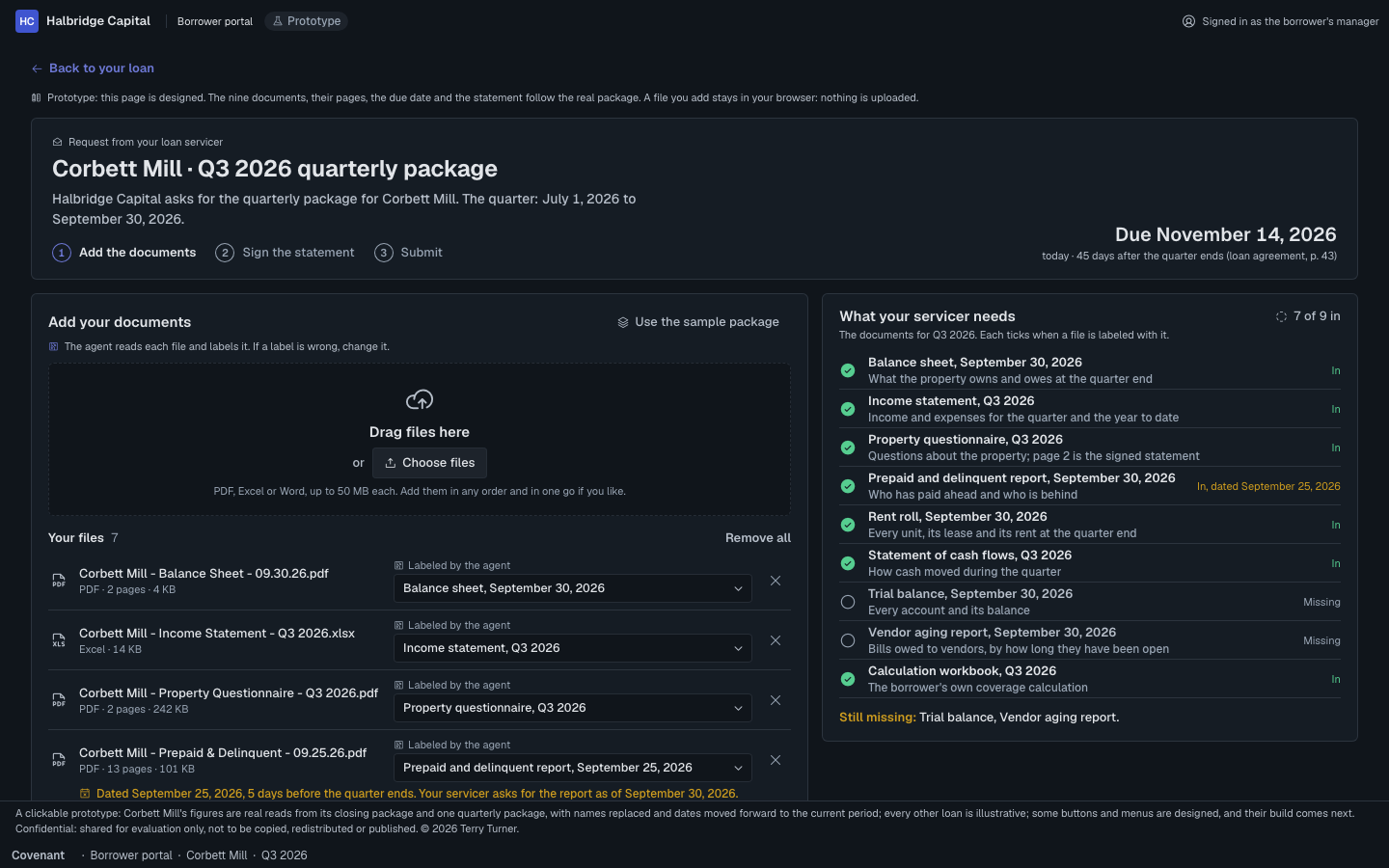 , opens live in a new tab
The borrower's side, designed, using the real package's files. The agent labels each file as it lands and names what is still missing, here the trial balance and the vendor aging report.
Open it live , The borrower's upload page, in a new tab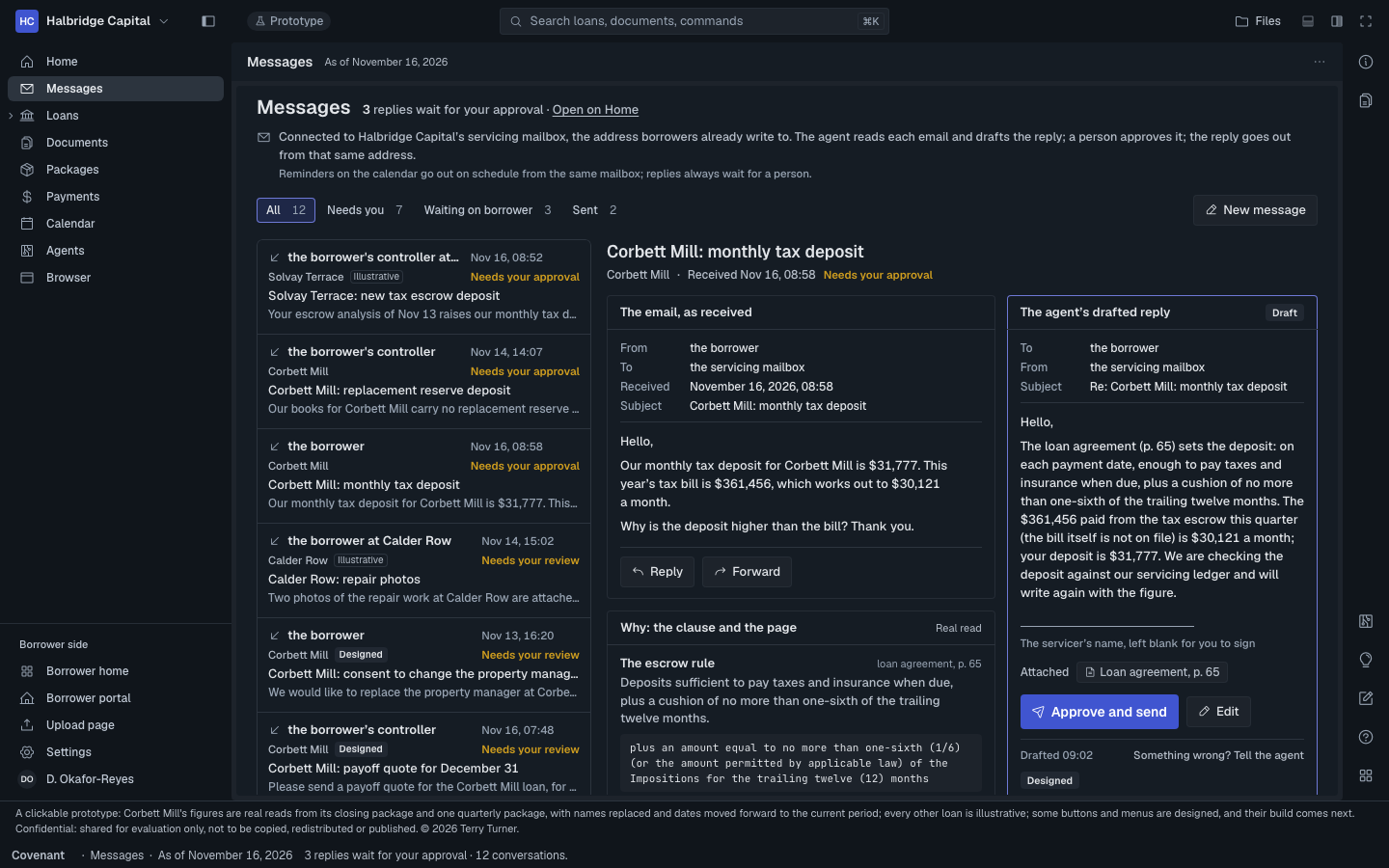 , opens live in a new tab
Three borrower emails wait with drafted replies. Corbett Mill's borrower asks why the $31,777 monthly tax deposit is above this year's bill, $30,121 a month; the reply attaches loan agreement page 65.
Open it live , Messages, in a new tab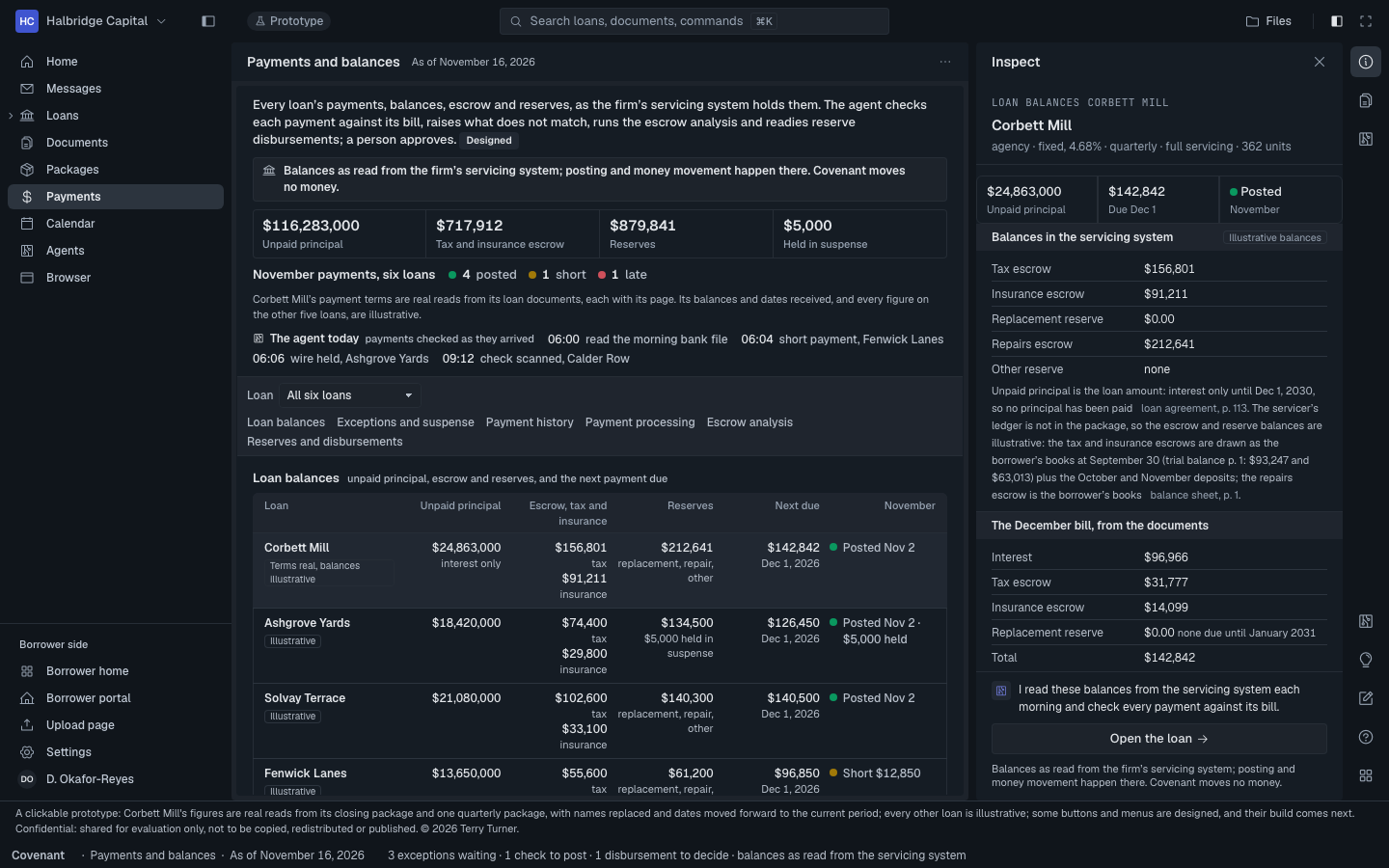 , opens live in a new tab
The agent checked November's payments on six loans against their bills and drafted a note for each of three exceptions: Fenwick Lanes short, Calder Row late, an Ashgrove Yards wire held.
Open it live , Payments and balances, in a new tab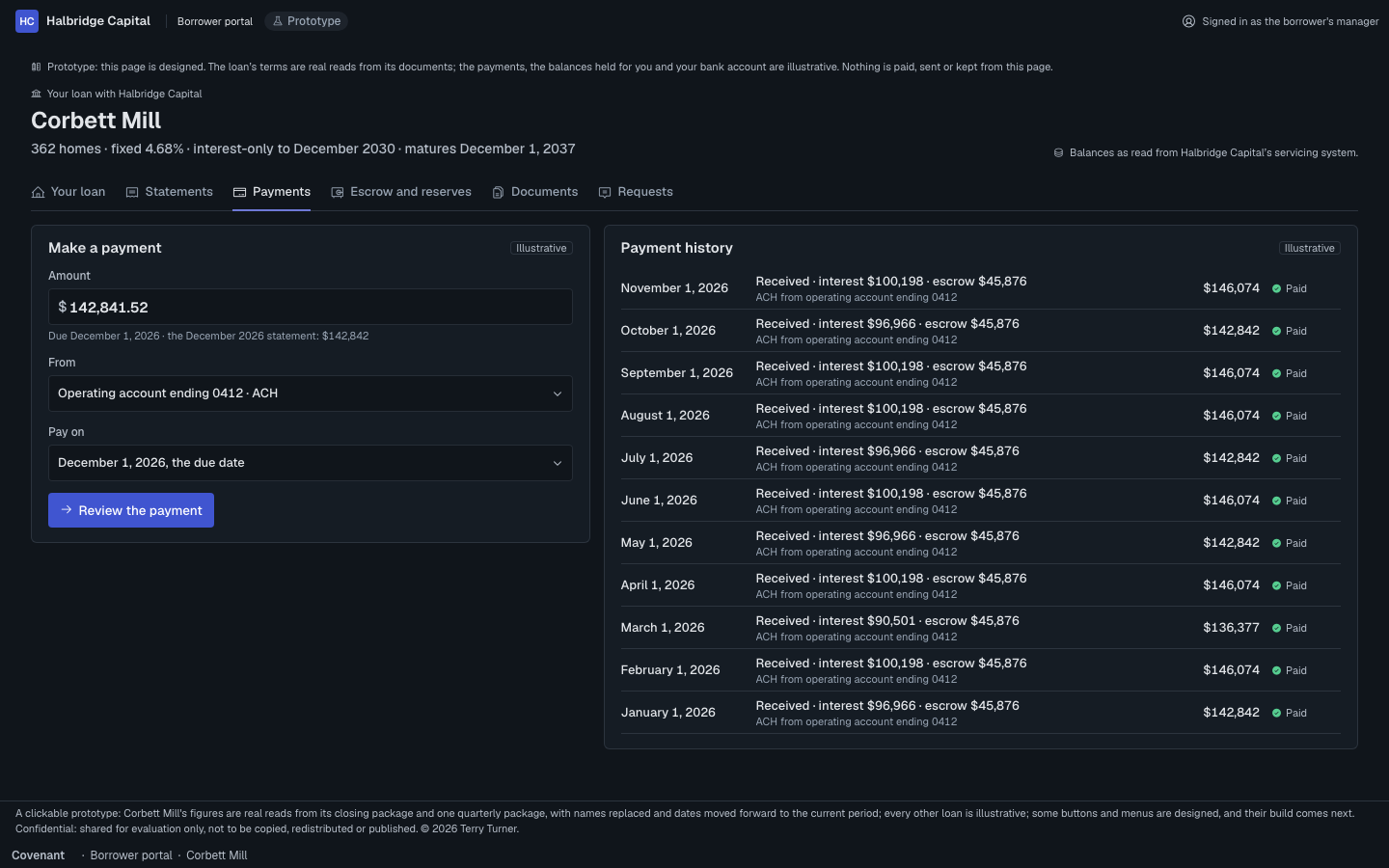 , opens live in a new tab
The borrower's side of Corbett Mill, its payments and balances illustrative: the December statement of $142,842, each 2026 payment so far received by ACH within the grace period, escrow balances, documents and requests.
Open it live , The borrower portal, in a new tabThree Basis screens to start with. Each card switches between its captures; the picture opens the screen live.
Basis · Every deal
All 16 active acquisitions in one table, with what each waits on and which agent is on it. Bexley has sat at investment committee nine days, awaiting release by the deal lead.
Open it live , Pipeline, in a new tabBasis · Underwrite
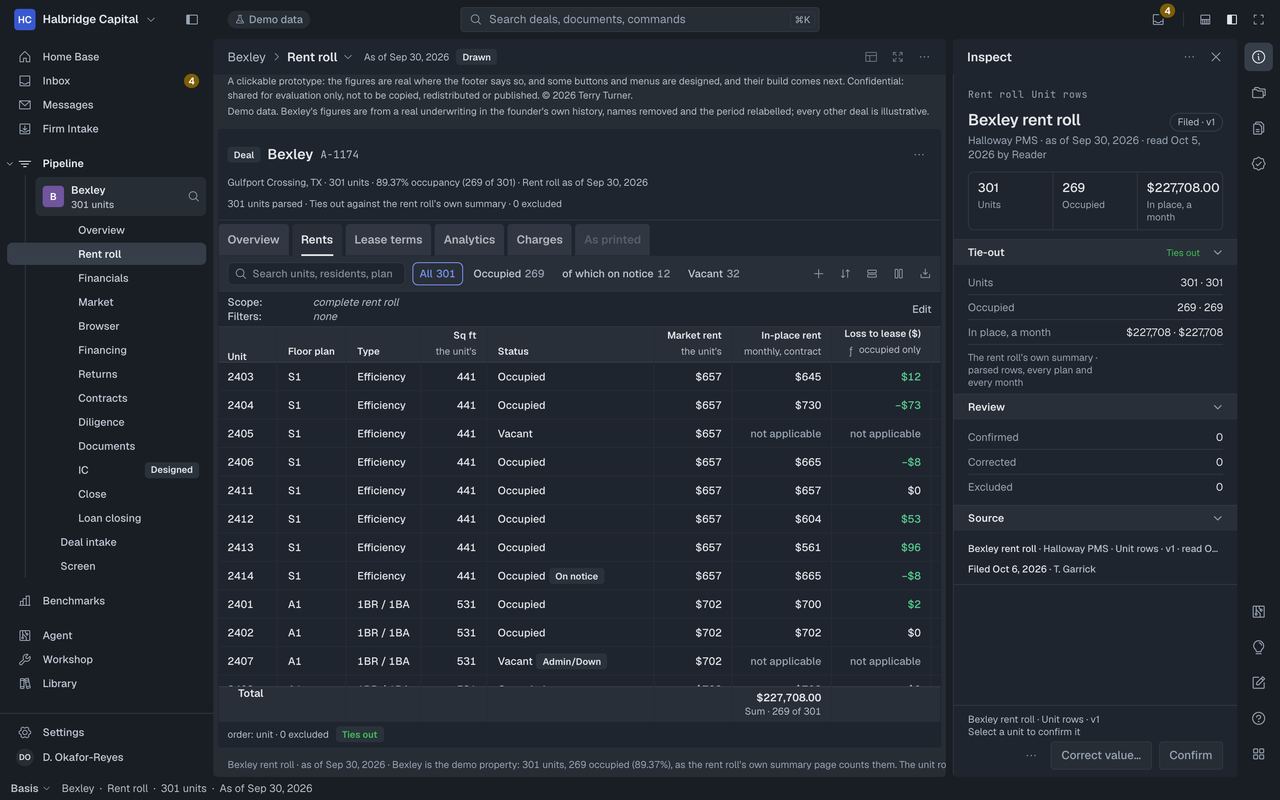
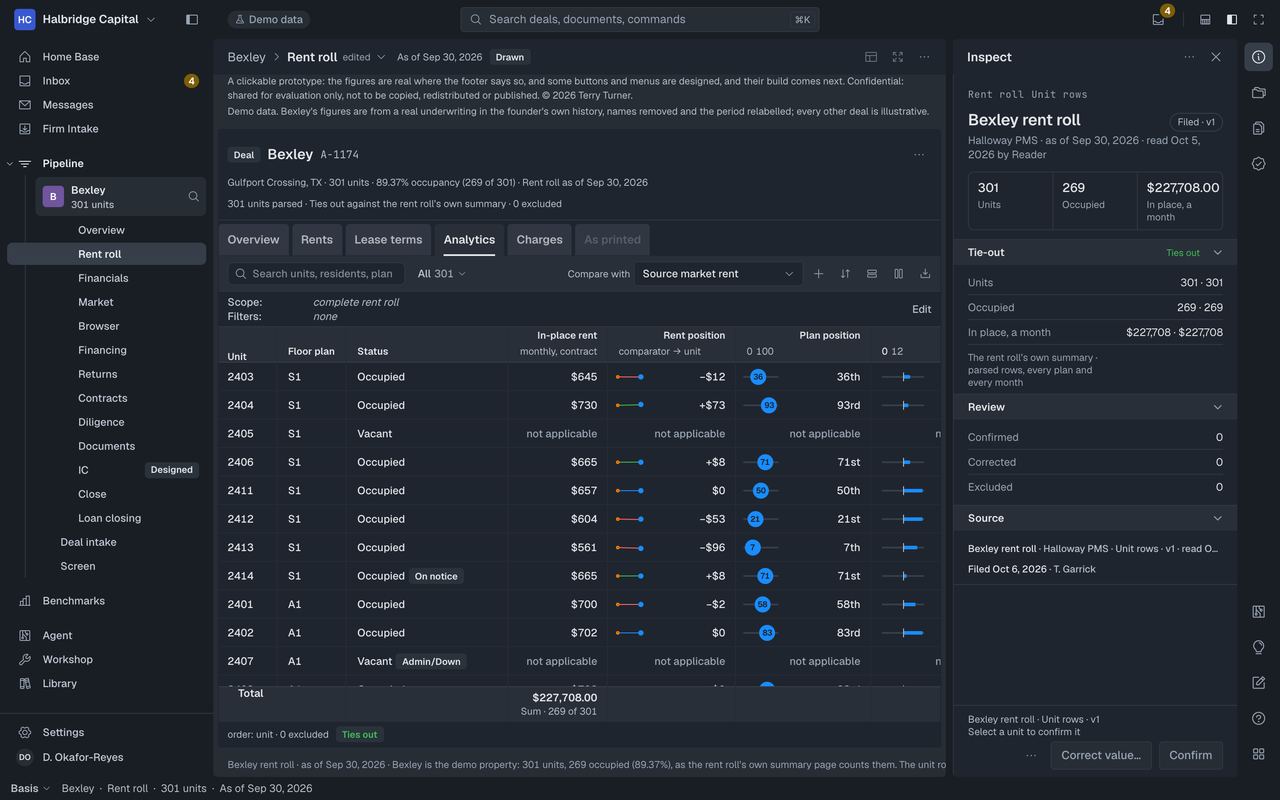
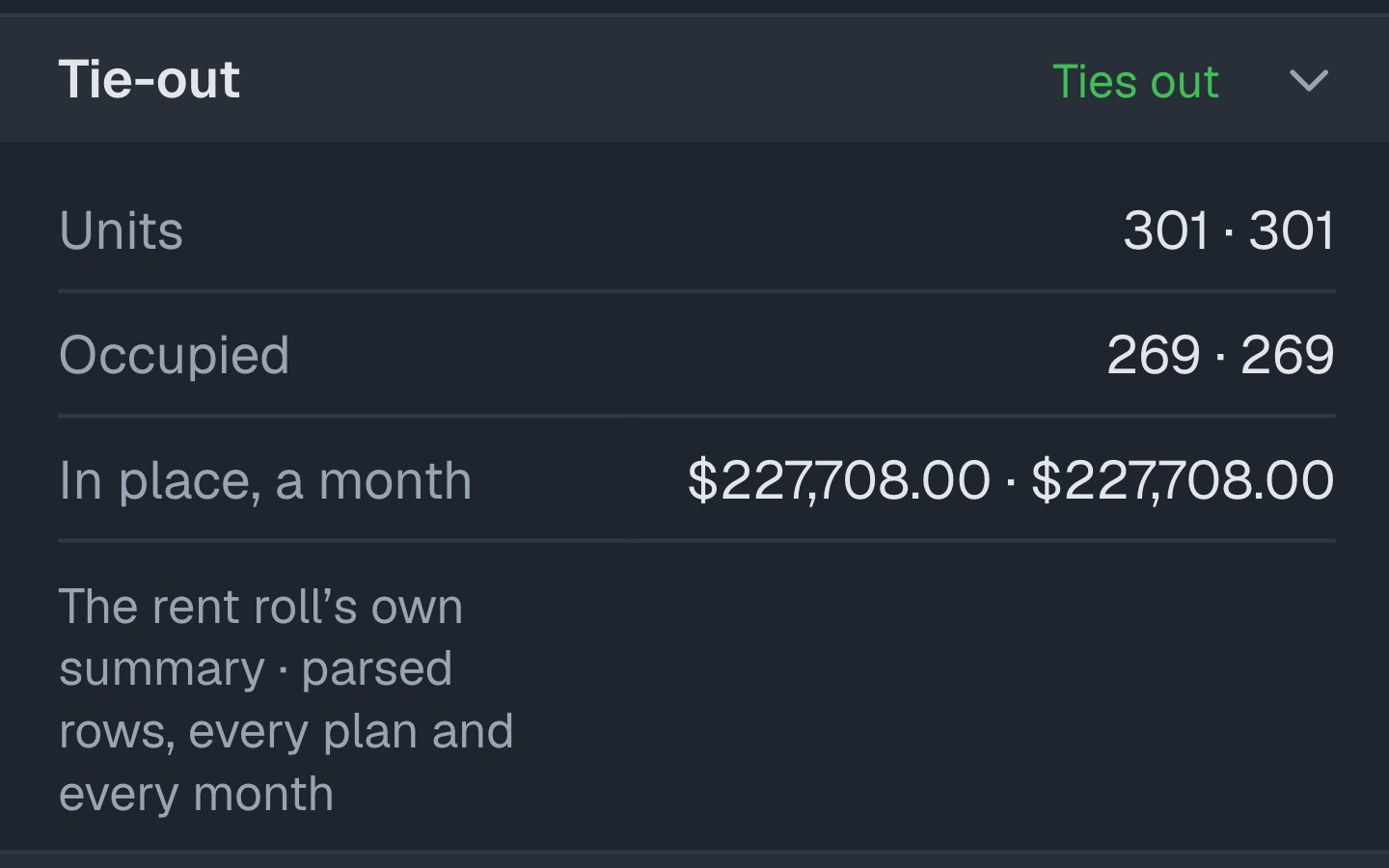
Reads all 301 of Bexley's units and ties them to the rent roll's own summary, down to the 17 leases ending in October 2026. A correction never overwrites the source.
Open it live , Rent Roll, in a new tabBasis · Decide
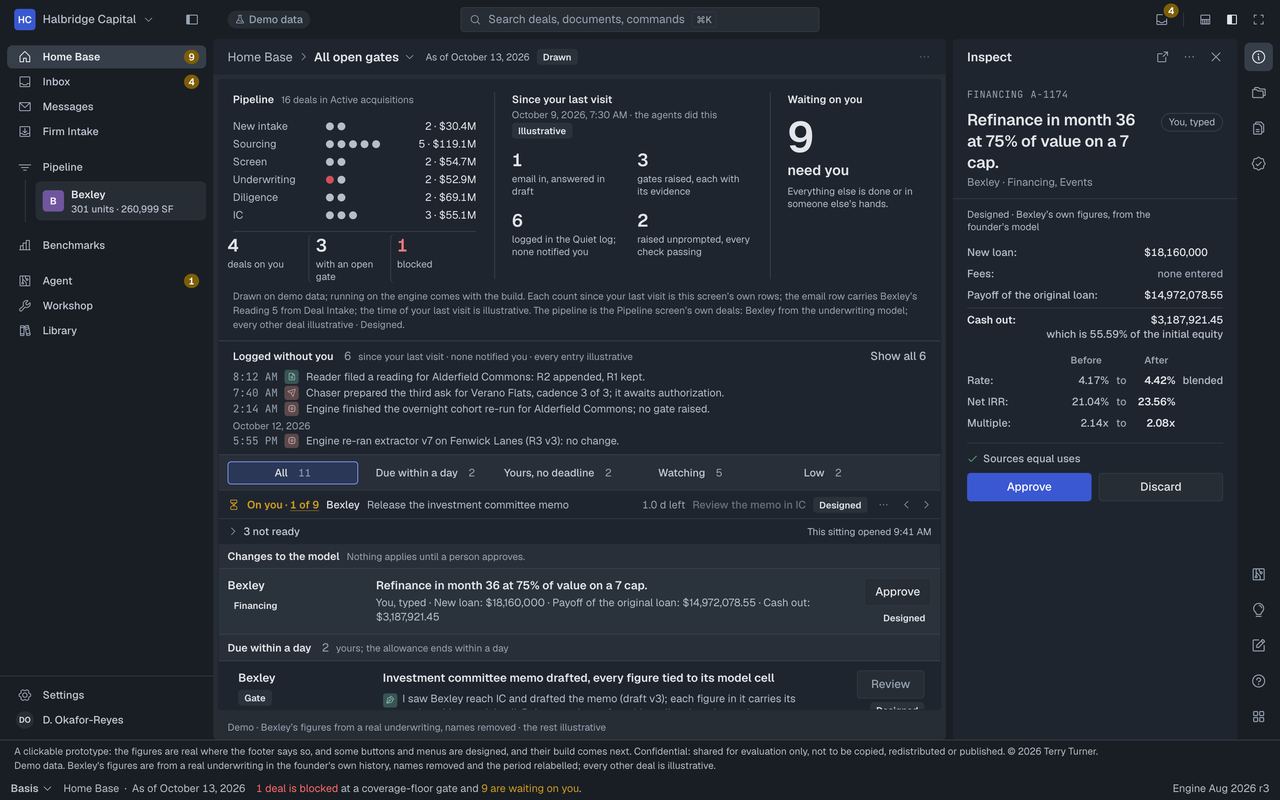
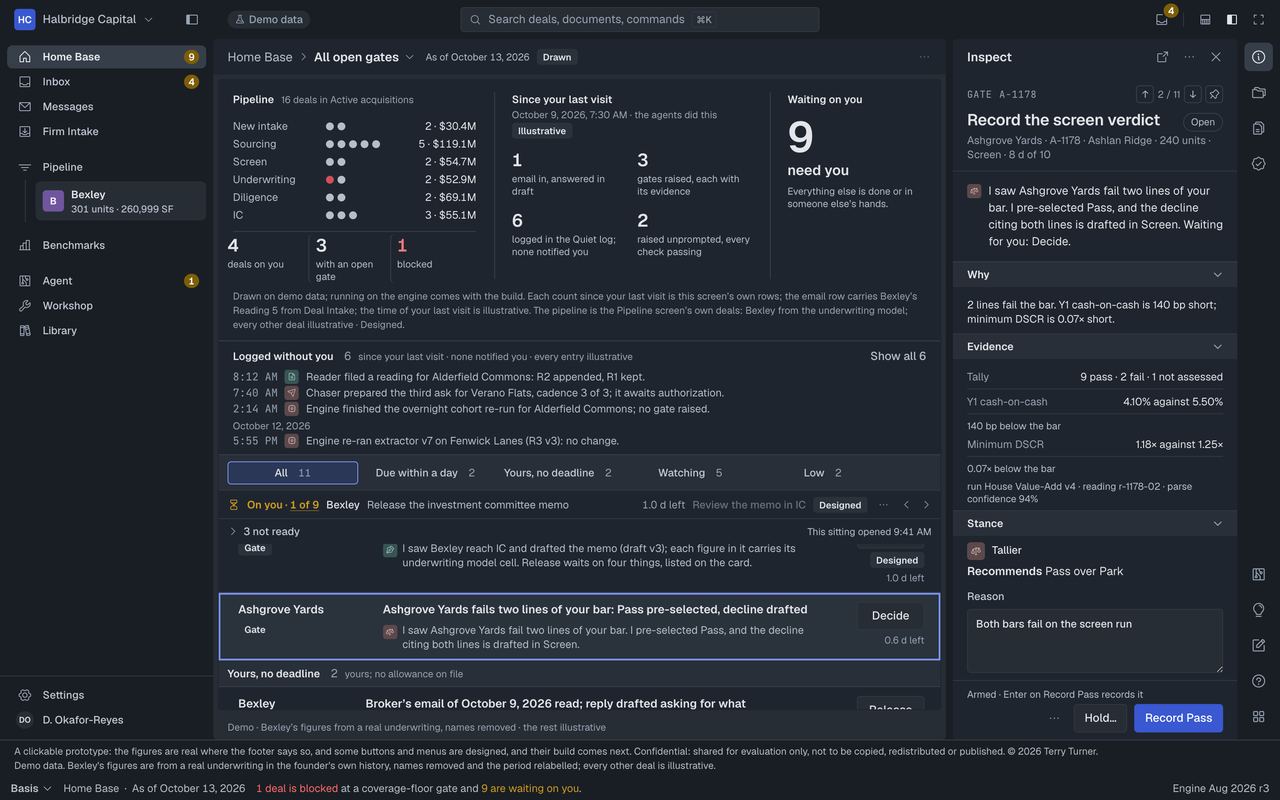
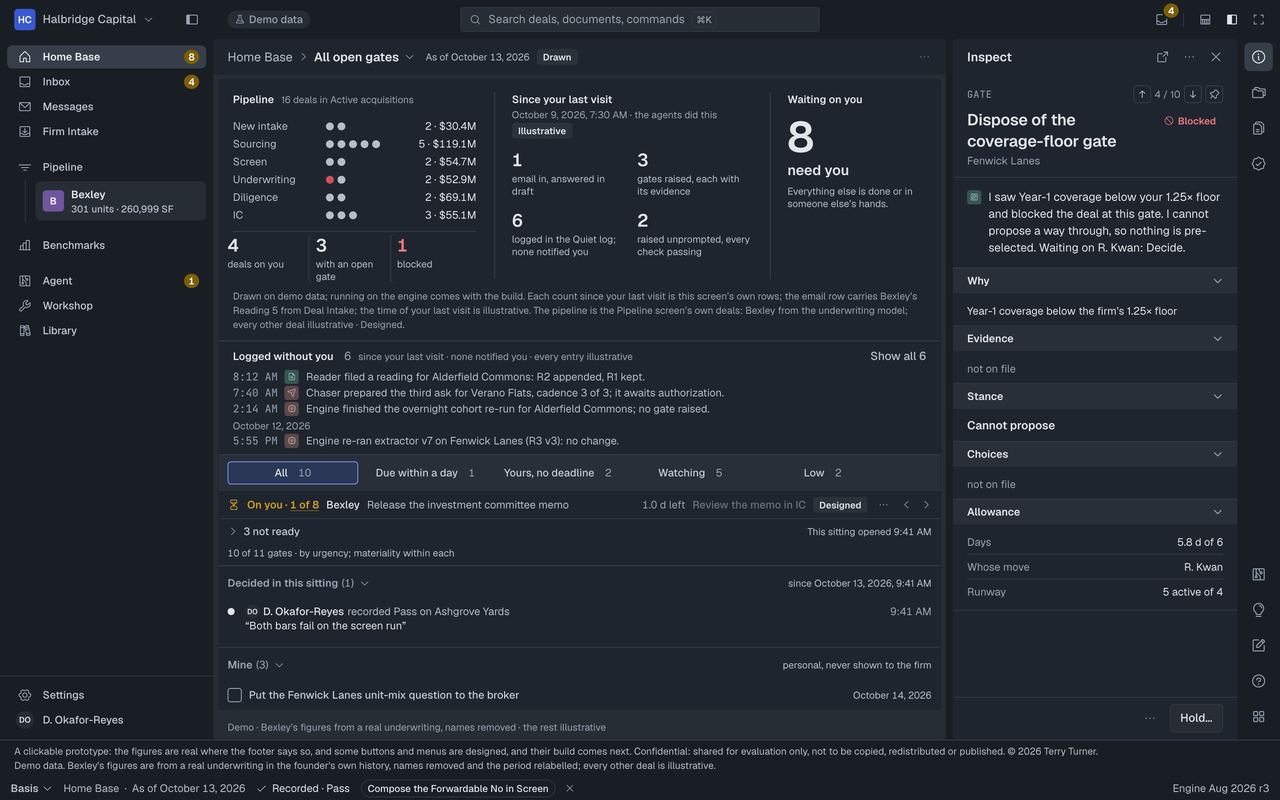
Every decision a person owes, ranked across deals. Nine wait on the deal lead, led by Bexley's investment committee memo, which the agent drafted. No decision records without a reason.
Open it live , Home Base, in a new tabEach entry says what the screen is for and where to click, with its state.
Basis · 19 screens and 2 views Prototype
Sold to lenders and to investors alike. A lender reviews its loan documents and chases the borrower for diligence; an investor reviews purchase agreements, letters of intent and diligence documents. It is the same work. The screens show the investor's desk; each entry says what a lender's desk does with it, and that view is designed.
 , opens live in a new tab
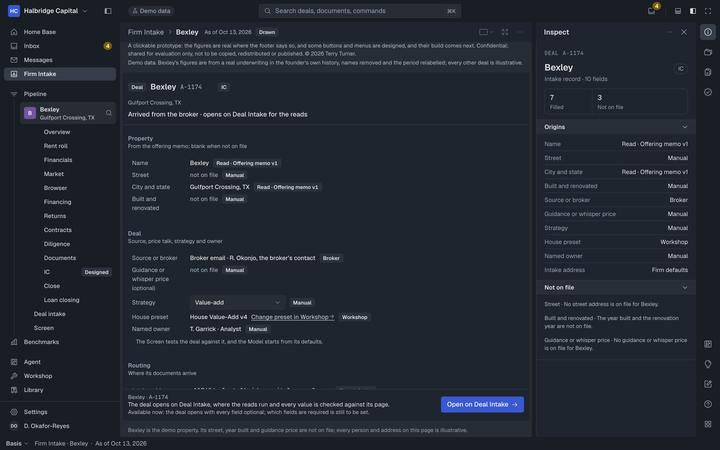
Opens a new deal before any document is read. Choosing Value-add for Bexley loads House Value-Add v4, the preset it is screened against, and gives it its own intake address. Try: change Strategy and watch the house preset follow.
For a lender Loan request intake: the request, its source and its owner, before any document is read. Designed
Open it live , Firm Intake, in a new tab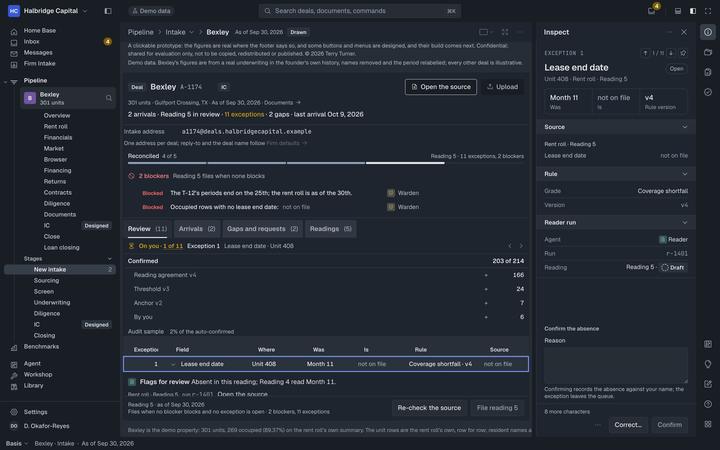 , opens live in a new tab
Every value read from Bexley's documents is checked against its page: 203 of 214 confirmed, 11 left for a person, such as an operating statement whose months end on the 25th. Try: step through the exceptions and watch the source page follow.
For a lender Borrower package intake: the operating statement, the rent roll and the sponsor's schedule of real estate owned, read and confirmed before anyone sizes the loan. Designed
Open it live , Deal Intake, in a new tab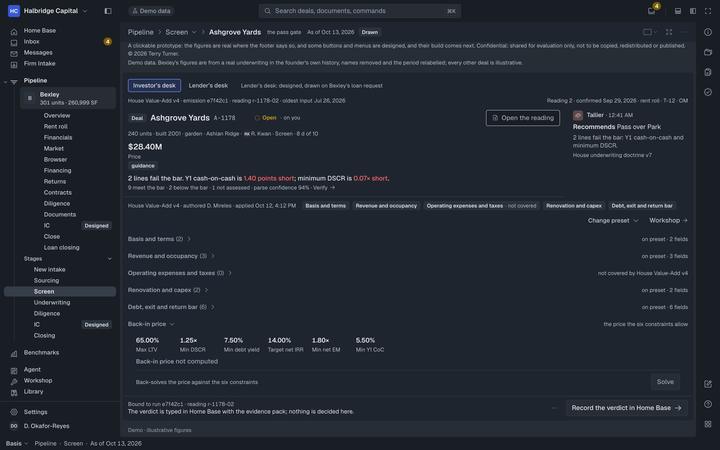 , opens live in a new tab
Tests a deal against the firm's bar, line by line. Ashgrove Yards meets the bar on nine lines and sits below it on two, including Year-1 cash-on-cash of 4.10% against a 5.50% minimum. Try: click a test line and press P for its plain-sentence Proof.
For a lender Sizing screen against agency limits (DSCR, LTV, debt yield), and a cited decline or counter to the broker the same day. Designed
Open it live , Screen, in a new tab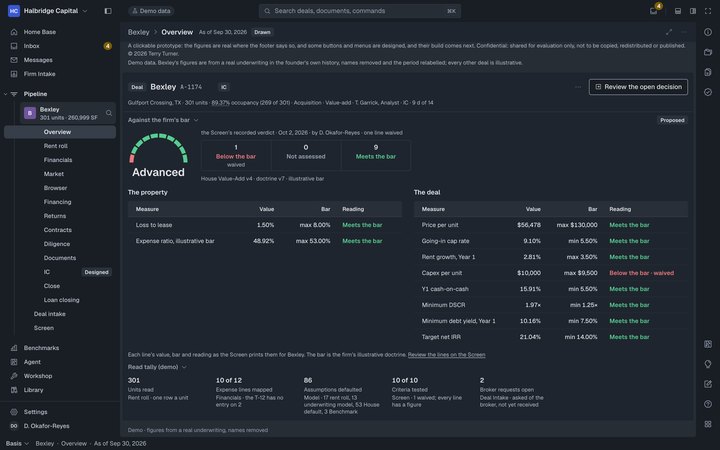 , opens live in a new tab
Bexley's front page: a $17,000,000 price, a $15,232,500 loan, and its standing against the firm's bar, nine lines meeting the bar and one below it, waived. Each figure opens to how it was computed. Try: click any key figure to open its Proof.
For a lender The loan's front page and the start of the credit memo, with every figure traceable. Designed
Open it live , Overview, in a new tab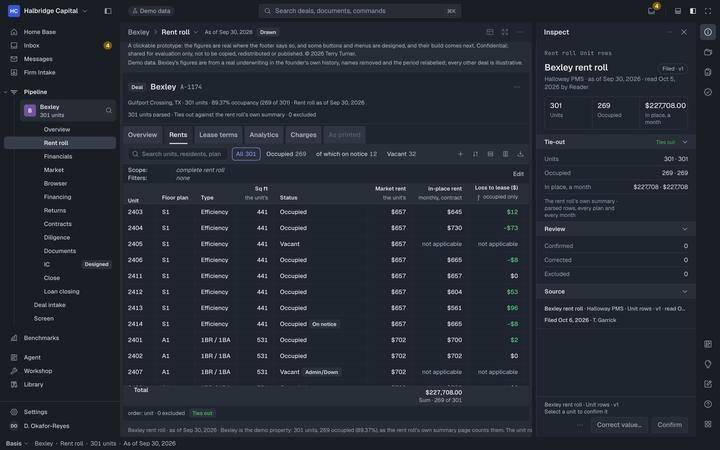 , opens live in a new tab
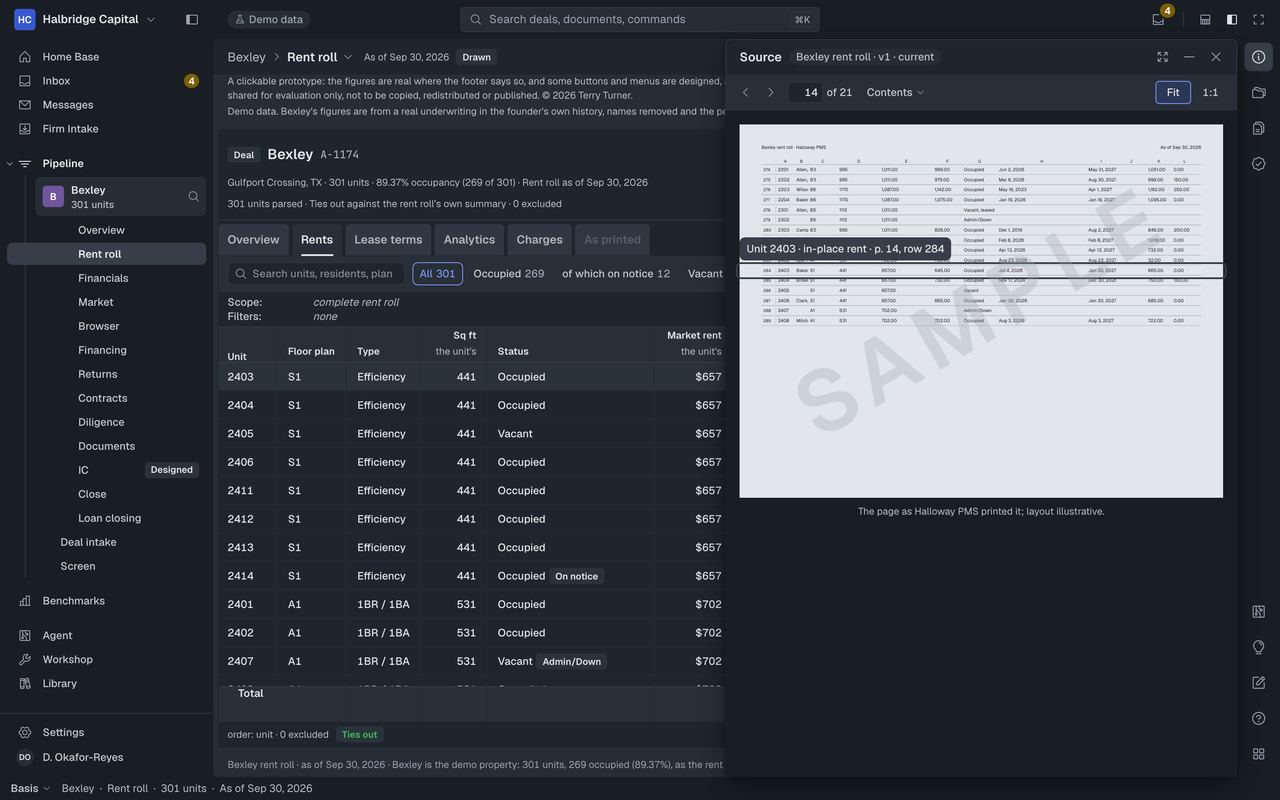
Reads all 301 of Bexley's units and ties them to the rent roll's own summary, down to the 17 leases ending in October 2026. A correction never overwrites the source. Try: click a unit, then press O to see its row ringed on the source page.
For a lender Lender rent-roll audit: in-place occupancy and rents tied to the source, unit by unit. Designed
Open it live , Rent Roll, in a new tab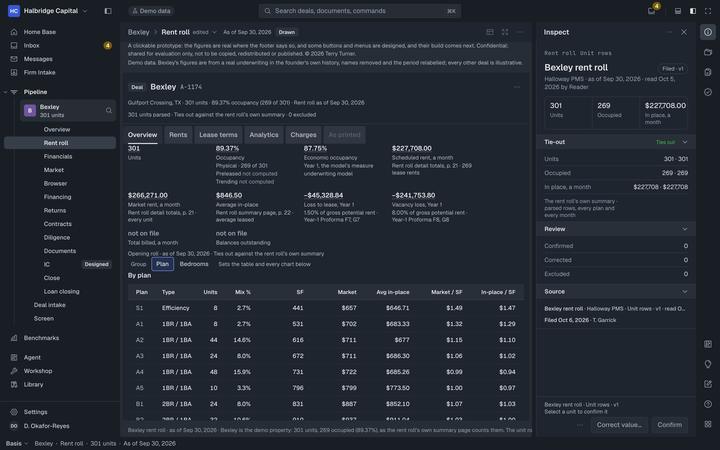 , opens live in a new tab
The whole rent roll on one page, every figure summed from the 301 unit rows: Bexley's leases bring in $227,708.00 a month in scheduled rent against $266,271.00 at market. Try: switch Group between Plan and Bedrooms.
For a lender Lender rent-roll summary: occupancy, in-place rent and exposure by plan, tied to the source. Designed
Open it live , Rent roll · Summary, in a new tab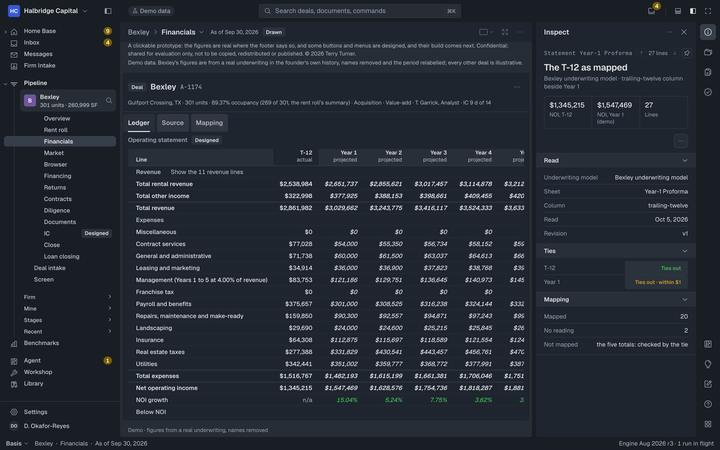 , opens live in a new tab
Bexley's trailing twelve months, mapped line by line beside five projected years. Actual net operating income is $1,345,215, and every line opens to its source. Try: open Ledger, Source and Mapping, then press P on a figure.
For a lender The trailing twelve months normalized to underwritten NOI, with every adjustment traced to its cell. Designed
Open it live , Financials, in a new tab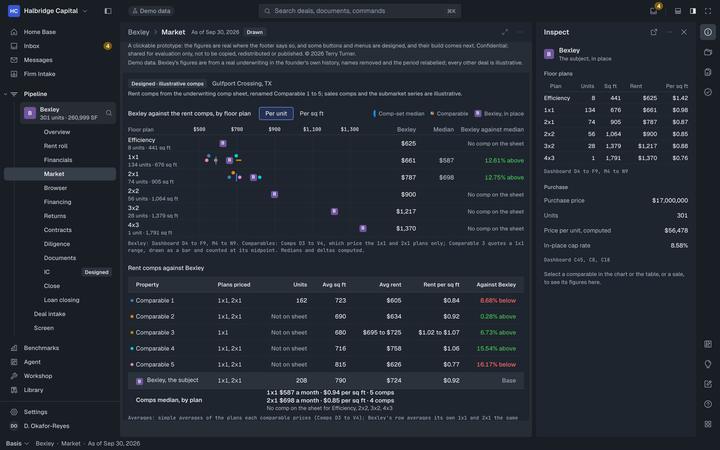 , opens live in a new tab
Bexley against five rent comps from its underwriting comp sheet. Its one-bedrooms rent at $661, 12.61% above the comp median of $587. Sales comps and the submarket series are illustrative. Try: open and close Inspect from the top bar.
For a lender Rent comps beside the subject, for the lender's own view of the market. Designed
Open it live , Market, in a new tab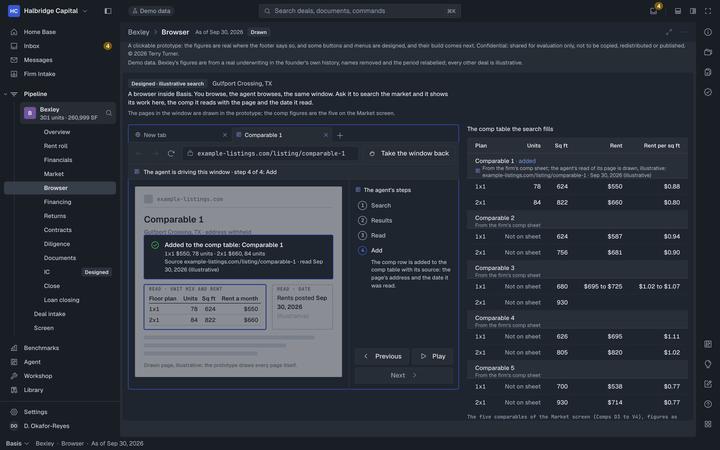 , opens live in a new tab
A browser inside Basis that the person and the agent share. Ask the agent to search the market and it works in the window step by step. The comp it reads goes into the comp table with the page and the date it was read. The pages are drawn for the prototype. In the product the agent works only on sites the firm has approved, reads and never signs in or submits a form, and saves a dated capture of each page it reads. Designed. Try: press Previous to step back through the search, or take the window back and type an address.
For a lender The benchmark is the lender's own loan history, for the loans it both made and services, kept apart from an investor's own past deals. Designed
Open it live , Browser, in a new tab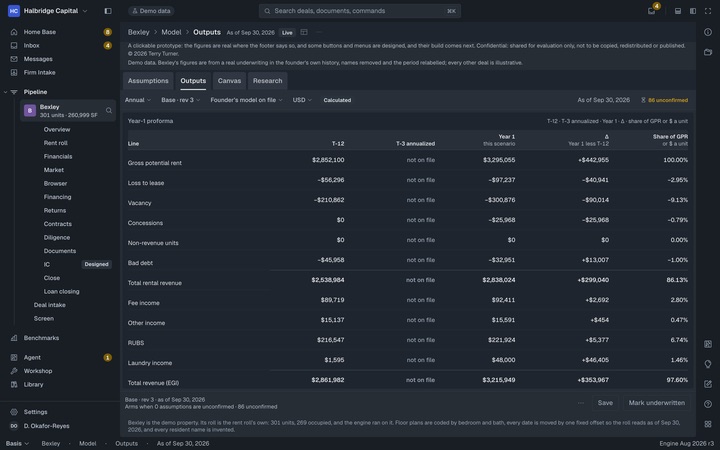 , opens live in a new tab
Built and running. From one rent roll it projects twelve months of revenue by floor plan, each month traceable. For Bexley it puts Year-1 vacancy at 9.13%, against the house's flat 8.00%.
For a lender Underwritten income from the borrower's own rent roll, month by month, every assumption visible and adjustable. Designed
Open it live , Revenue engine, in a new tab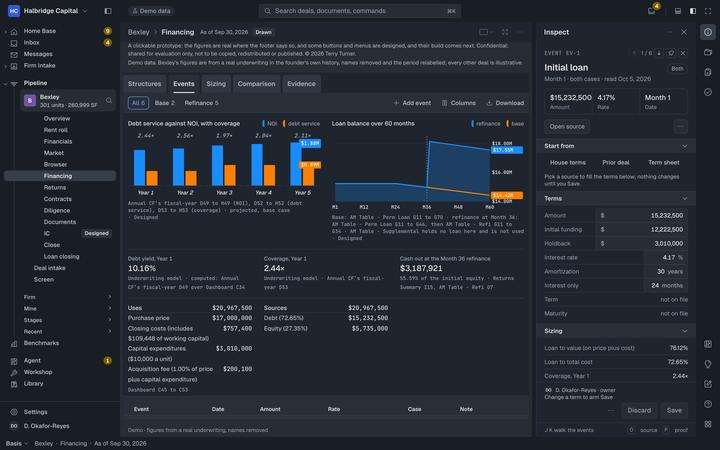 , opens live in a new tab
Bexley's debt: a $15,232,500 loan at 4.17%, inside $20,967,500 of sources and uses. Sizing sets each loan's tests side by side, so the one that limits the loan is plain. Try: press 3 for Sizing, then O on a value to see its cell ringed.
For a lender Loan sizing itself: each constraint side by side, so the binding test is plain. Designed
Open it live , Financing, in a new tab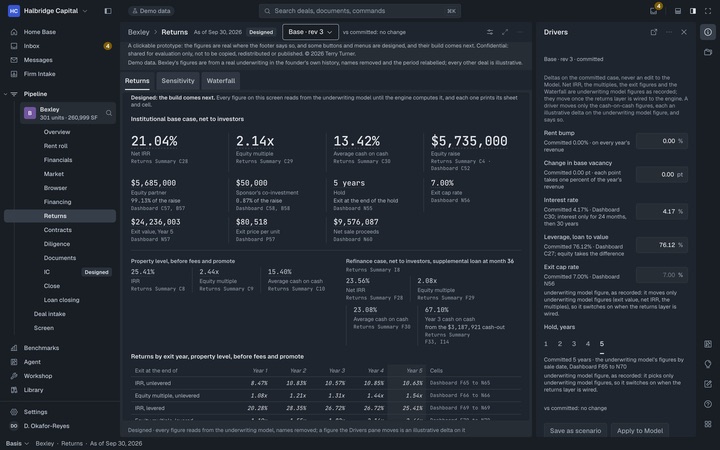 , opens live in a new tab
Bexley's returns to investors, net of fees: a 21.04% net IRR and a 2.14x equity multiple over five years. Each figure shows its cell in the underwriting model.
For a lender The investor returns a lender's committee reads beside the loan.
Open it live , Returns to investors, in a new tab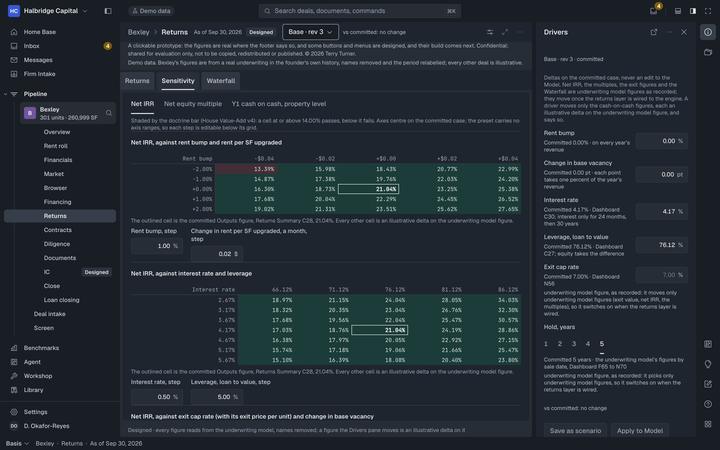 , opens live in a new tab
Bexley's net IRR as rent, interest rate, leverage and exit cap rate change. Each cell is shaded against the firm's 14.00% bar; the outlined 21.04% is the figure in the founder's underwriting model, the rest illustrative. Try: switch between Net IRR, equity multiple and Year-1 cash on cash.
For a lender Which assumptions can change the decision, quantified, for the lender's committee. Designed
Open it live , Returns · Sensitivity, in a new tab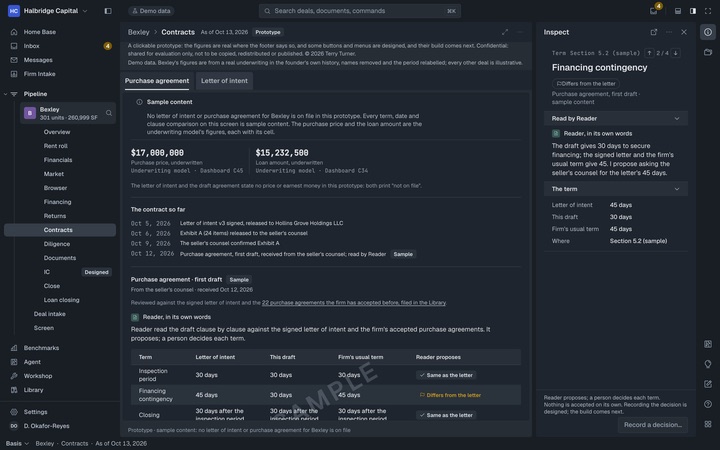 , opens live in a new tab
The agent reads the seller's draft purchase agreement against the signed letter of intent and 22 past agreements, and flags a financing contingency cut from 45 days to 30. Sample content.
For a lender The lender's own loan documents, reviewed the same way. Designed
Open it live , Contracts, in a new tab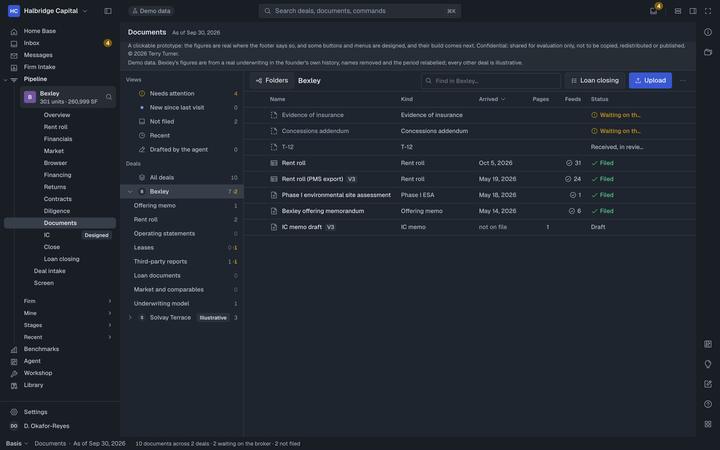 , opens live in a new tab
Bexley's filed record: four documents, five readings, and two still owed by the broker, including evidence of insurance. Where two documents disagree, both sources sit one click away. Try: move between Filed, Readings, Fields and Conflicts.
For a lender Third-party reports (appraisal, property condition, environmental, title) filed, read and checked against each other. Designed
Open it live , Documents, in a new tab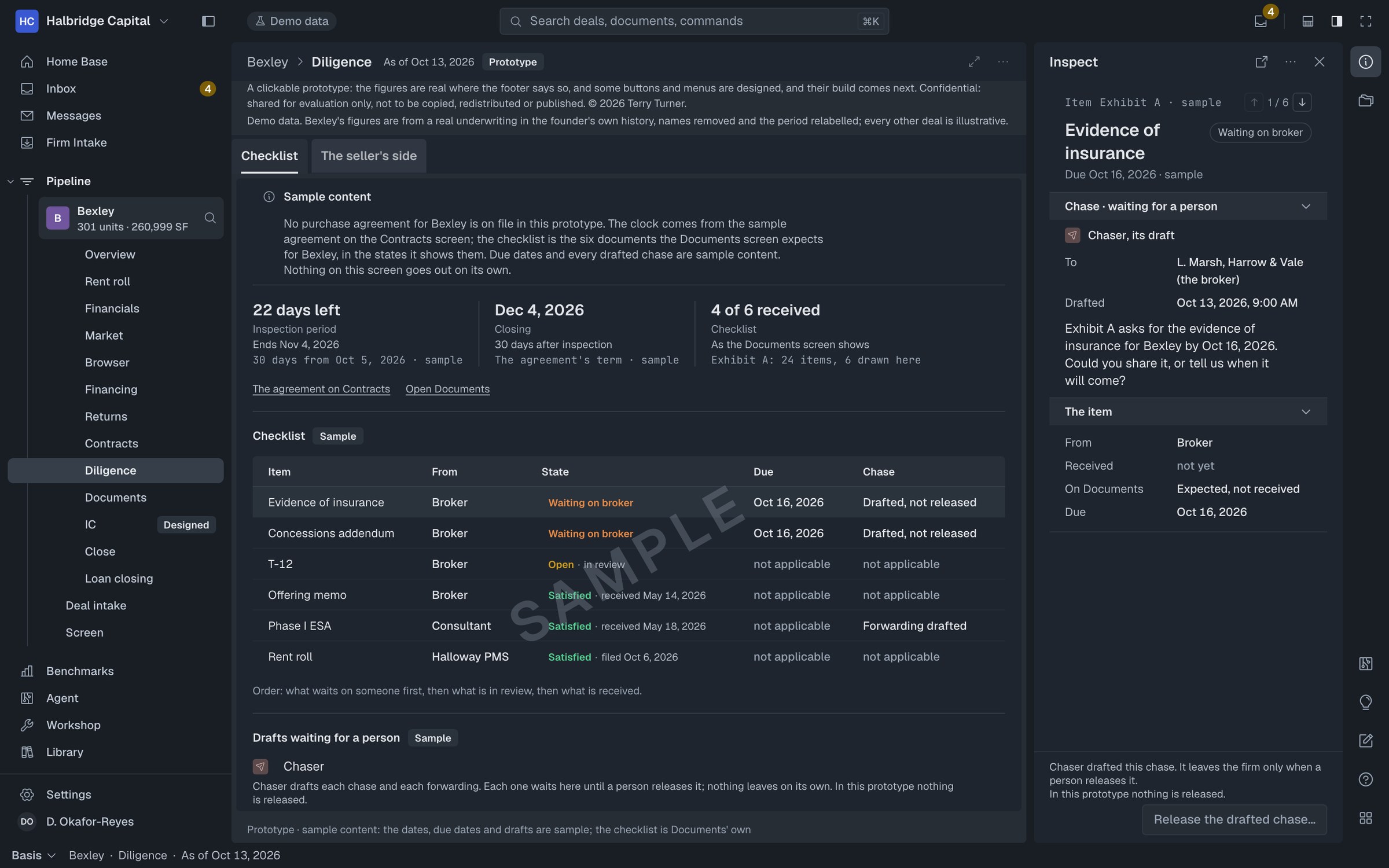 , opens live in a new tab
The inspection clock and checklist from the purchase agreement, 22 days left. The agent drafts each chase, such as asking the broker for evidence of insurance; a person releases it.
For a lender Chasing the borrower for diligence, the same way. Designed
Open it live , Diligence · Coordination, in a new tab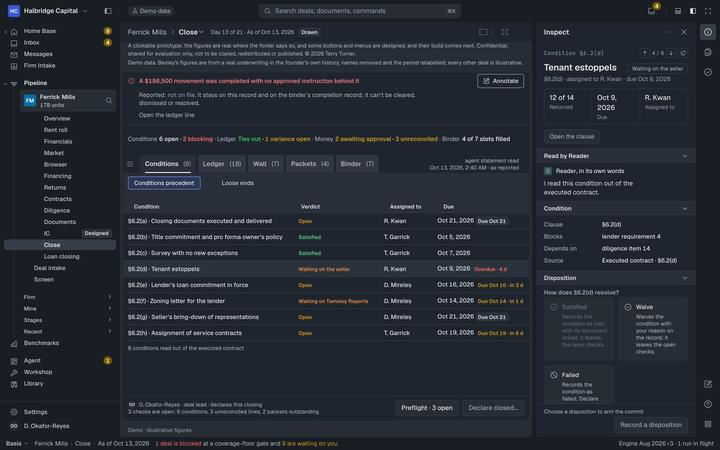 , opens live in a new tab
Conditions, money, signing packets and the binder, until the deal lead declares the deal closed. On Ferrick Mills, a $186,500 transfer with no approved instruction stays on the record. Try: open the Wall and try to approve a wire.
For a lender Closing conditions, funding wires with separation of duties, and the closing binder. Designed
Open it live , Close, in a new tabThe firm's own screens
 , opens live in a new tab
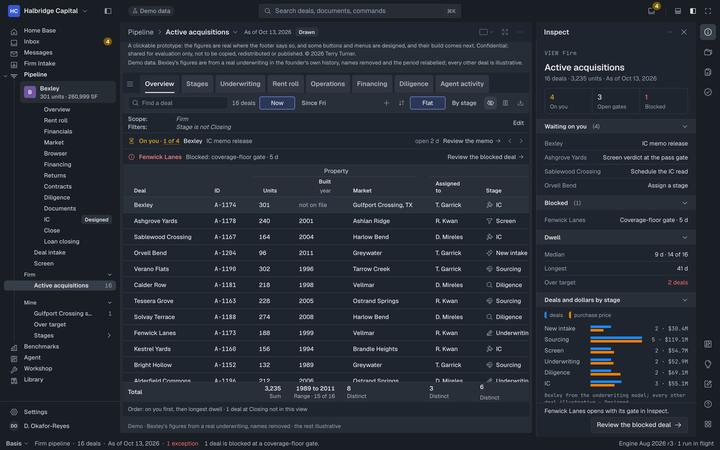
All 16 active acquisitions in one table, with what each waits on and which agent is on it. Bexley has sat at investment committee nine days, awaiting release by the deal lead. Try: click Agent activity, then a row, and press Space to peek the deal.
For a lender Loan pipeline: every request by stage (screen, quote, application, commitment, closing), with the agent and the person on each. Designed
Open it live , Pipeline, in a new tab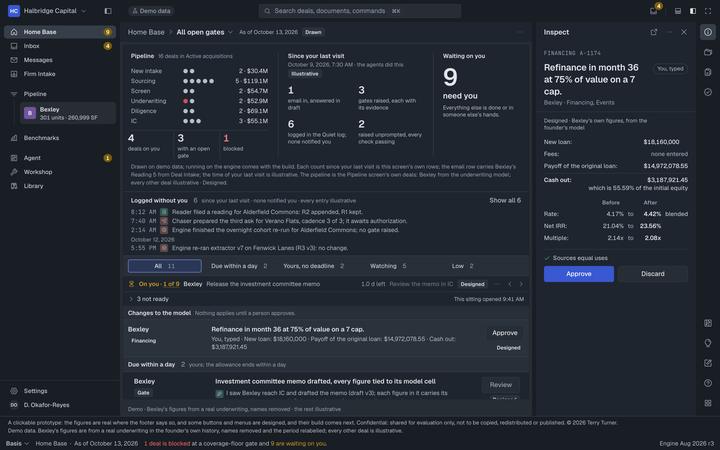 , opens live in a new tab
Every decision a person owes, ranked across deals. Nine wait on the deal lead, led by Bexley's investment committee memo, which the agent drafted. No decision records without a reason. Try: open Bexley's memo gate and read its evidence.
For a lender Credit gates (screen, quote, rate lock, loan committee), each recorded with its reason and evidence. Designed
Open it live , Home Base, in a new tab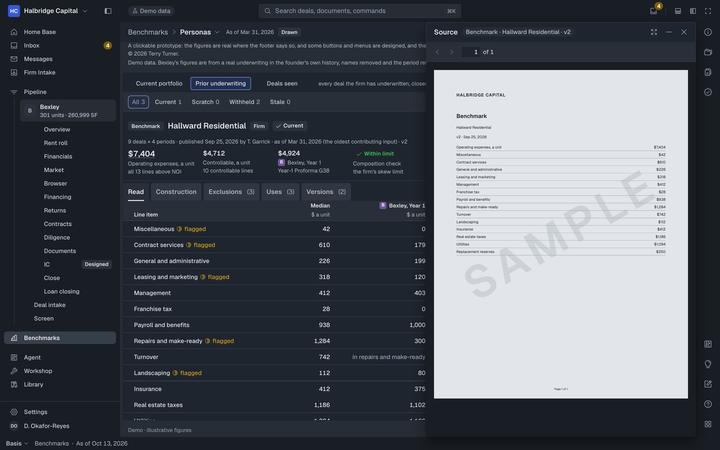 , opens live in a new tab
Tests a deal against the firm's own record. Bexley's Year-1 repairs budget of $300 a unit is flagged against a median of $1,284 across 36 past deal-periods. Thin benchmarks are withheld. Try: switch from Personas to Cohorts.
For a lender Sponsor calibration: how this sponsor's prior loans were projected against how they performed. Designed
Open it live , Benchmarks, in a new tab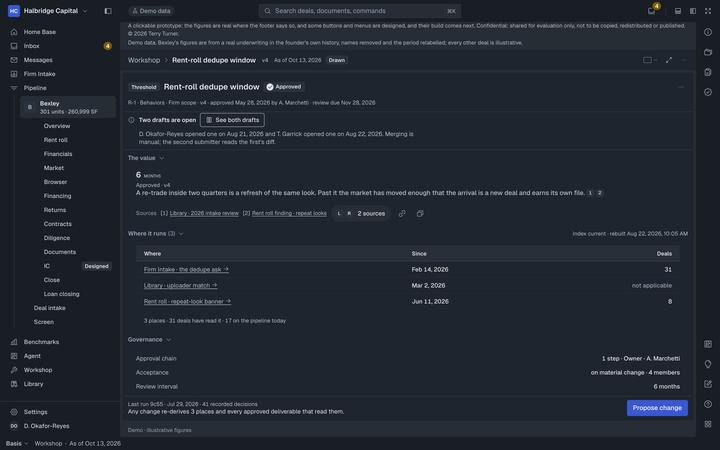 , opens live in a new tab
The firm's rules as versioned objects, each drafted, replayed against past decisions and approved before it publishes. The rent-roll dedupe window has four versions and 41 recorded decisions. Try: open a register row, start a draft and replay it.
For a lender Credit policy as governed objects: agency limits and house rules, versioned and replayed before they change. Designed
Open it live , Workshop, in a new tab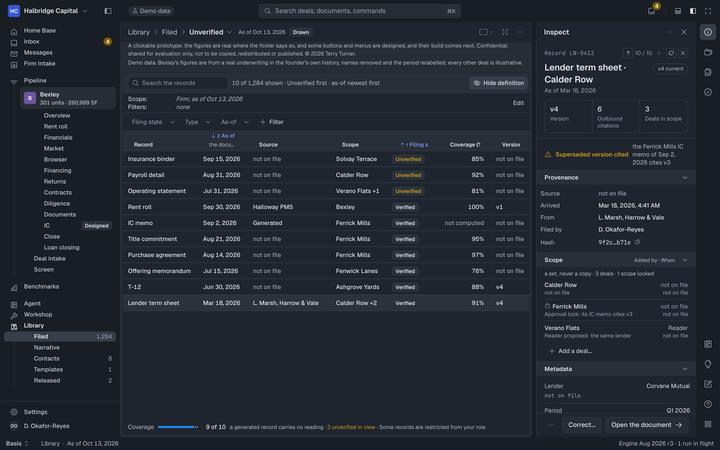 , opens live in a new tab
Every document the firm holds, 1,284 records across all deals, each marked verified or unverified with its coverage. Bexley's rent roll is verified at 100%. Try: ask a question in Narrative and read the passage each cell quotes.
For a lender Sponsor and borrower records across every loan: identity files, prior deals, term sheets, templates. Designed
Open it live , Library, in a new tabBasis · out of Excel Designed
Each screen answers one thing an underwriter does in Excel today: type over a cell, insert a row, rebuild the waterfall, add a sheet. Each is drawn on a screen the prototype already has, and one card appears across them. The card states the change by name, shows what moves in net operating income, coverage and return, and waits for a person to approve. Four of the nineteen run as one short sequence on the Basis page, and two more show the same work on a phone. Designed means the build comes next. Each designed screen names what it rests on today: a run of the engine, a screen of the prototype, or a platform capability read on a stated date.
The four acts, on the Basis page →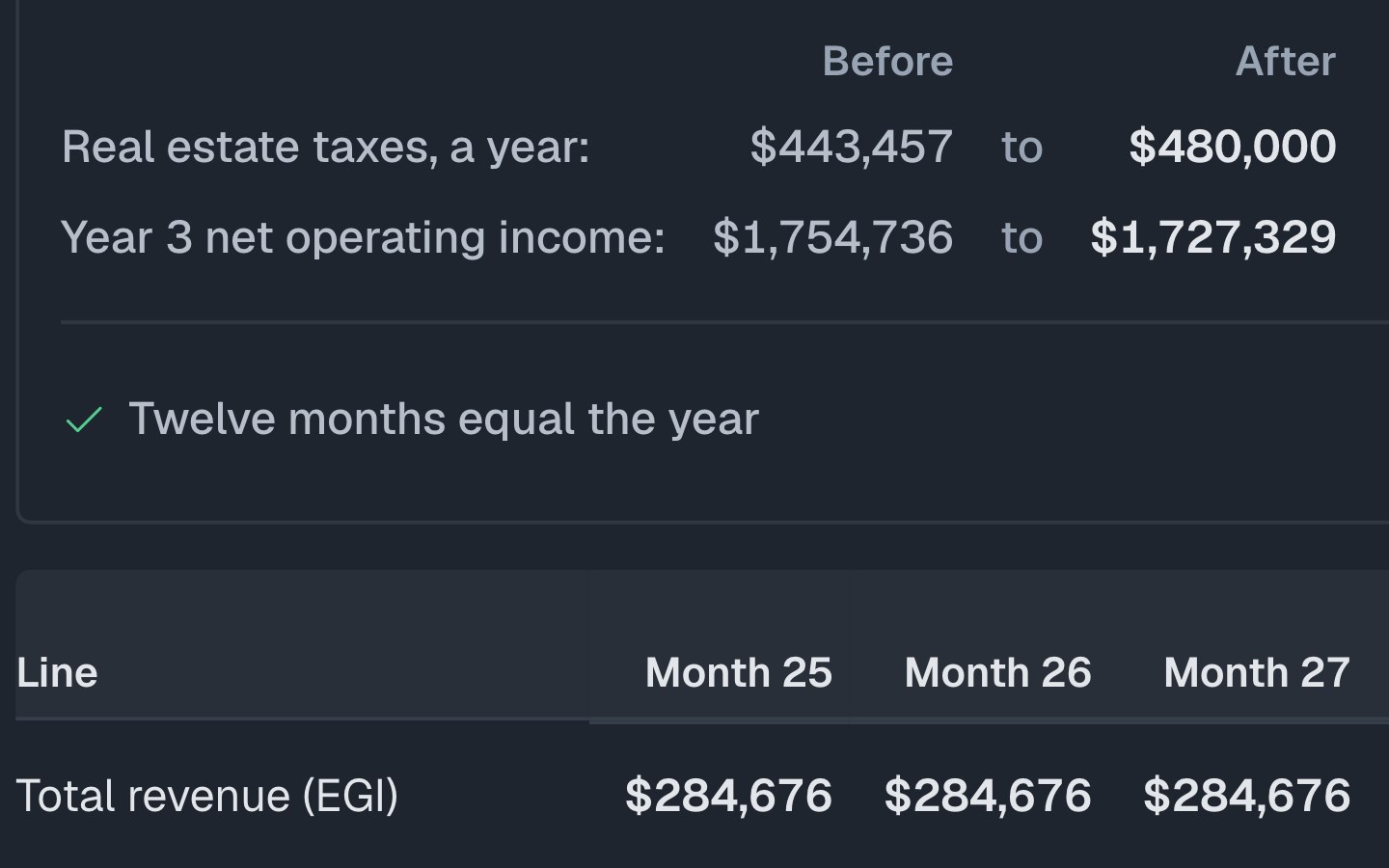 , opens the screen in a new tab
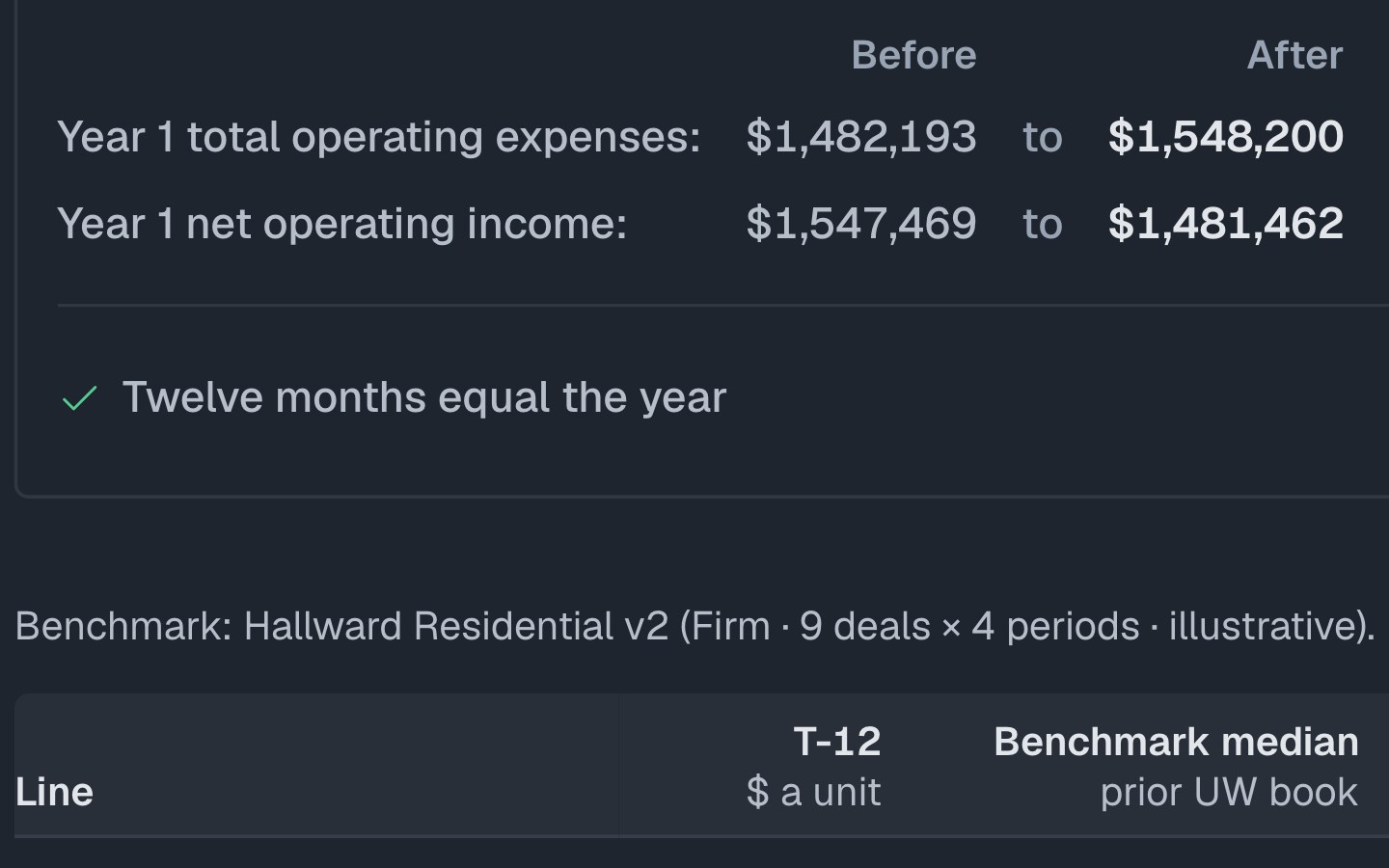
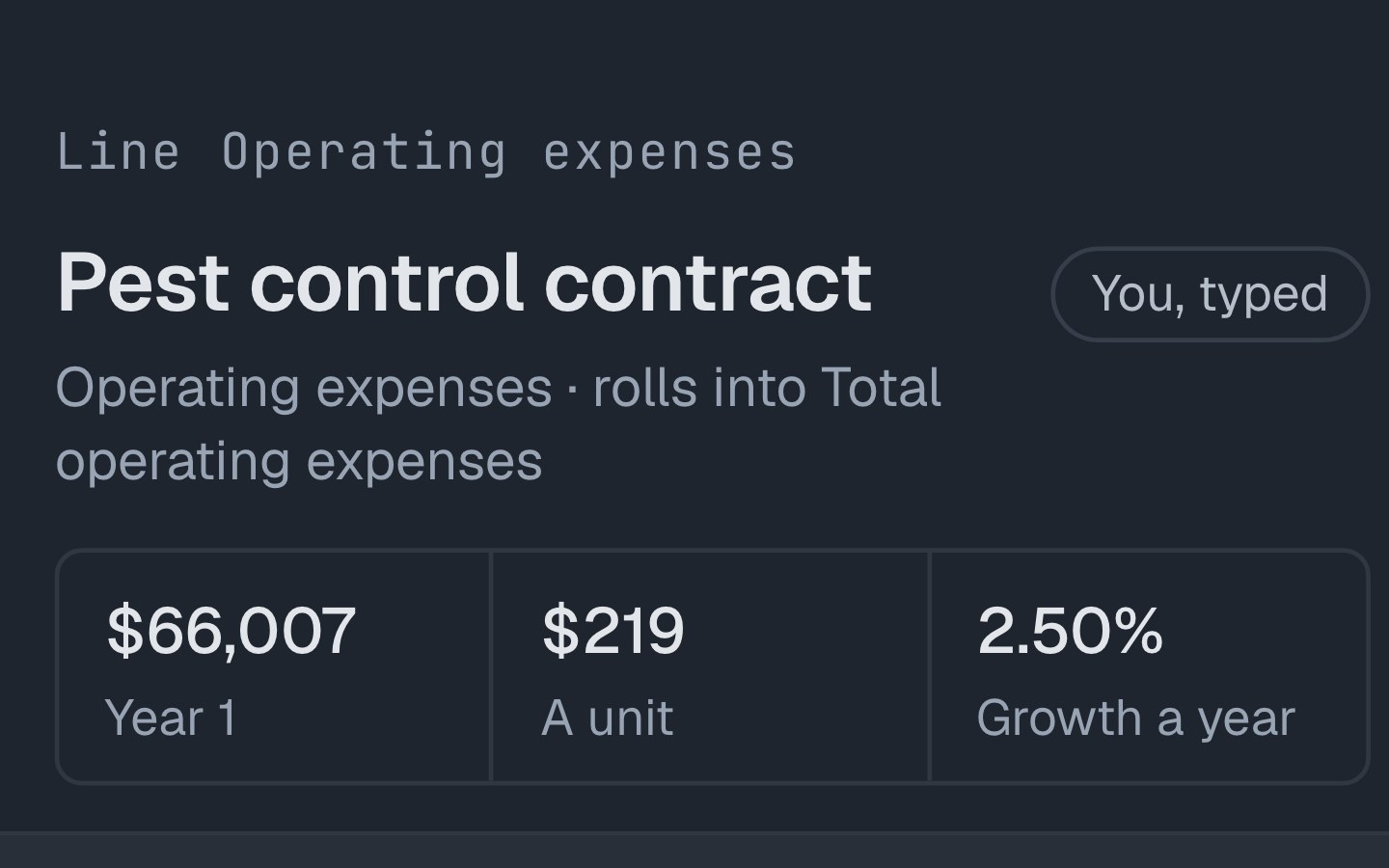
An override sits on the line for the months named, with its reason. The line's own formula stays underneath and returns when the override is removed. The engine re-runs the deal before a person approves.
Rests on today (November 14, 2026): a full run of the engine takes 17 milliseconds, so a change can be run before it is approved. The override form is in the prototype. To build: an override by period on any line.
 , opens the screen in a new tab
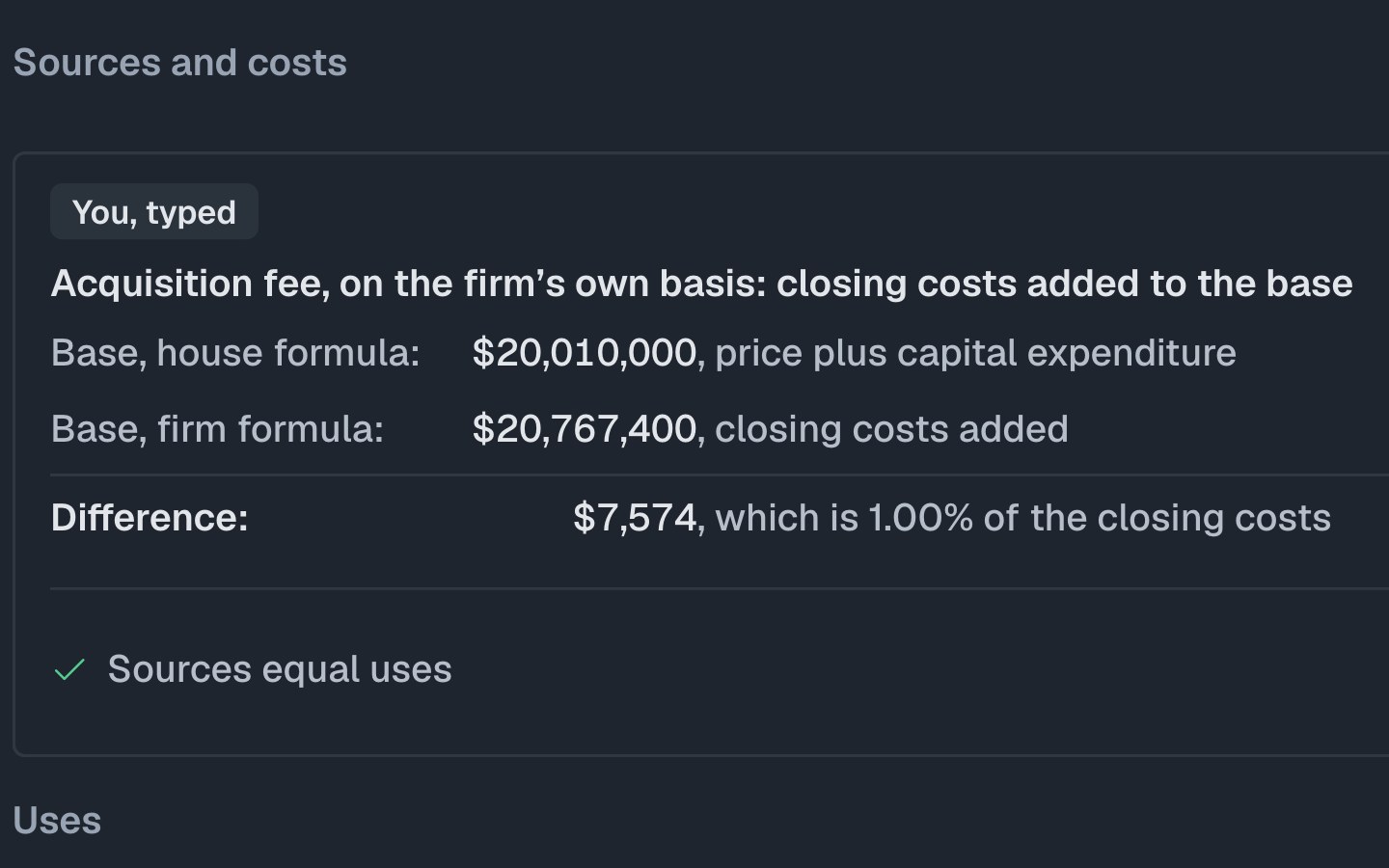
A line is added by name. The engine re-runs the deal and the checks hold. A person approves before any figure moves.
Rests on today (November 14, 2026): a full run of the engine takes 17 milliseconds, so a change can be run before it is approved, and the bar's re-test when a lever moves works live in the prototype. To build: the cash flow as lines that roll up into their totals.
 , opens the screen in a new tab
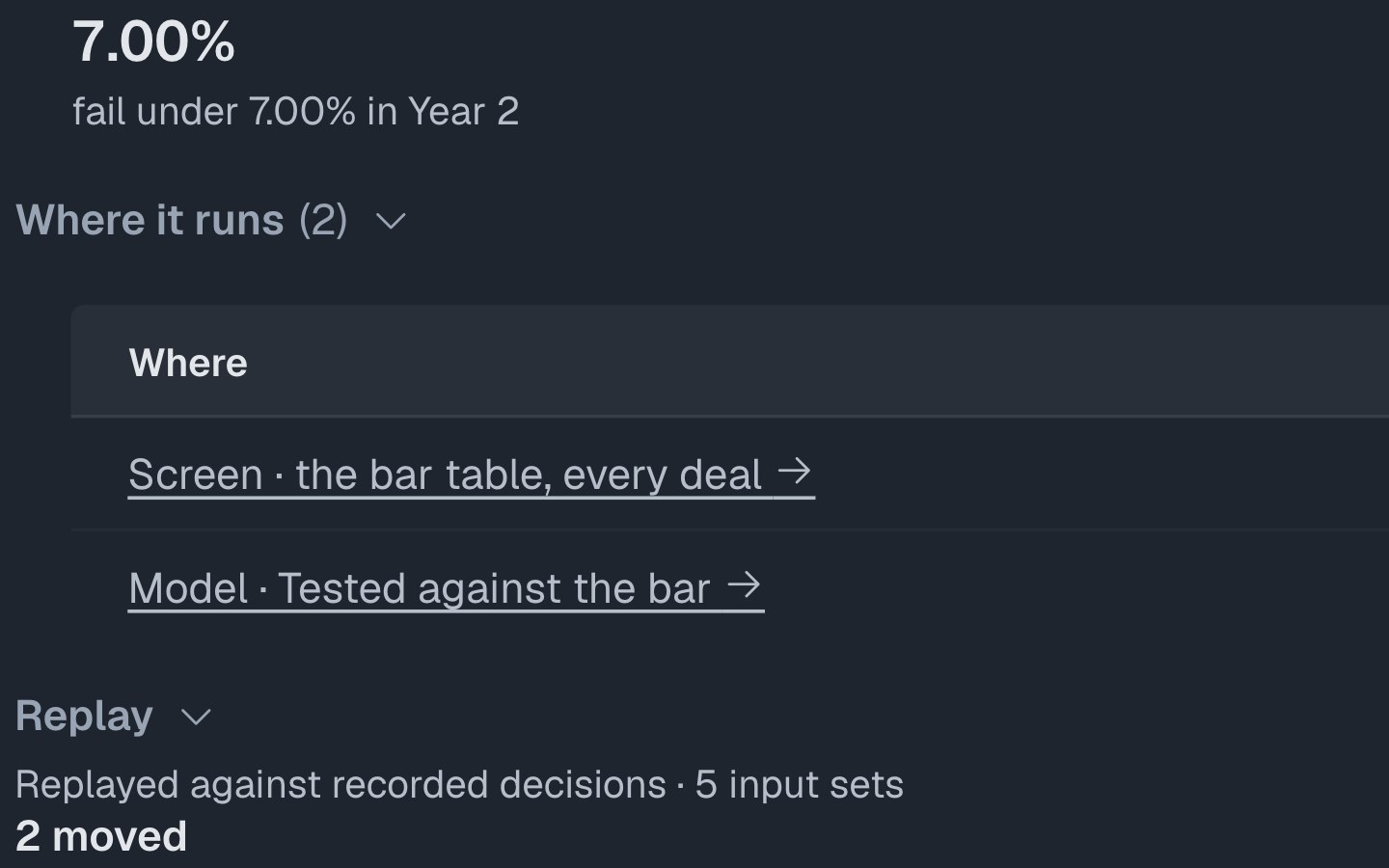
The firm's formula sits in the firm's layer, with the house formula kept underneath. The difference from the house prints beside the line on every deal. A person approves the change.
Rests on today (November 14, 2026): nothing is run or built behind this step yet. The difference it answers is cataloged in one of the founder's own workbooks. To build: a formula for each line, by layer.
 , opens the screen in a new tab
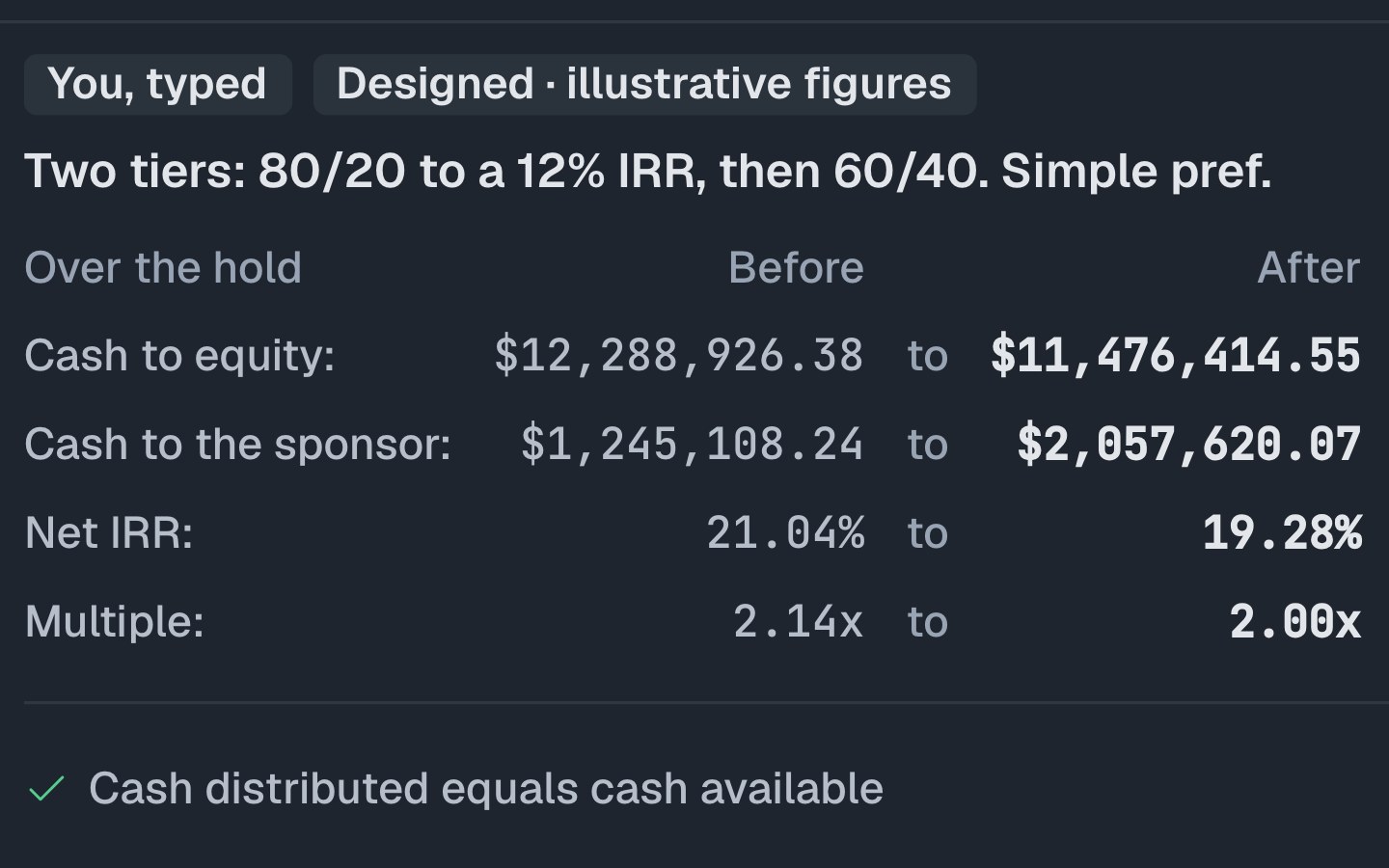
A metric is a formula over the model's lines, by name. A test is a metric with a threshold. It is replayed against the firm's past decisions and approved before it publishes.
Rests on today (November 14, 2026): Workshop's rule page and its replay are in the prototype, and the engine's run time makes a replay a batch of runs. To build: metric lines and test objects.
 , opens the screen in a new tab
The waterfall is an ordered list of steps that ends in a residual, so cash distributed equals cash available. A step is added, removed or reordered, and the engine shows cash to each party before and after. A person approves.
Rests on today (November 14, 2026): a waterfall built as a list of steps, with a separate check of its arithmetic, was run in a working session on November 14, 2026 and passes. To build: the step list in Basis's engine, behind the check that cash distributed equals cash available.
 , opens the screen in a new tab
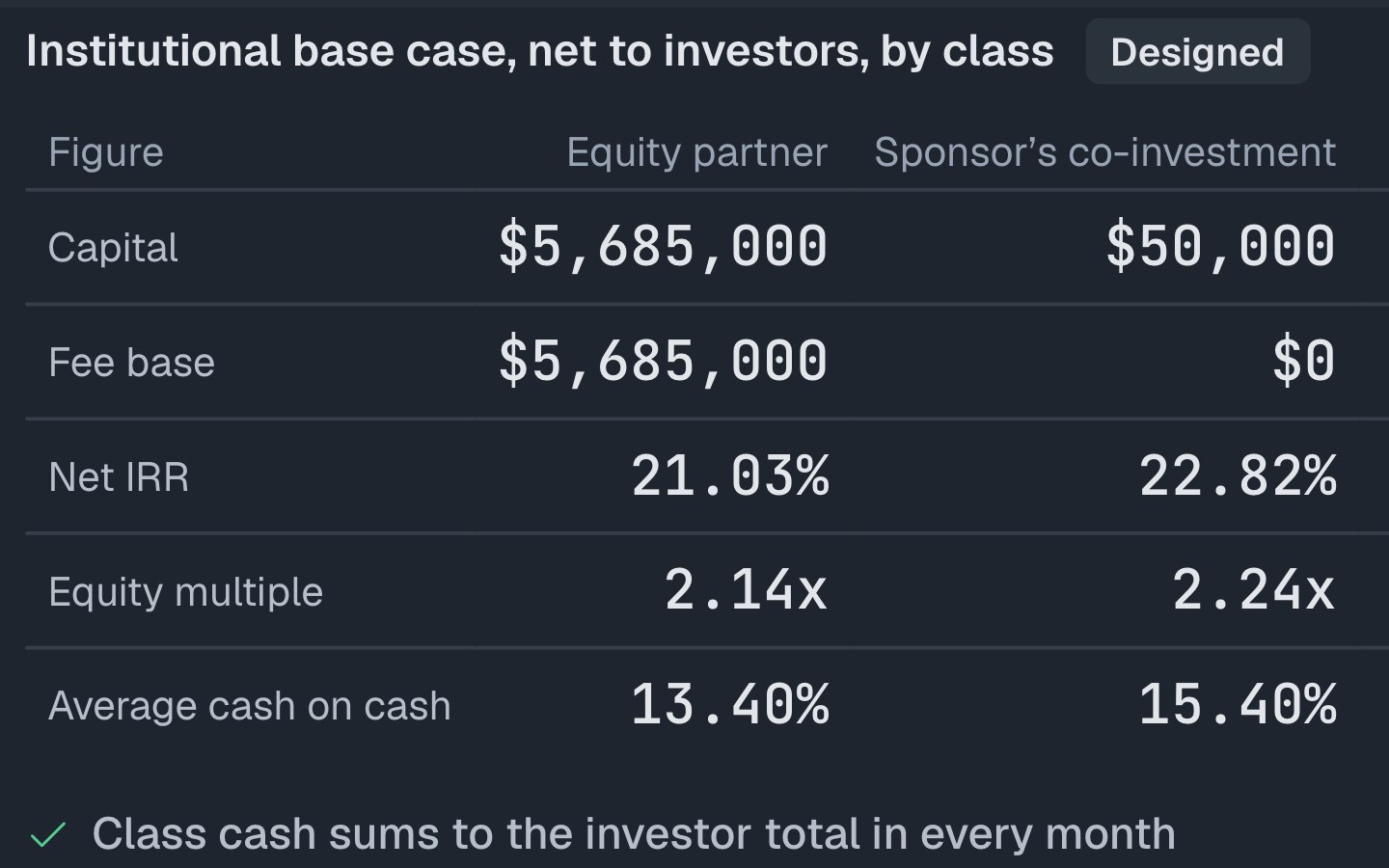
Each class has its own accounts at every step of the waterfall, with its own capital, fees and returns. Class cash sums to the investor total in every month, and the check prints.
Rests on today (November 14, 2026): the step-list waterfall run on November 14, 2026 passes. Classes were not in it. One of the founder's source workbooks reports two classes, which sets the test to pass. To build: classes as accounts in the step list.
 , opens the screen in a new tab
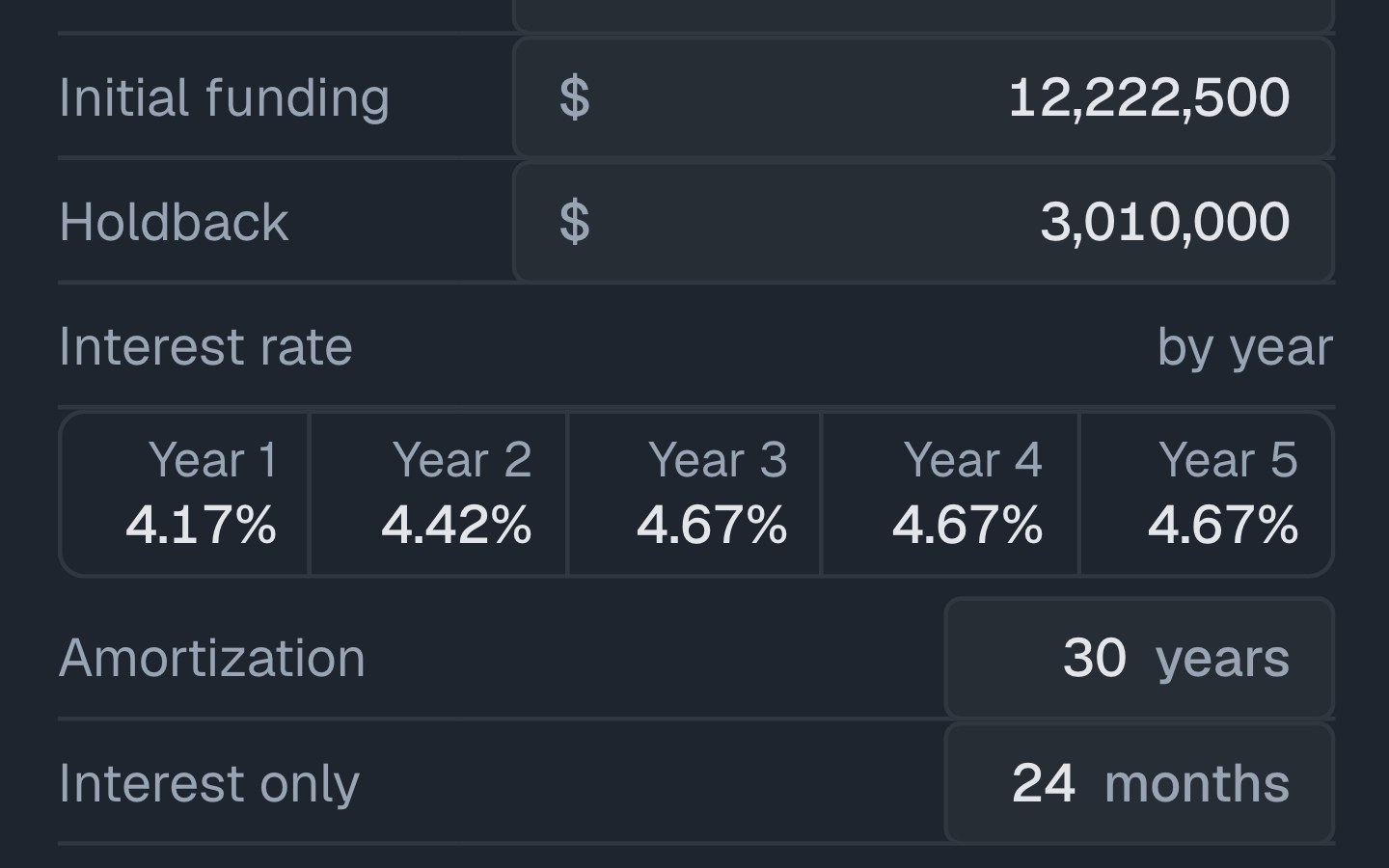
A loan is a schedule built from terms that can vary by month, plus a list of events: a draw, a rate step, a payoff with its cost. A person adds an event, and the schedule and coverage re-run before approval.
Rests on today (November 14, 2026): Financing's events table is in the prototype, and the page marks the debt schedule as built (Station 06 · Debt). To build: the rate as a series, and loan events.
 , opens the screen in a new tab
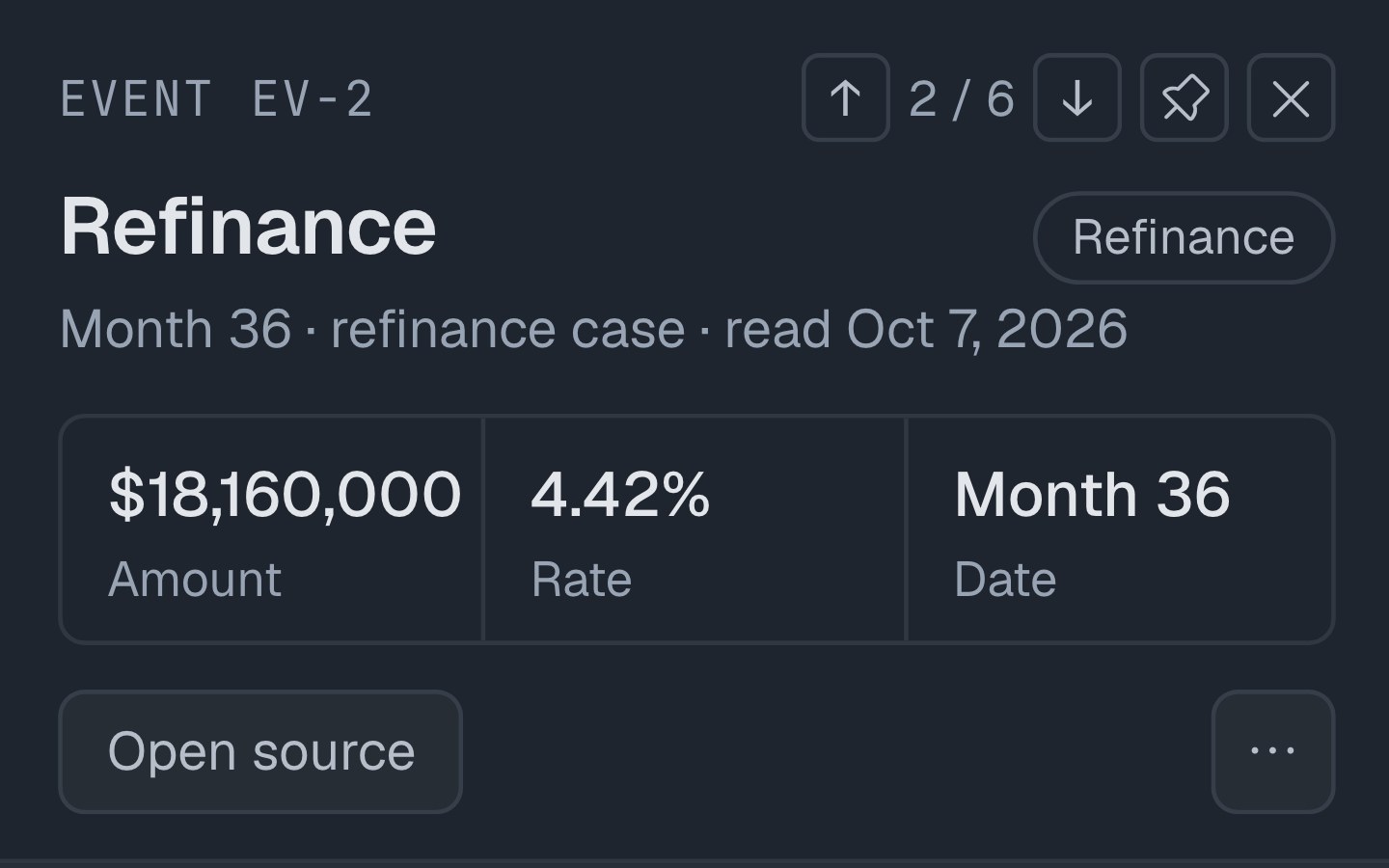
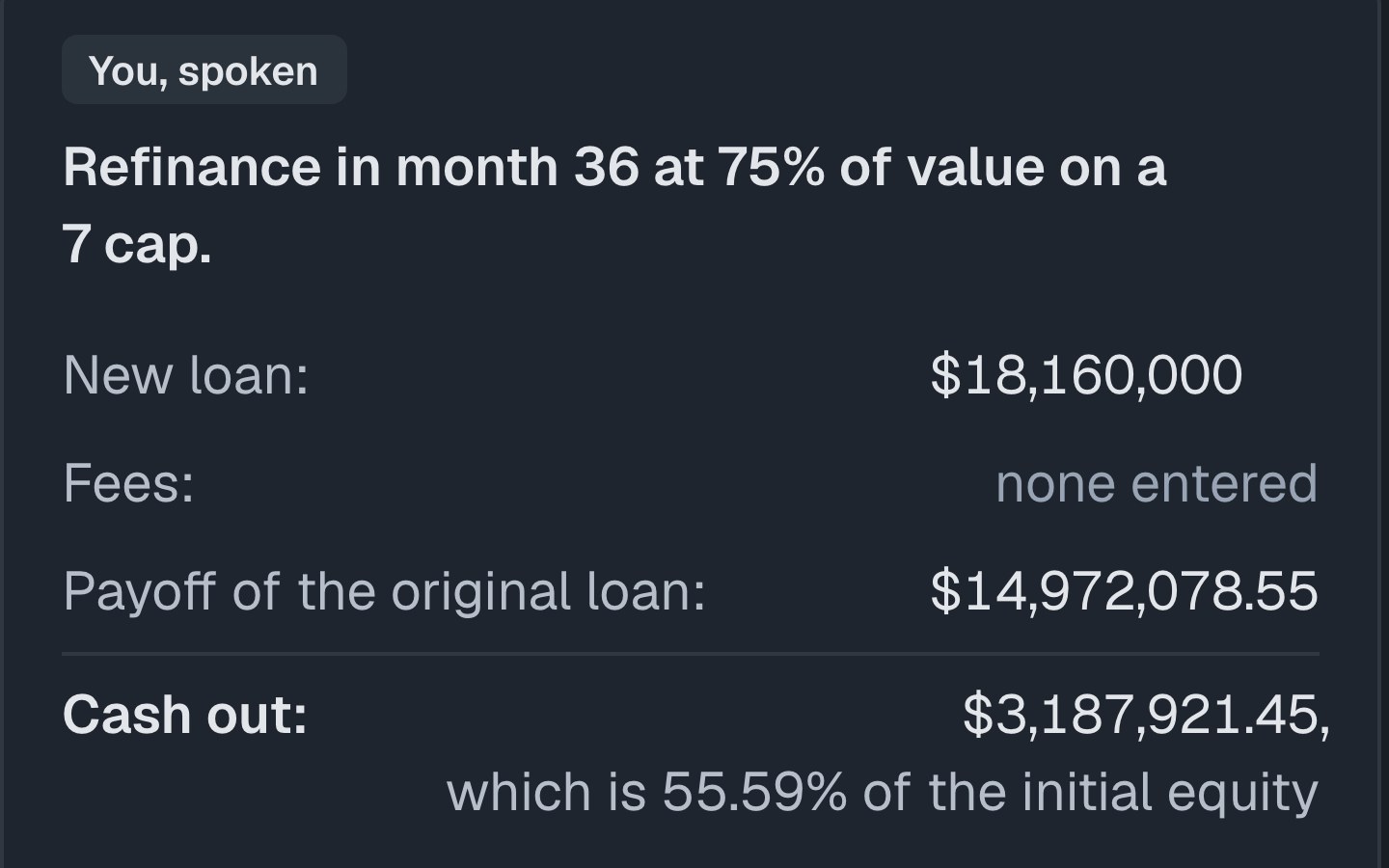
Cash out is the new loan, less fees, less the old loan's balance from its amortization table at that month. A refinance pays off one loan and adds another; a supplemental adds a loan and pays off none. The cash goes through the waterfall in the month it funds.
Rests on today (November 14, 2026): the payoff ties on the engine today. It gives $14,972,078.55 after payment 36, so $3,187,921.45 of cash out against the $18,160,000 loan. To build: loan events in place of the refinance inputs, which are not wired today.
 , opens the screen in a new tab
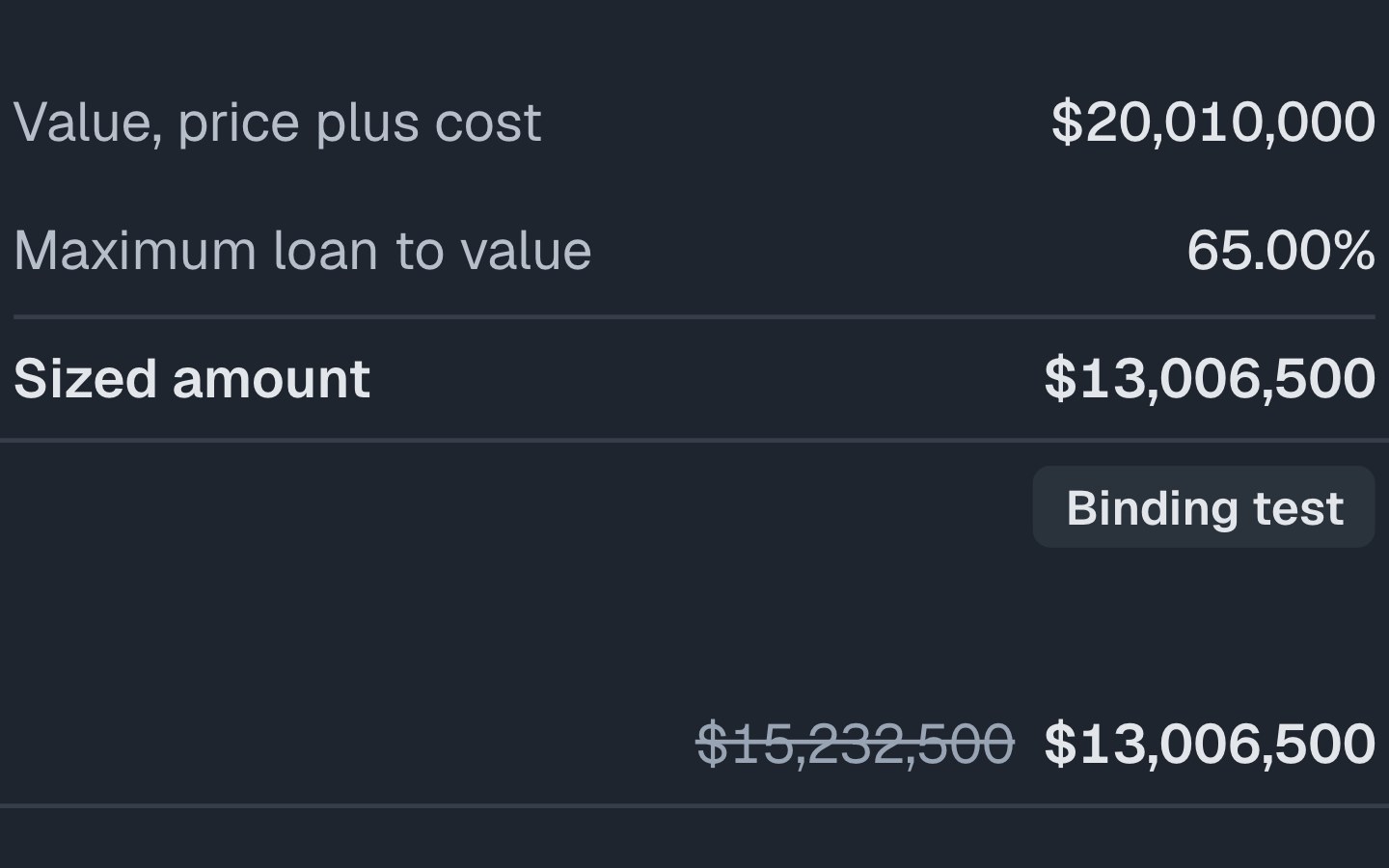
Three sized amounts are lines in the model, and the loan is their minimum. The binding test is named. At the sized loan the binding test sits at its limit and the other two pass.
Rests on today (November 14, 2026): Sizing names a binding test in the prototype. No run stands behind three-way sizing yet. To build: three sizing lines and their minimum.
 , opens the screen in a new tab
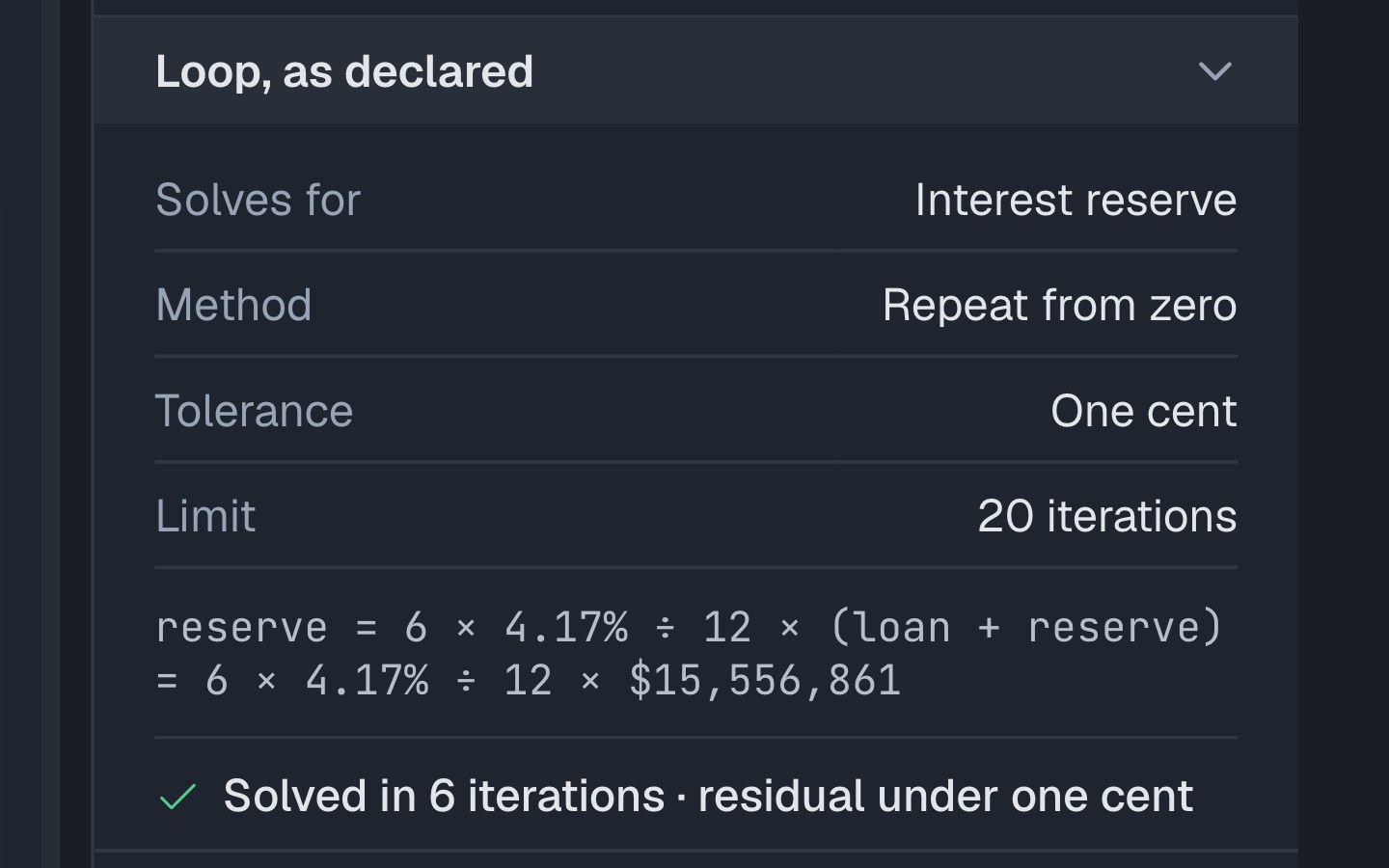
A loop is declared: what it solves for, the method, a tolerance and a limit. Each result prints whether it converged and with what residual. A loop that does not converge withholds its value, and every figure downstream says so.
Rests on today (November 14, 2026): a loop test with a known answer was run on November 14, 2026 and passes in 37 steps; the picture's six iterations are an illustration. To build: the loop declaration, starting with the return solver the engine already has.
 , opens the screen in a new tab
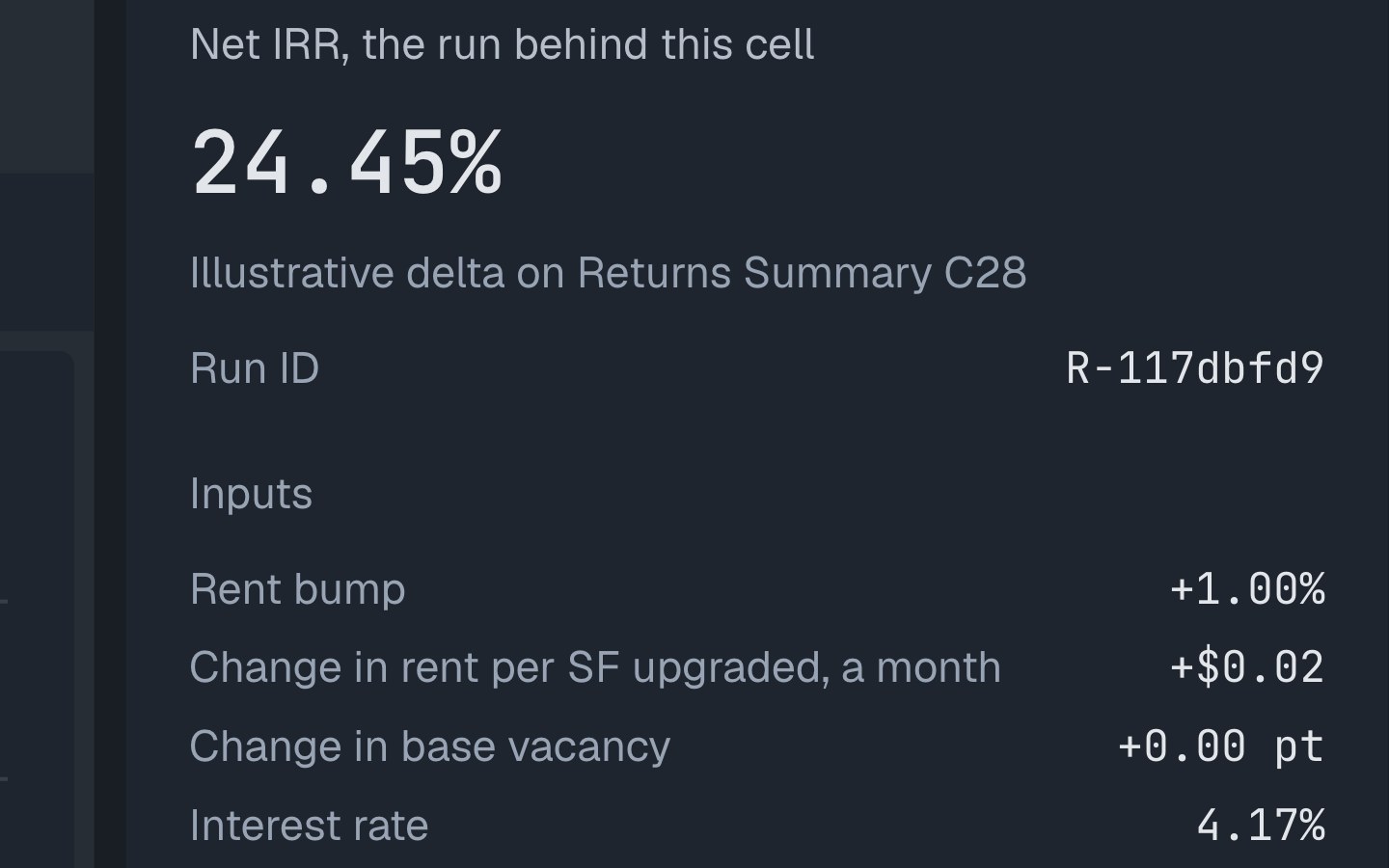
Each cell of a grid is a full run of the engine, and any cell opens the run behind it. A target is found by bisection on one input. Every cell reproduces from its run.
Rests on today (November 14, 2026): measured on the engine on November 14, 2026, on a test deal shaped like Bexley: a 1,296-run grid in 19.8 seconds, and a target found in 25 runs. To build: the grid and goal-seek tools.
 , opens the screen in a new tab
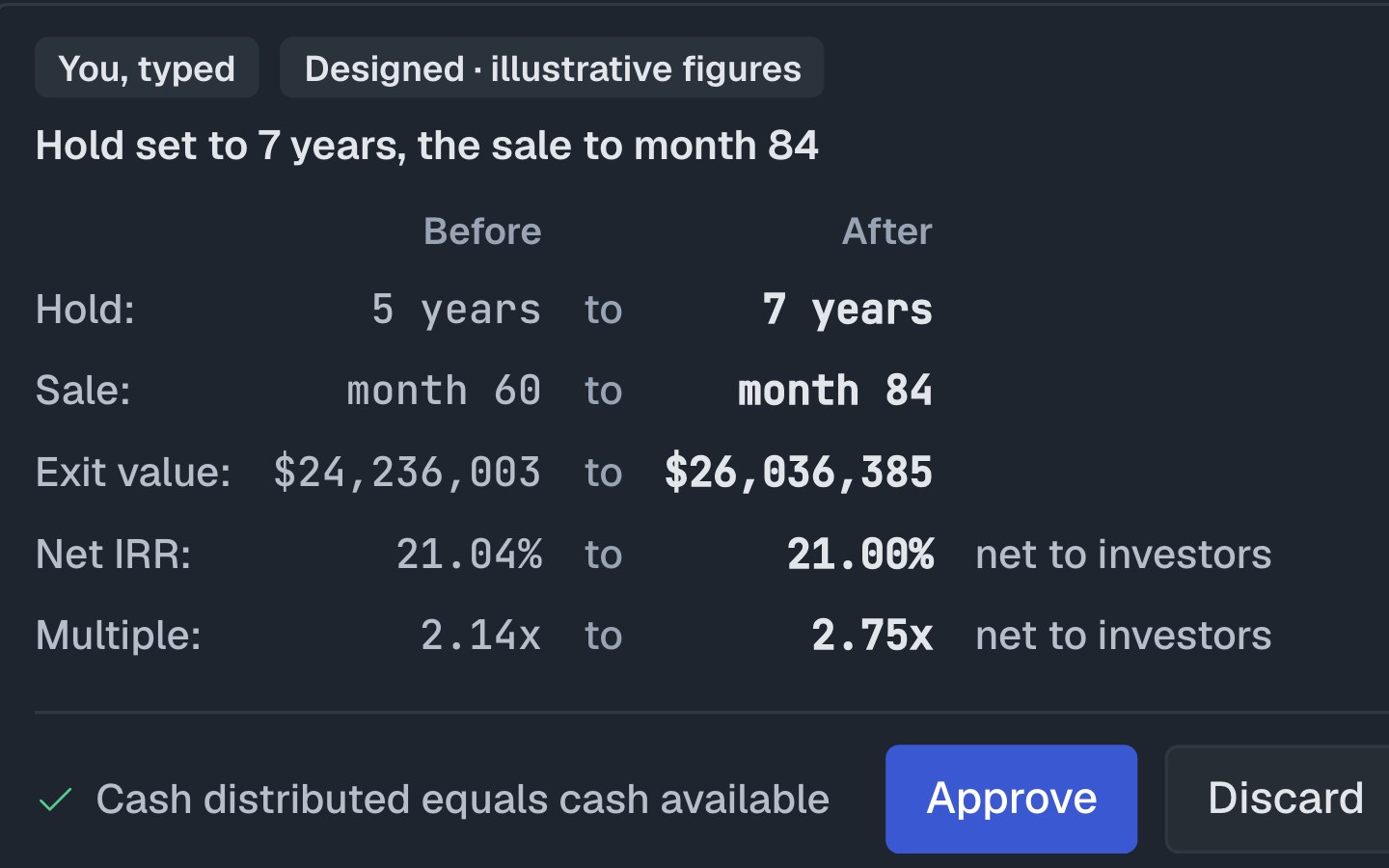
The hold and the sale month are inputs. Yearly inputs extend past Year 5 by a rule printed on the screen. The deal re-runs to the sale month before a person approves.
Rests on today (November 14, 2026): nothing is run or built behind this step yet. Today the hold is 60 months. A seven-year case is set as the test to pass. To build: the hold as an input.
 , opens the screen in a new tab
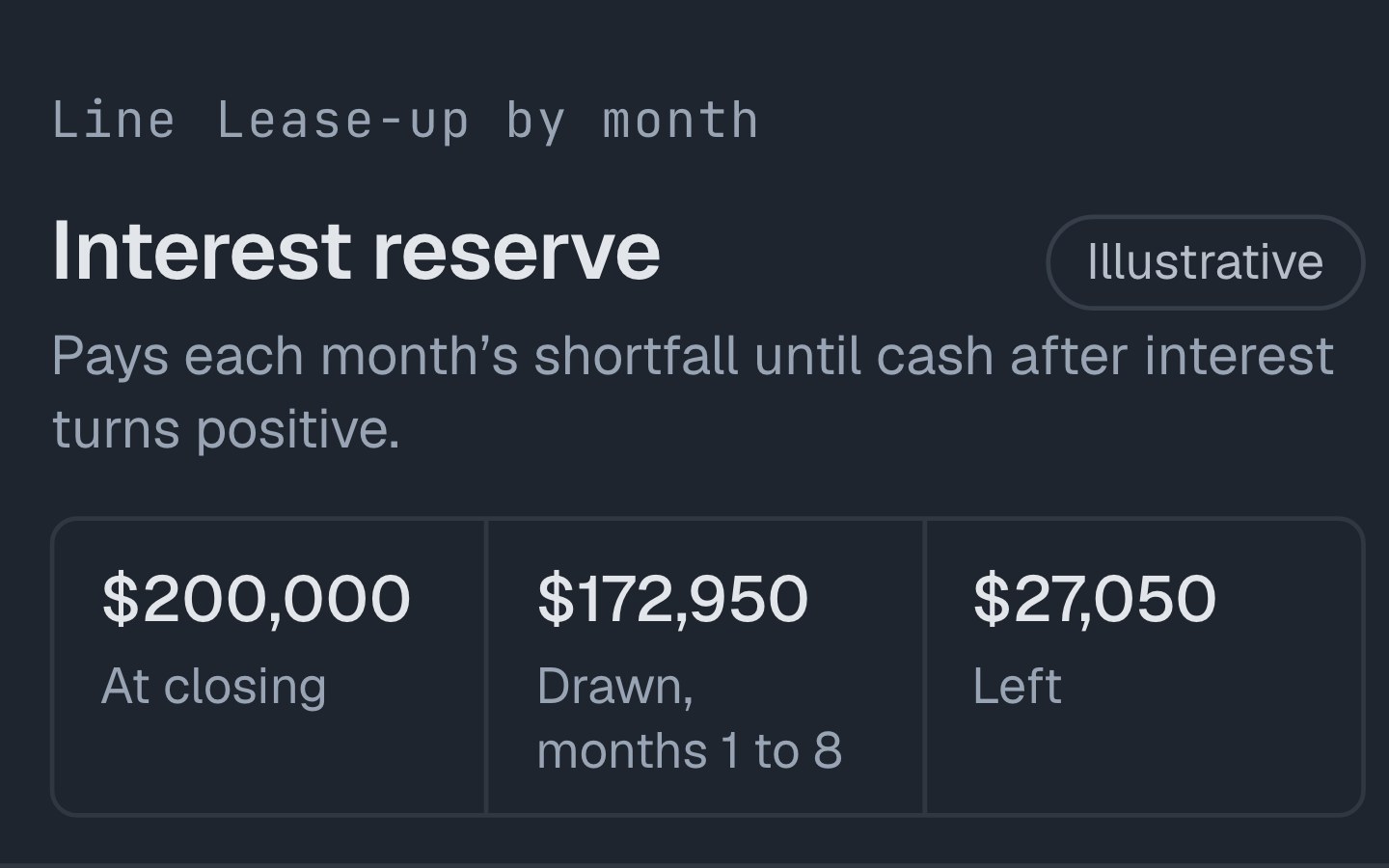
Absorption and concessions are monthly series. Draws, an interest reserve and a longer hold are the same pieces the rest of the model uses. The pro forma is the engine's run at monthly detail.
Rests on today (November 14, 2026): the revenue engine runs twelve months by floor plan in the prototype, built and live. To build: nothing of its own. It follows from the override, the loan events, the loop and the longer hold.
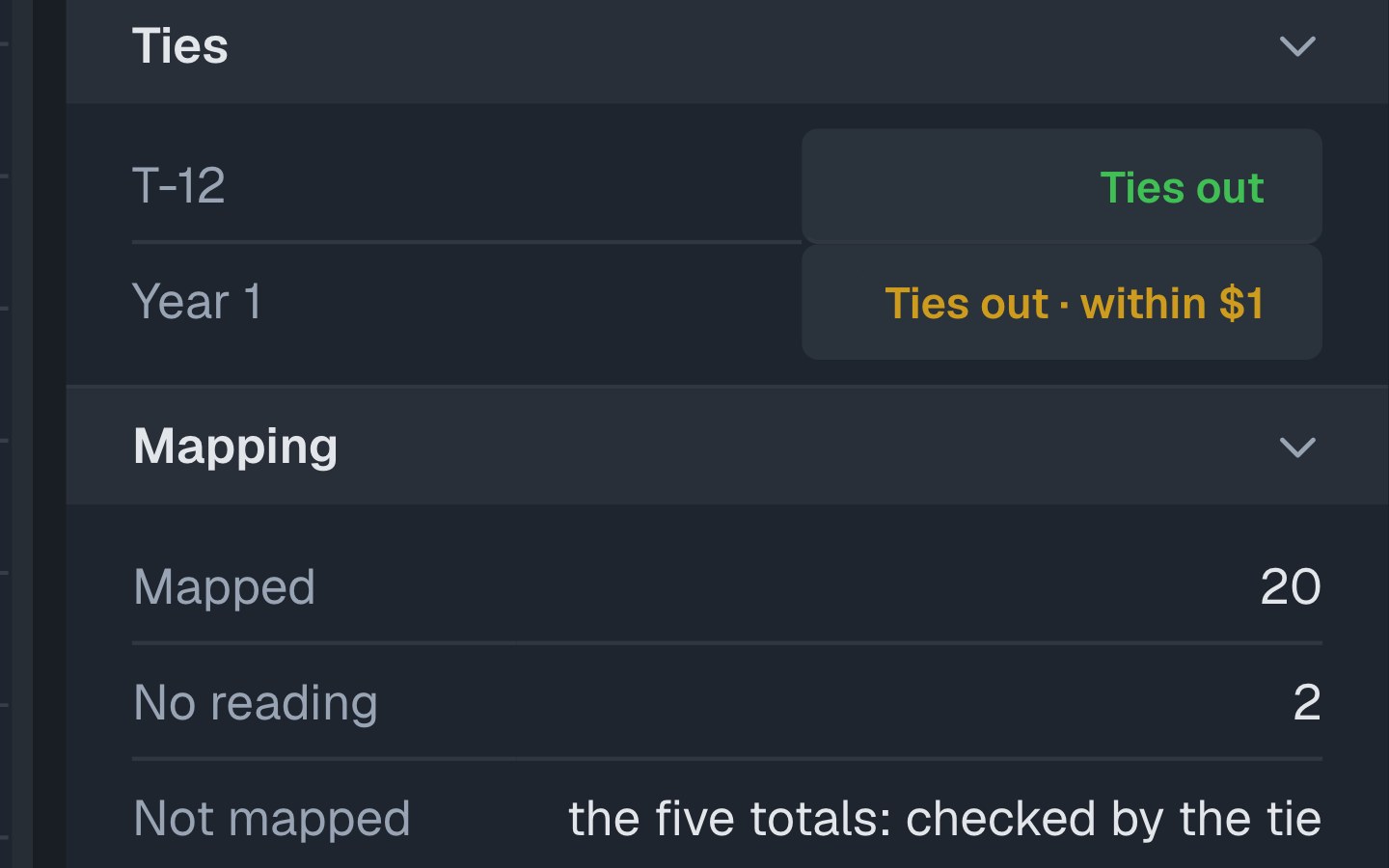
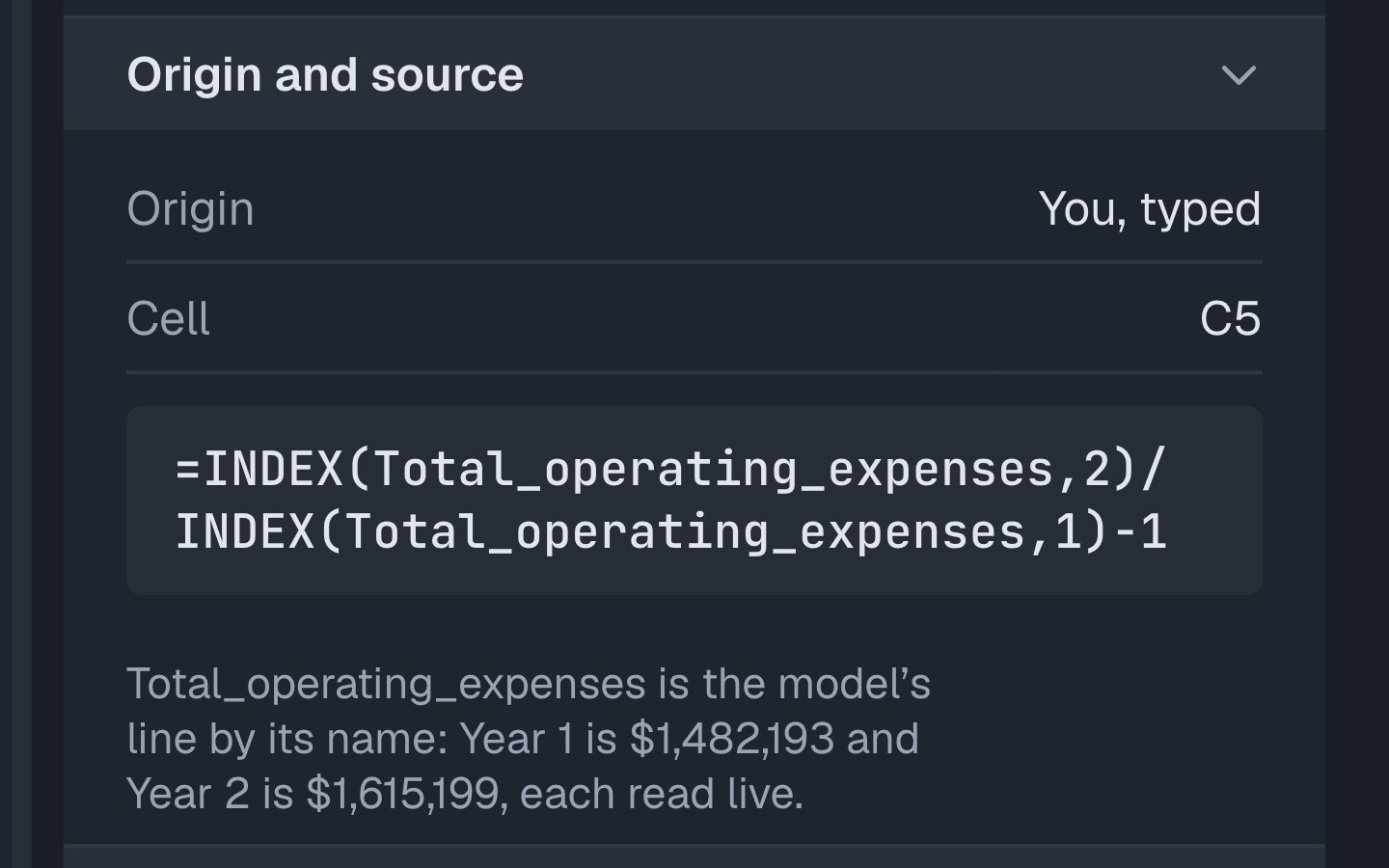
The account mapping is the firm's own data. An account with no mapping is named and left for a person, never guessed. A pivot is a query over the rent-roll rows, shown in a tab.
Rests on today (November 14, 2026): Bexley's statement was read and tied to its printed totals on November 10, 2026, and the Mapping view is in the prototype. To build: the mapping as the firm's own data, and a query tab.
 , opens the screen in a new tab
A tab has a kind and reads any model line, document fact or date by name, live. It changes nothing in the model by itself. One named, approved step moves a range into the model, and the checks pass or the step is refused with the failing check shown.
Rests on today (November 14, 2026): nothing is run or built behind this step yet. The pattern it follows, a tab of a set kind that an agent fills, was read in the model platform maker's own apps on November 14, 2026. To build: the kinds of tab, a grid on a formula engine that runs on the server, names in a cell, and the promote step.
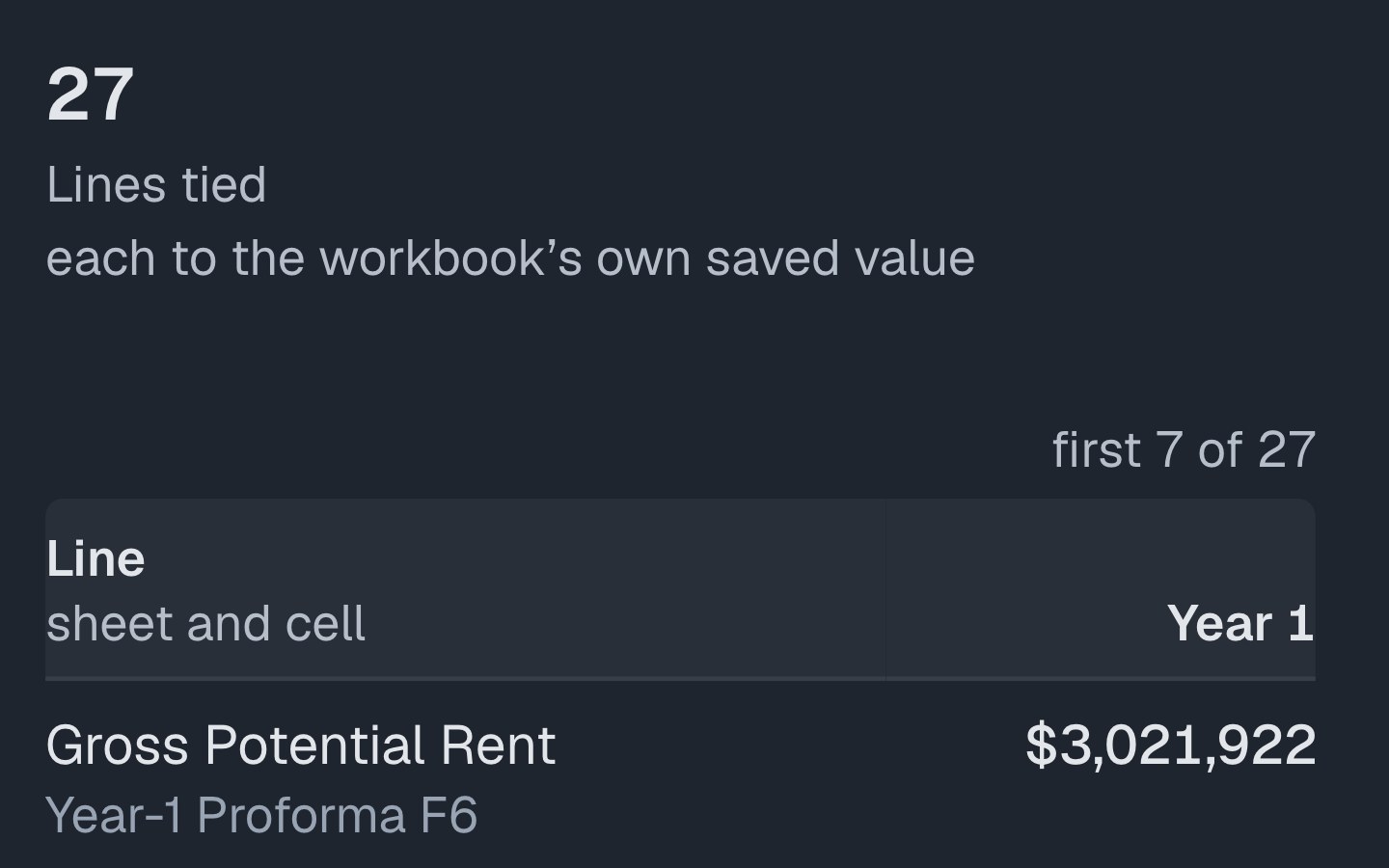
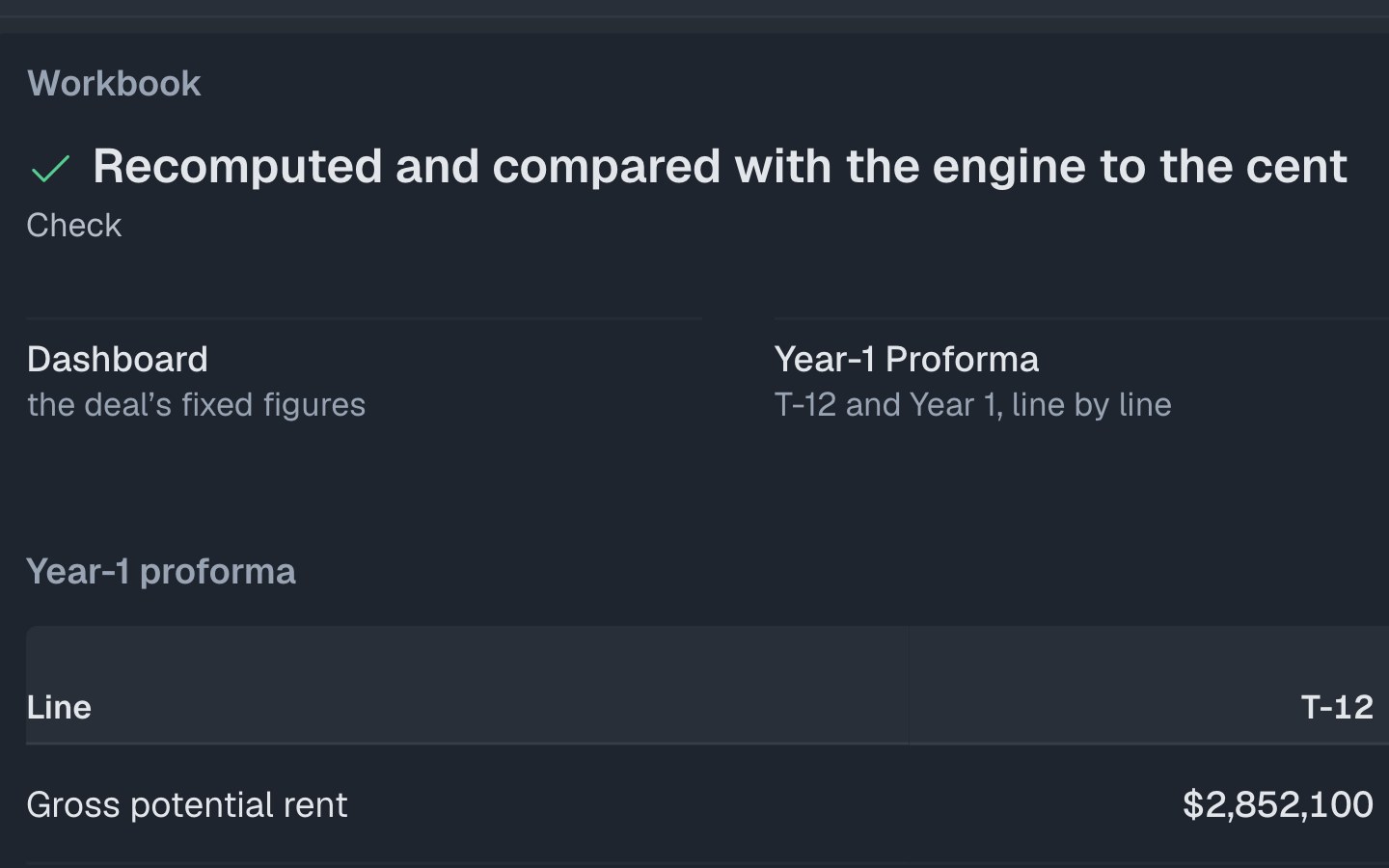
A firm's template comes in where a family of rows maps to one line and ties to the workbook's own saved values. The rest comes in as labeled values. A report lists what tied, what came in as a value and what was left behind.
Every Working leaves as a live workbook: real formulas where Excel has an equivalent, labeled values for the rest. Before download it is recomputed and compared with the engine to the cent.
Rests on today (November 14, 2026): done once, by hand: Bexley ties to the penny on its full operating spine. Writing Excel files is a listed capability of the model platform underneath, read November 14, 2026. To build: the importer and the exporter, each with its check. Any workbook whatever is out of scope.
Spoken or typed words become a named change. The server runs the engine and reads the change back. Nothing applies until a person approves.
Rests on today (November 14, 2026): typed outputs and custom tools are available on the model platform underneath, as read on November 14, 2026, and the read-back's figures come from the engine's own dry run. To build: the change format, and the propose and approve tools.
 , opens the screen in a new tab
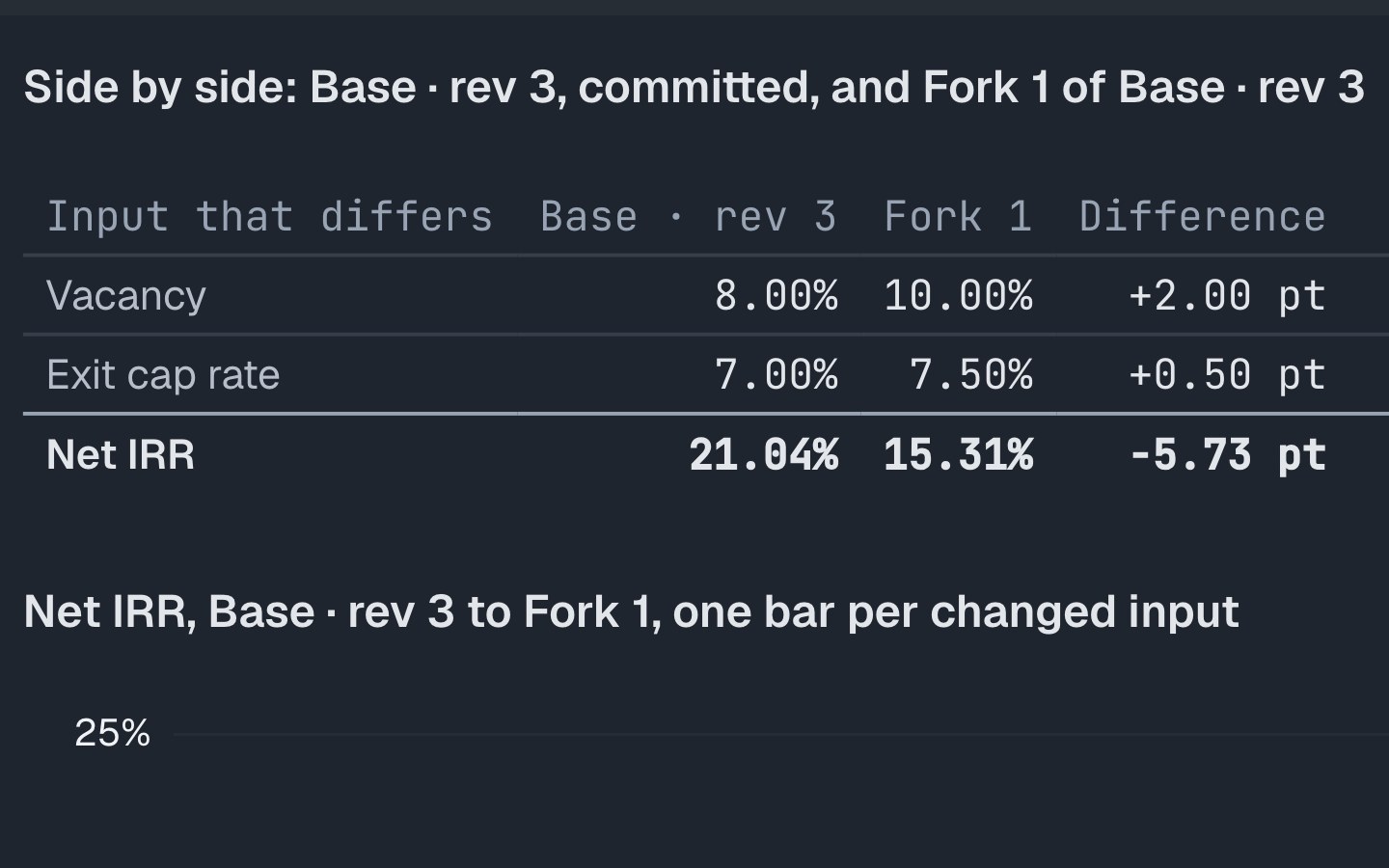
A branch stores its differences from its parent, so the parent is kept. Two branches sit side by side with the inputs that differ and a bridge between their results. A person commits one branch as the decision case.
Rests on today (November 14, 2026): the engine is one function of its inputs, so a branch is a set of input differences, and the scenario control is in the prototype. To build: the branch store, the comparison and the bridge.
 , opens the screen in a new tab
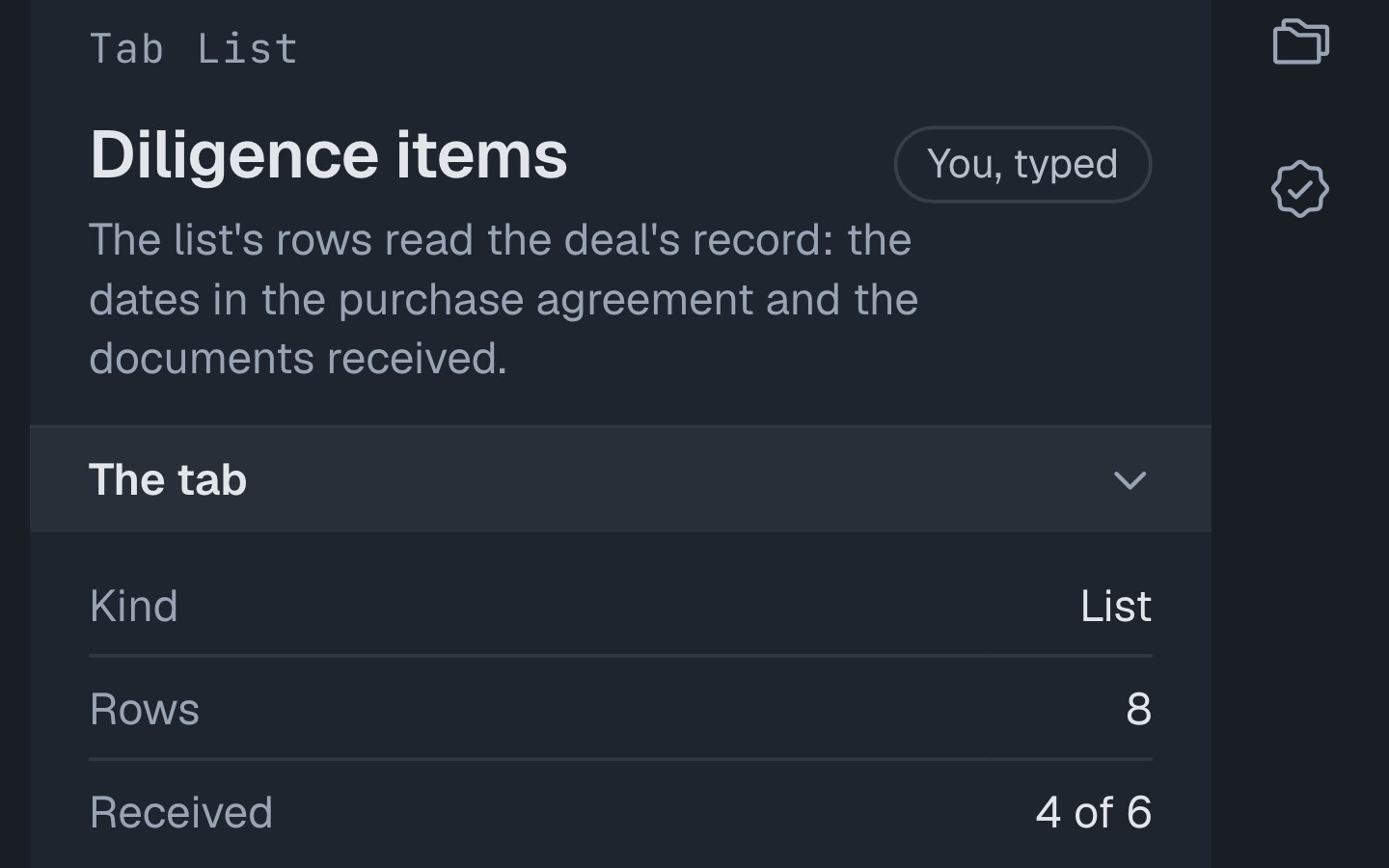
The list's rows read the deal's record: the dates in the purchase agreement and the documents received. A row's status changes when its document lands. Change the closing date in the record and every dependent row moves.
Rests on today (November 14, 2026): the diligence checklist is in the prototype on sample content, and values are read and pinned to their pages on one real deal. To build: the list kind of tab, and rows that read a document's facts.
 , opens the screen in a new tab
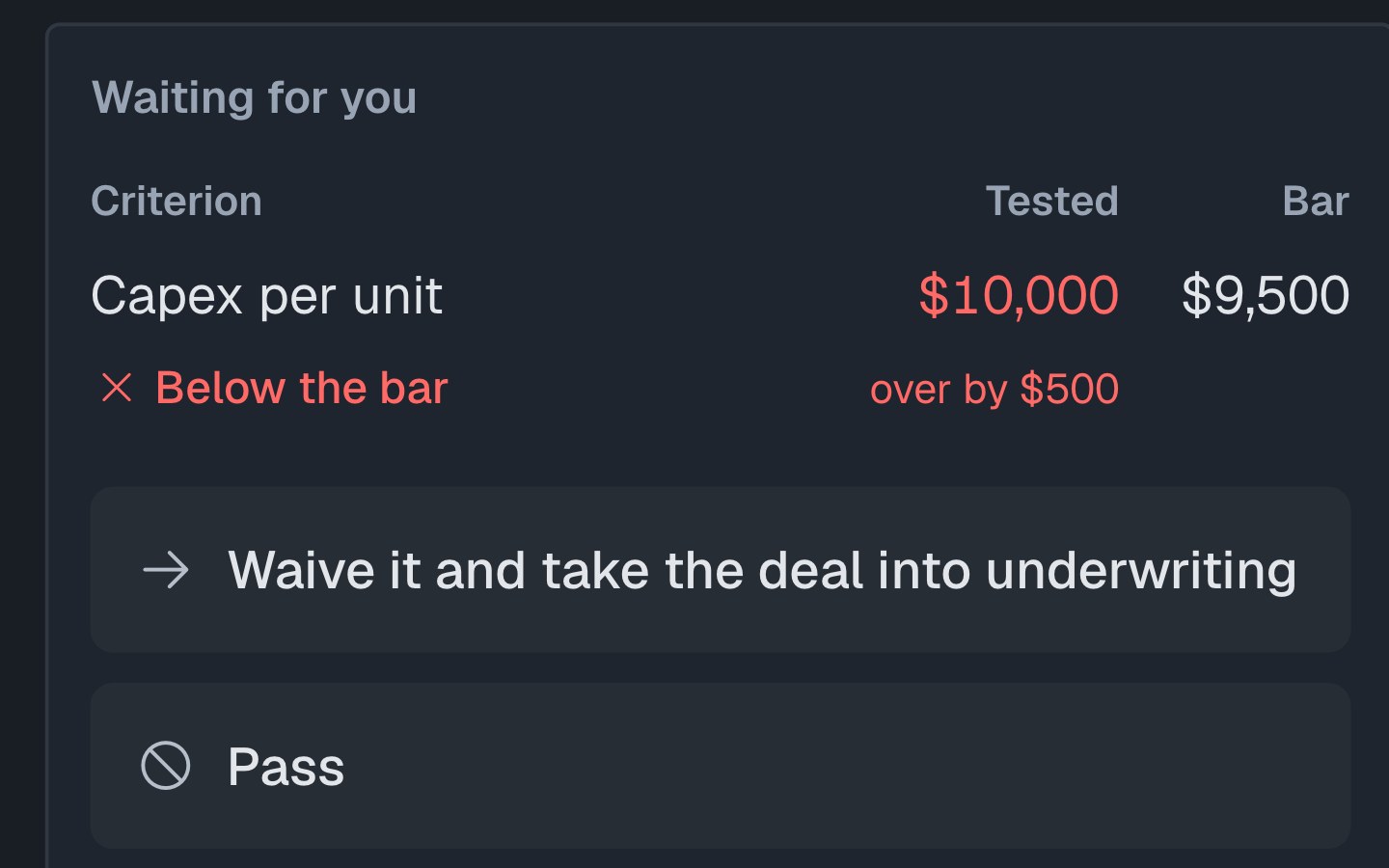
When a deal's documents arrive, the agent reads and ties them and the engine tests the deal against the firm's bar. The phone shows what was done and the one decision that waits. A person records it, with a reason.
Rests on today (November 14, 2026): Bexley's documents were read, tied and run through the engine on November 10, 2026, in 9 minutes 44 seconds, and the Screen and its decision card are in the prototype. To build: unattended runs and a phone surface.
 , opens the screen in a new tab
Spoken words become a named change. The server runs the engine and reads the change back. Nothing applies until a person approves.
Rests on today (November 14, 2026): typed outputs and custom tools are available on the model platform underneath, as read on November 14, 2026. The read-back's figures come from the engine's own dry run. Speech is the phone's own dictation. To build: the change format, the propose and approve tools, and a phone surface.
The screens show both apps as they stand today: clickable prototypes, with real reads where a screen says so. The round and the plan are on the revenue and cash page.