Out of Excel · four acts on Bexley · DesignedEvery screen in this block is designed.
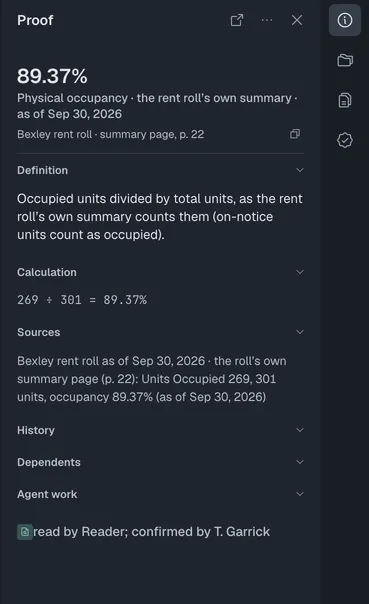
Basis One deal's rent roll and operating statement, read, tied and run through the underwriting engine: all 5 of the rent roll's printed totals tie to the cent across 301 units, in 9.7 minutes and $1.73 of computer cost, before a person's review. One measured run on one real deal, November 10, 2026.
Covenant One quarterly package, read end to end: 9.2 minutes and $2.76 of computer cost, before a person's review. One measured run on one real loan, November 2026.
I want to be the first. I want to be the best. And I never want to stop evolving, so that we always stay ahead.
Built by its founder: $1B multifamily closed · $300M+ equity raised.
Basis is the multifamily underwriting app for lenders and investors. It keeps the firm's own model as software, out of Excel, and runs the transaction end to end, from the first rent roll to the closing statement, with a person approving each step. Each stands alone.
Covenant is the servicer's app. By the time the servicer logs in, the agent has read every package against the loan's own terms, chased what's missing and raised what needs a decision, each with its source.
What the servicer's app shows for that loan is the agent's own output, untouched by any person. Items marked illustrative show capabilities beyond this loan's own documents, or quarters still to be read.
Covenant · the morning list · clickable prototype · opens live
A clickable prototype of the app. Corbett Mill's figures are real reads from one loan's closing documents and one quarterly package, with names replaced and dates moved forward to the current period. Every other loan is illustrative.
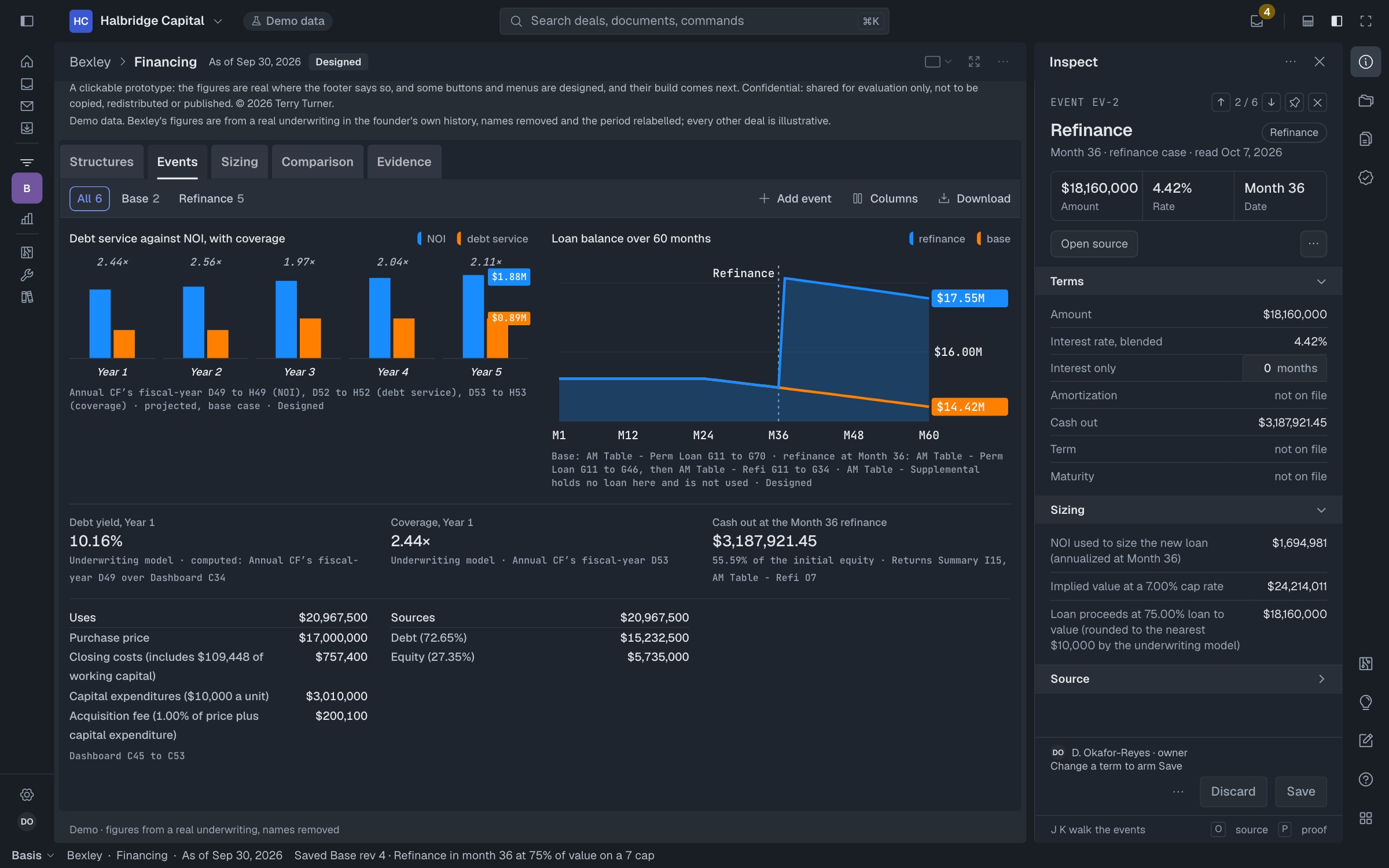
Basis · underwriting for lenders and investors · clickable prototype
Basis. Your model, out of Excel.
Out of ExcelThe model's lines, loans and waterfall are the firm's to change. Any tab the firm wants, a schedule, a checklist, a calculation in Excel's own functions, is made by asking for it. Every tab reads the model by name. Nothing moves a figure until a person approves it, and the whole Working exports as a live workbook.
Designed.
Excel is an exportLenders, partners and committees still want the file. Basis writes it: a live workbook with real formulas, checked against the engine before it leaves. The record stays in Basis.
Designed.
Agents work the deal, not the cellsThey read every document, tie every figure and chase what is missing. They propose, a person approves, and the engine computes every number.
Reading and tying are real on one deal. The rest is a clickable prototype or designed.
Your way stays yoursEvery firm underwrites its own way, and Basis keeps that freedom: branch any scenario, move every lever, and write the firm's own metrics and screening tests.
A lender reviews its loan documents and chases the borrower for diligence; an investor reviews purchase agreements, letters of intent and diligence documents. It is the same work, and Basis carries it from the deal's arrival to the closing statement. Its rules stay in force, versioned and replayed against past decisions before they change. The agents proposing each change in place, with a person approving it, are designed.
The house model is the founder's Stonemill Row underwriting model: 30,132 formulas across 43 sheets, its operating spine running as software. A firm bringing its own model: designed.
Clickable prototype on demo data. Lender presets are designed.
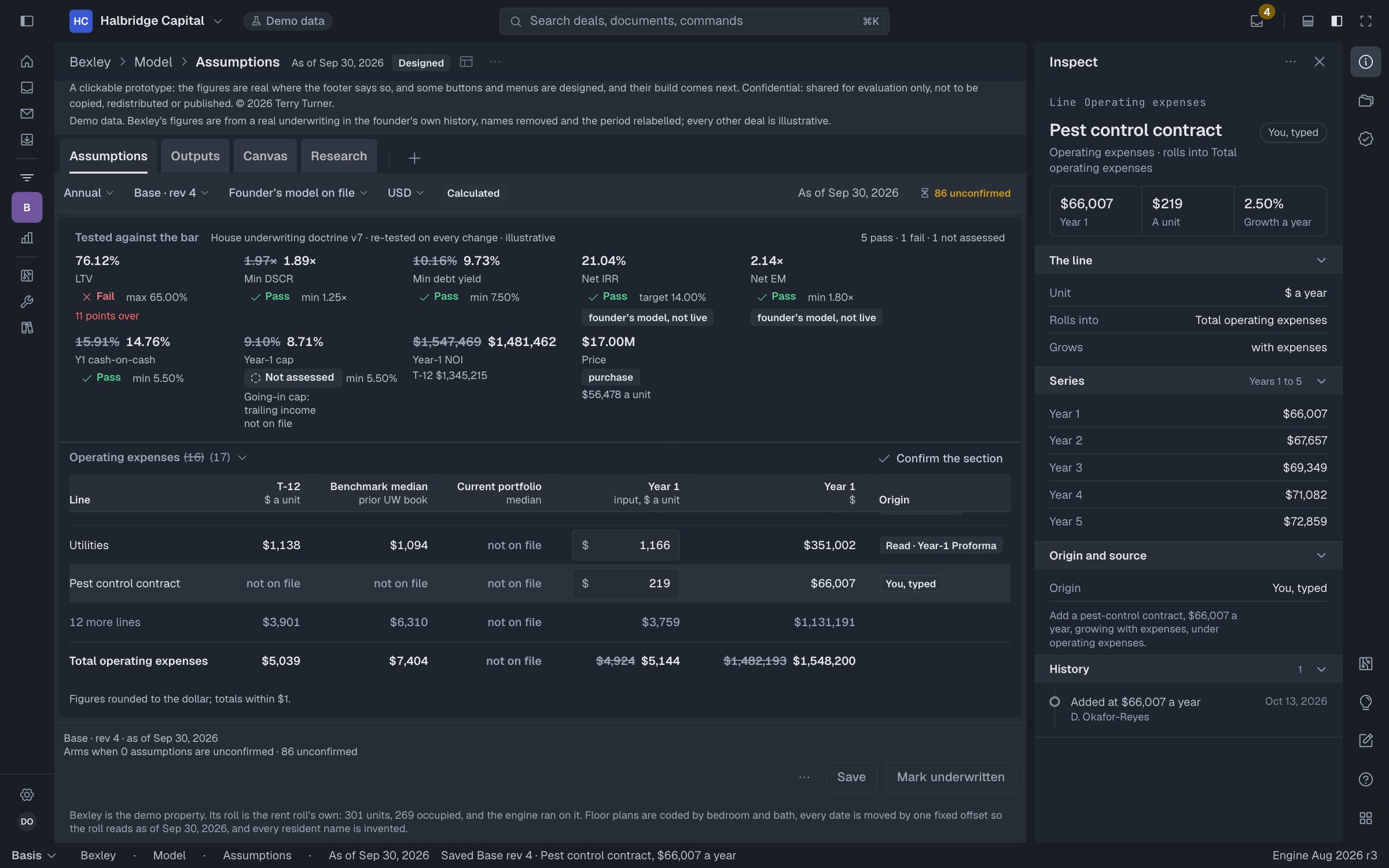
A line is added by name. The engine re-runs the deal and the checks hold. A person approves before any figure moves.
Rests on today (November 14, 2026): a full run of the engine takes 17 milliseconds, so a change can be run before it is approved, and the bar's re-test when a lever moves works live in the prototype. To build: the cash flow as lines that roll up into their totals.
Ten screens
Ten screens,each live to click.
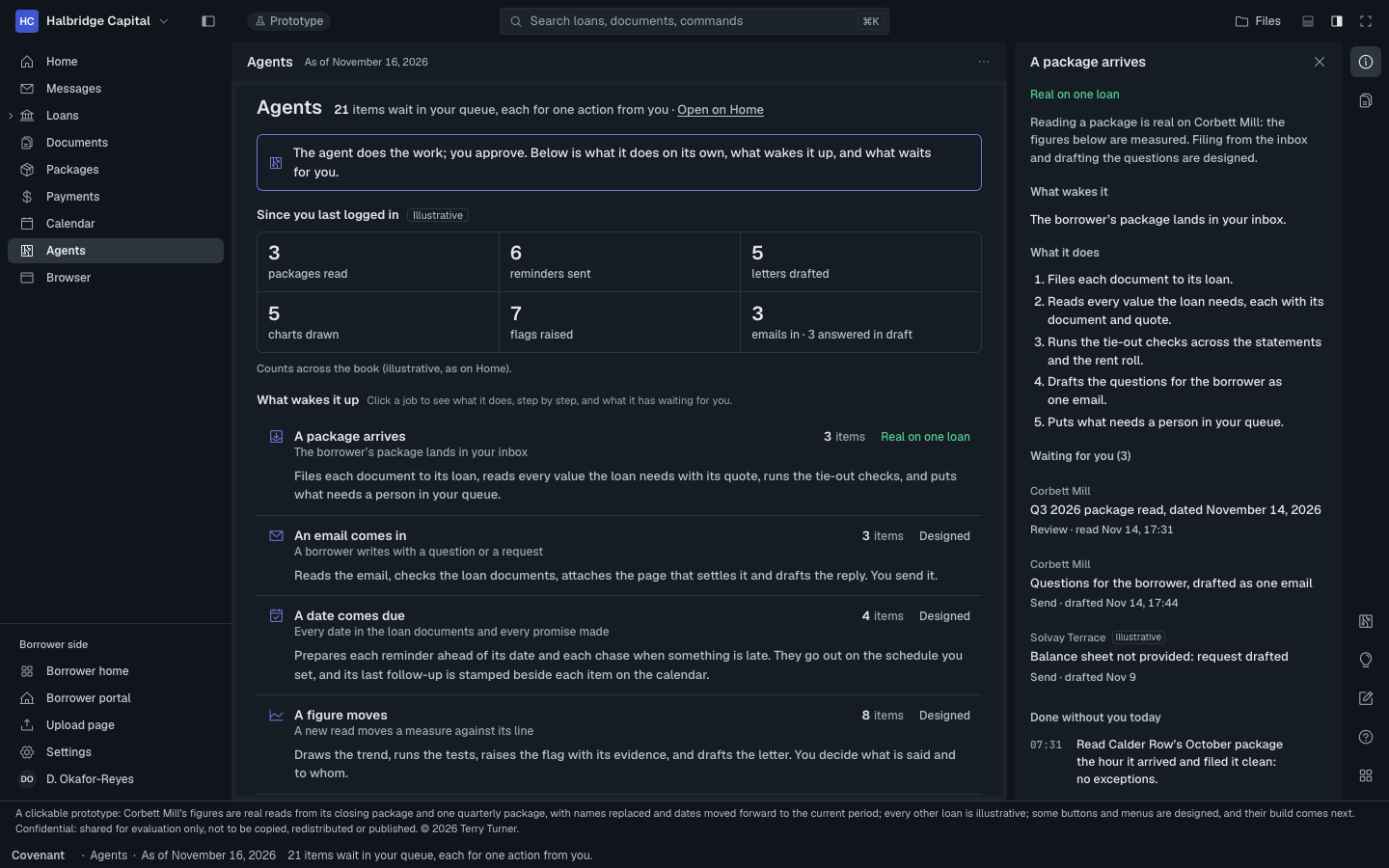
Each picture opens its screen. On every one the agent's work is already done and waits for one action from the servicer: approve, send or review. Status on every one: a clickable prototype; Corbett Mill's reads are real, the other loans are illustrative.
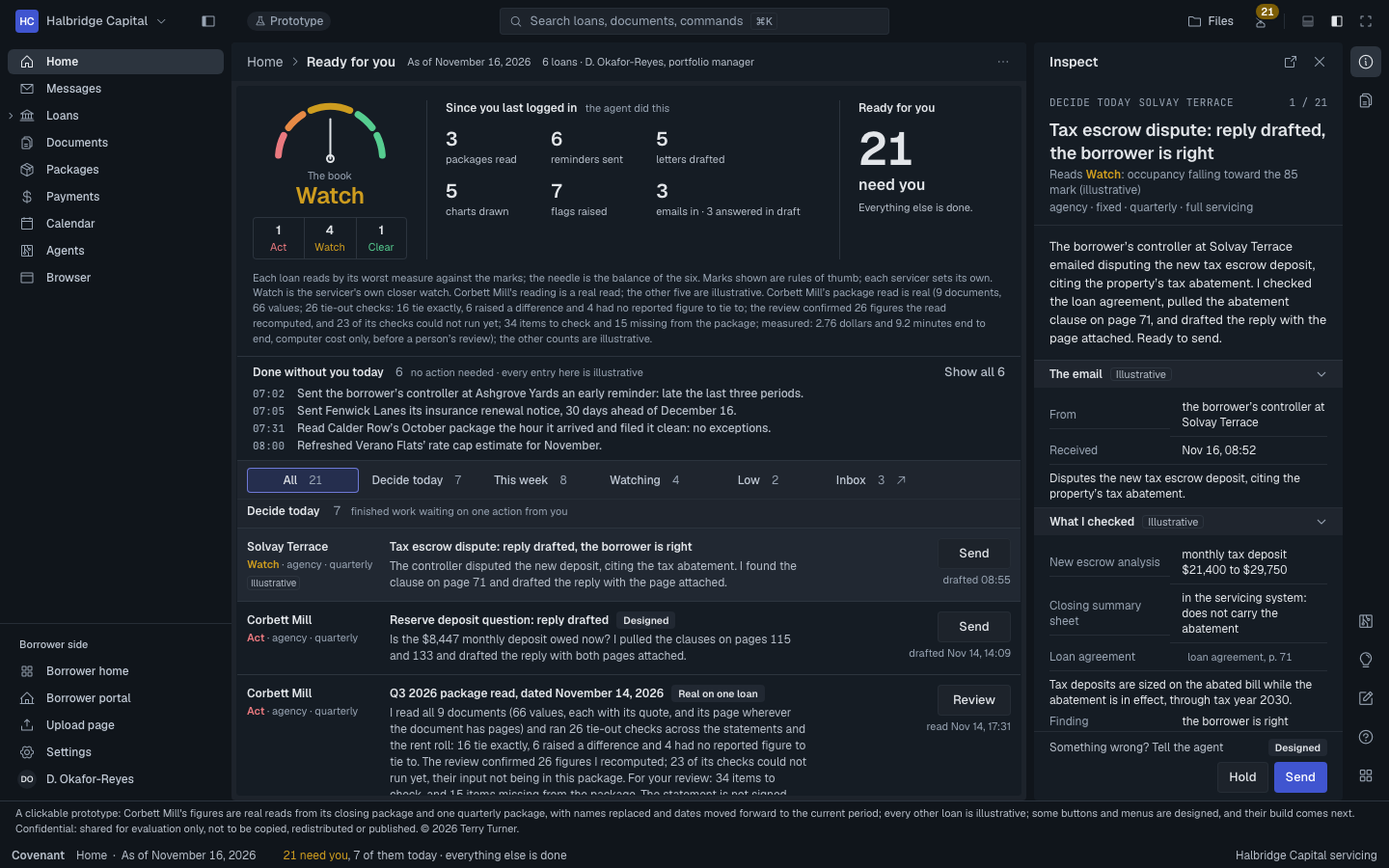
The morning listWork the agent finished since the last login, each waiting on one action. On Corbett Mill it drafted a letter: occupancy fell to 72.73%, short of the 85% line.
How it works: every row is one finished job with one action left: approve, send or review. The figures behind it are read with their sources, the tests run in code against the loan's own terms, and the letter is drafted from the record. Reminders the servicer has set up go out on schedule; nothing else leaves until the servicer acts.
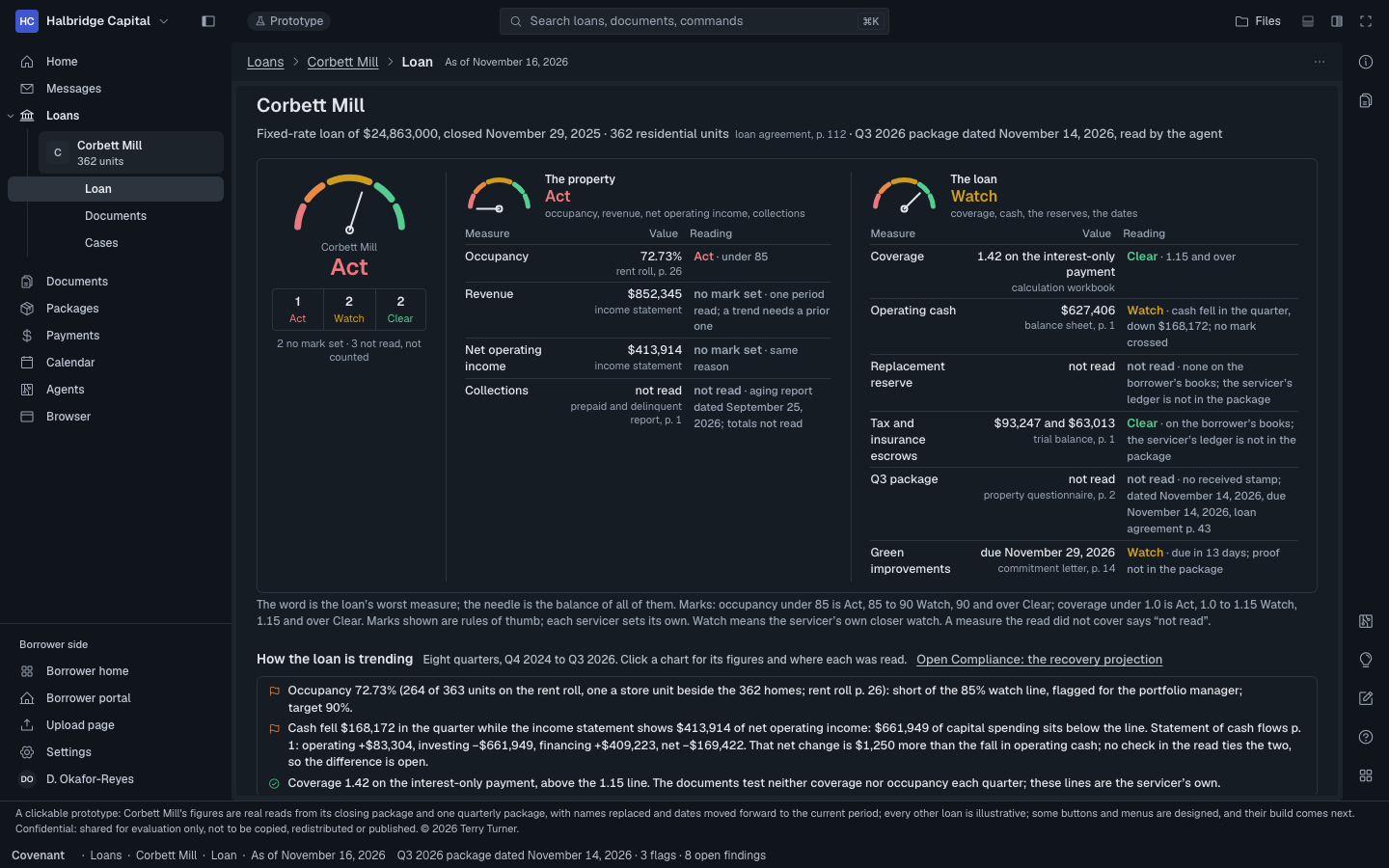
One loanCorbett Mill on one page, every figure with its source. It shows why cash fell $168,172 in a quarter with $413,914 of net operating income: $661,949 of capital spending sits below the line.
How it works: each figure was read from a document in the loan's file and shows the document it came from. The quarter's comparison is computed in code, and the agent writes the plain-words explanation from those figures.
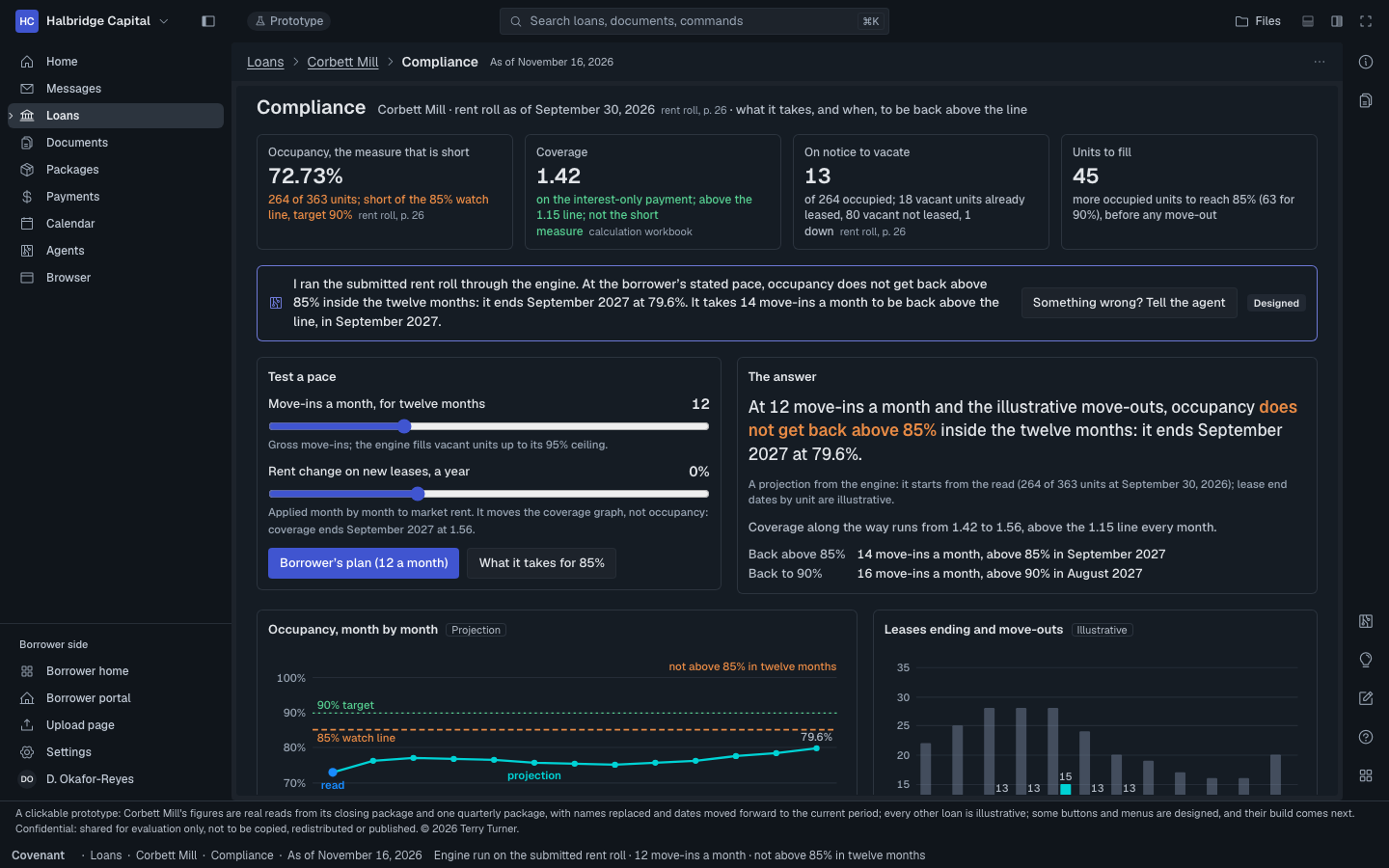
ComplianceThe agent runs Corbett Mill's rent roll through the engine. At the borrower's 12 move-ins a month and the illustrative move-outs, occupancy ends September 2027 at 79.6%; clearing the 85% line takes 14 a month.
How it works: the package's rent roll feeds the revenue engine, which projects twelve months of revenue by floor plan. Moving a slider runs it again, the borrower's own plan goes through the same engine, and the same inputs give the same answer every time.
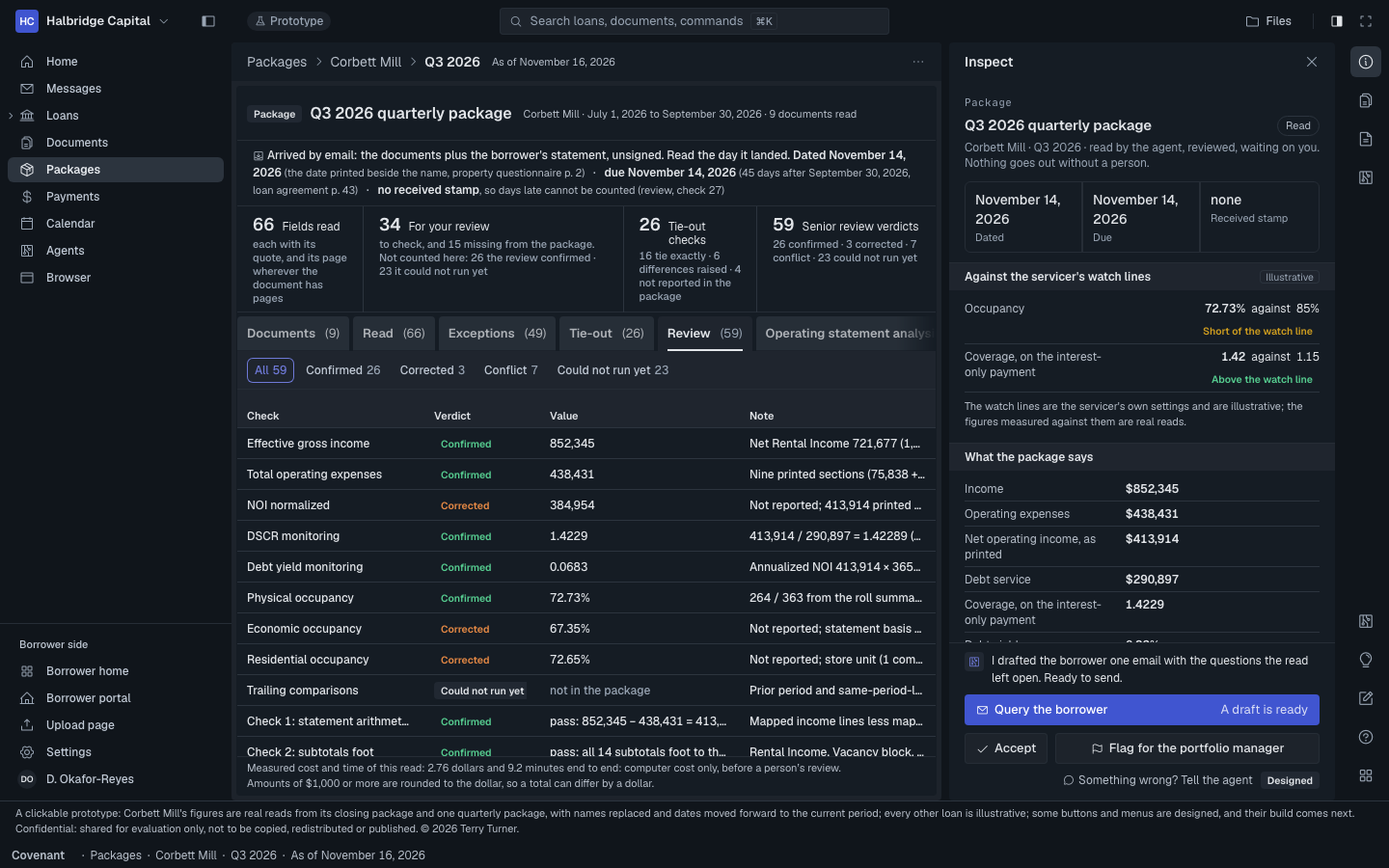
A package, readThe agent read Corbett Mill's nine quarterly documents in 9.2 minutes, each of the 66 values with its quote, and its page wherever the document has pages. It caught a $28,960 cable rebate left in reported income.
How it works: each document is read into typed values, each with its document and the quoted text. The tie-out checks then test the statements and the rent roll against each other. What disagrees is listed for the servicer, and a person approves each figure before it counts.
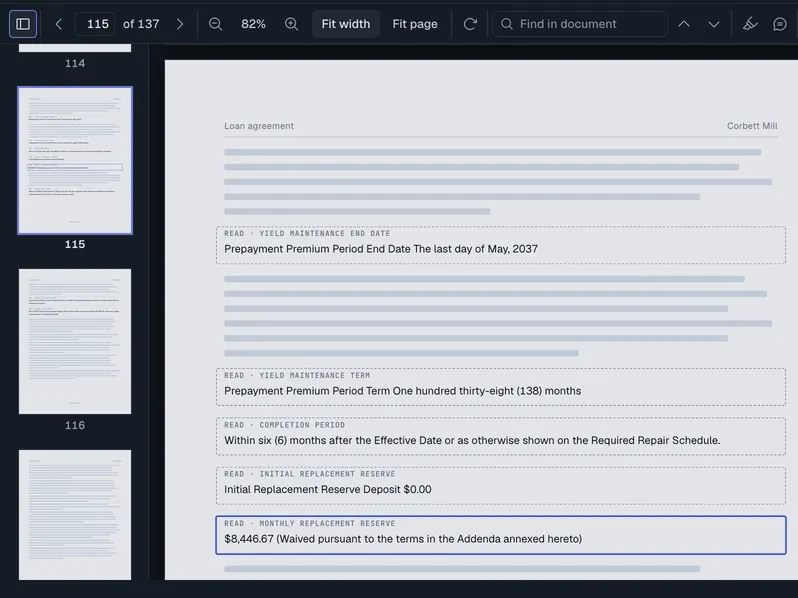
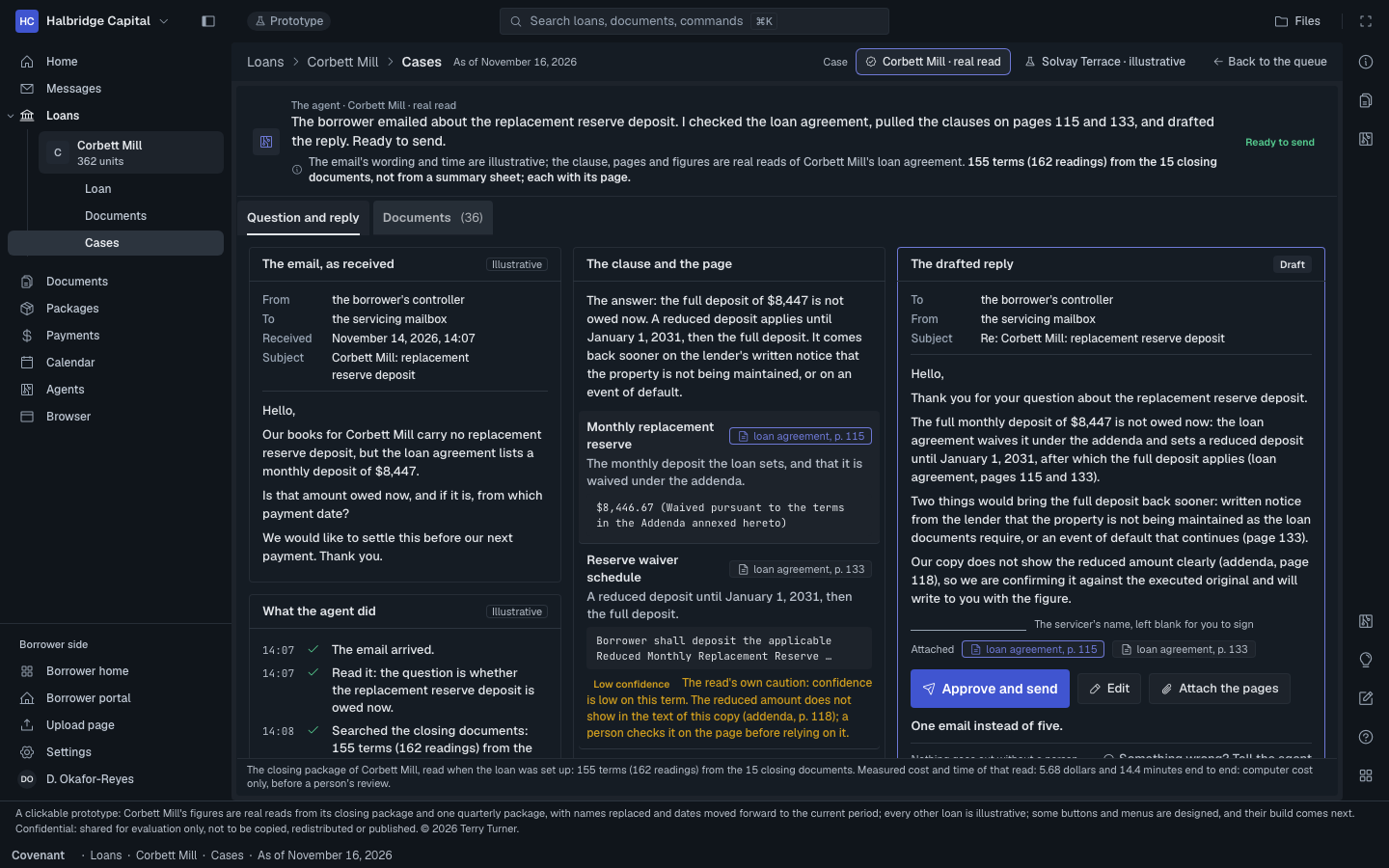
A question, answeredA borrower asks whether Corbett Mill's $8,446.67 monthly reserve deposit is owed now. The agent finds the answer on loan agreement pages 115 and 133 and drafts the reply.
How it works: the agent searches the loan's own closing documents, quotes the clause that settles the question and attaches its page. The reply waits as a draft. The servicer sends it, or tells the agent what to change.
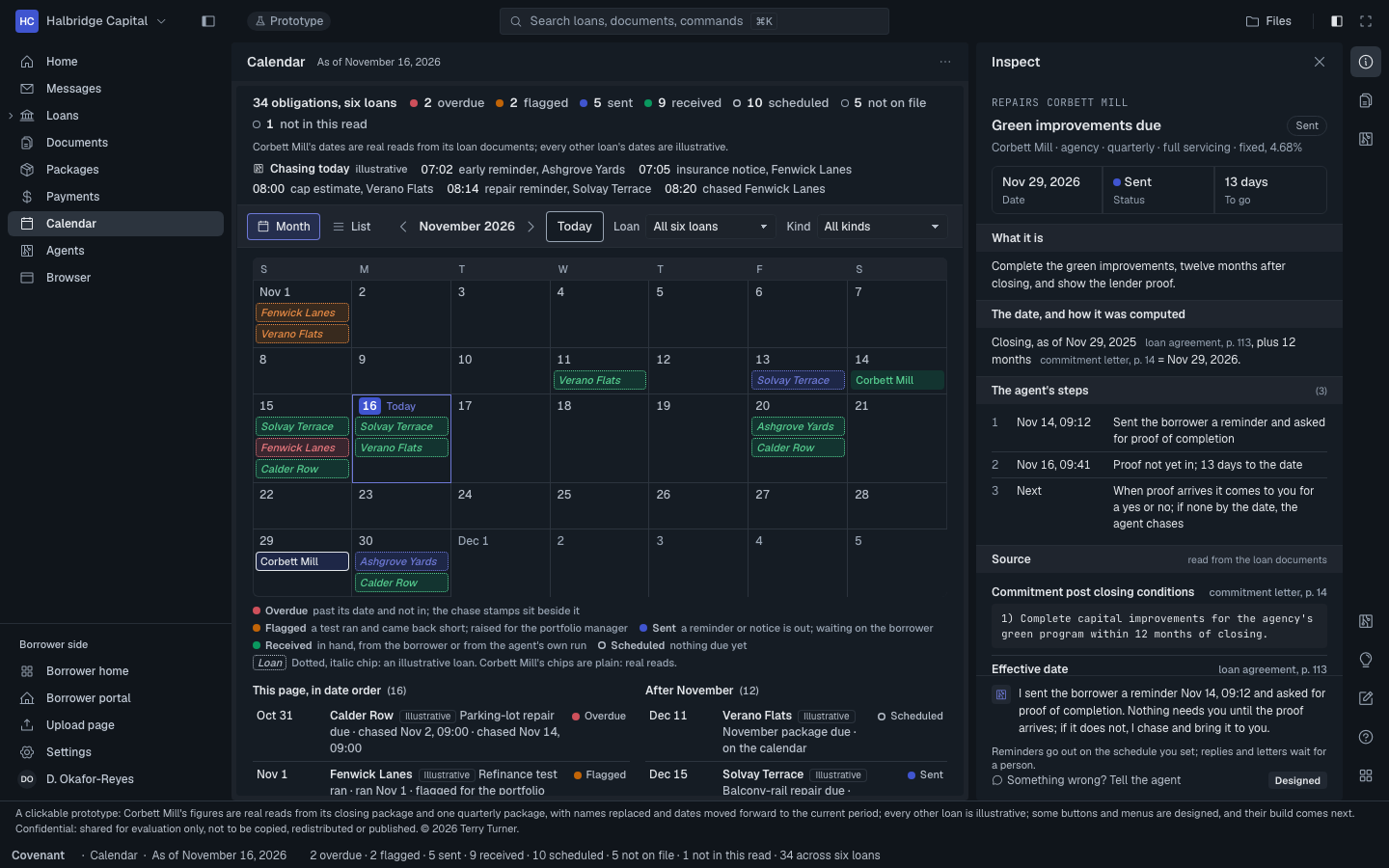
The calendarAll 34 dated obligations across six loans, each with its status, such as sent, received, scheduled, flagged or overdue. The agent sent Corbett Mill's green-improvements reminder November 14, ahead of the November 29 due date.
How it works: every date comes from a term read in the loan's documents or from a promise a person recorded, and code works out what is due and what is late. The agent prepares each reminder from the servicer's approved template. A reminder the servicer has set to go by itself, like the one shown, is designed.
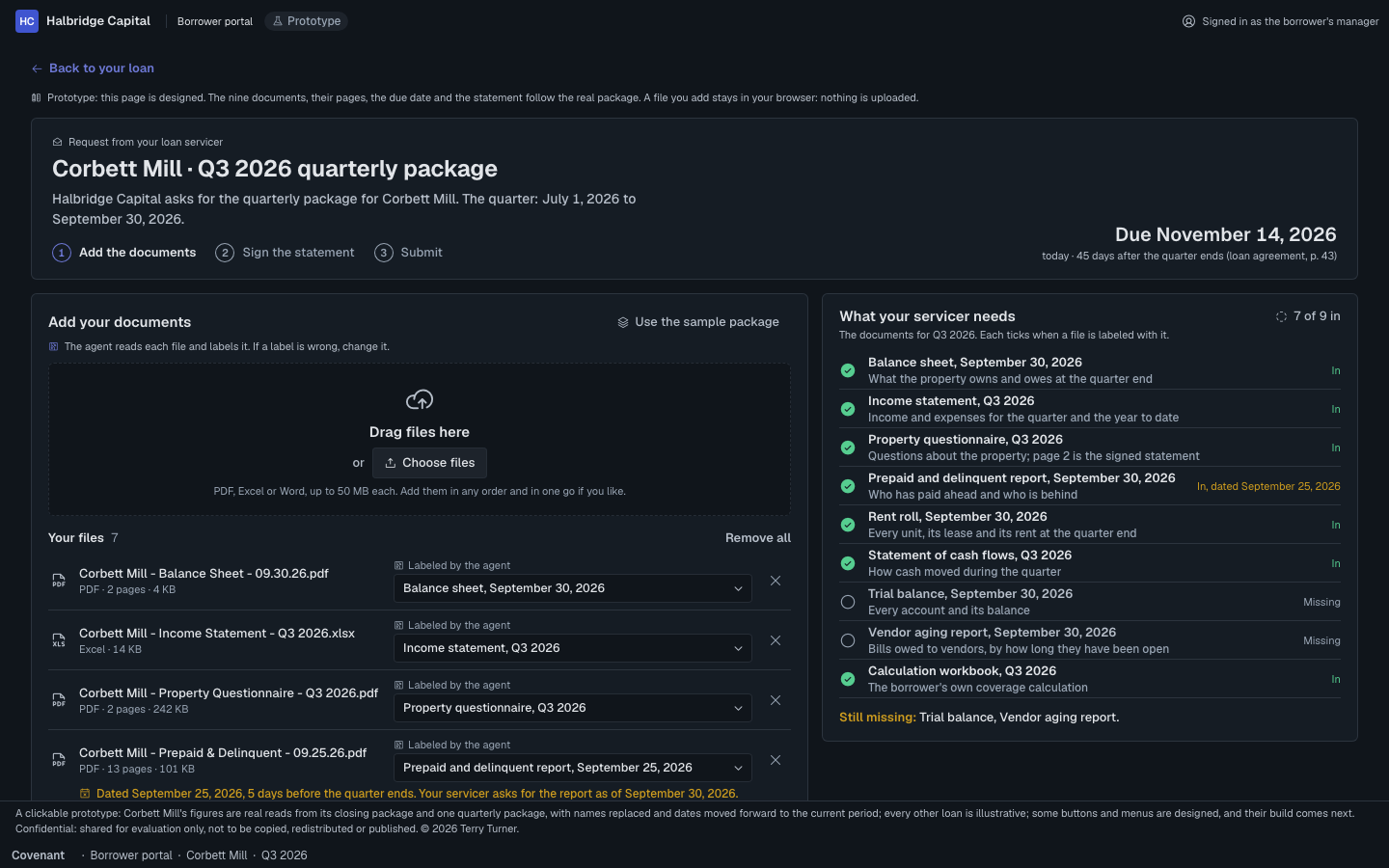
The borrower's upload pageThe borrower's side, designed, using the real package's files. The agent labels each file as it lands and names what is still missing, here the trial balance and the vendor aging report.
How it works: the servicer's request names the loan, the period and the documents owed, so an upload arrives already tied to its loan and period. The borrower signs one statement that the figures are true, and the read starts.
Rests on today (November 14, 2026): a prototype screen drawn with the real package's own file names. Labeling files as they land and taking in the signed statement are still to build.
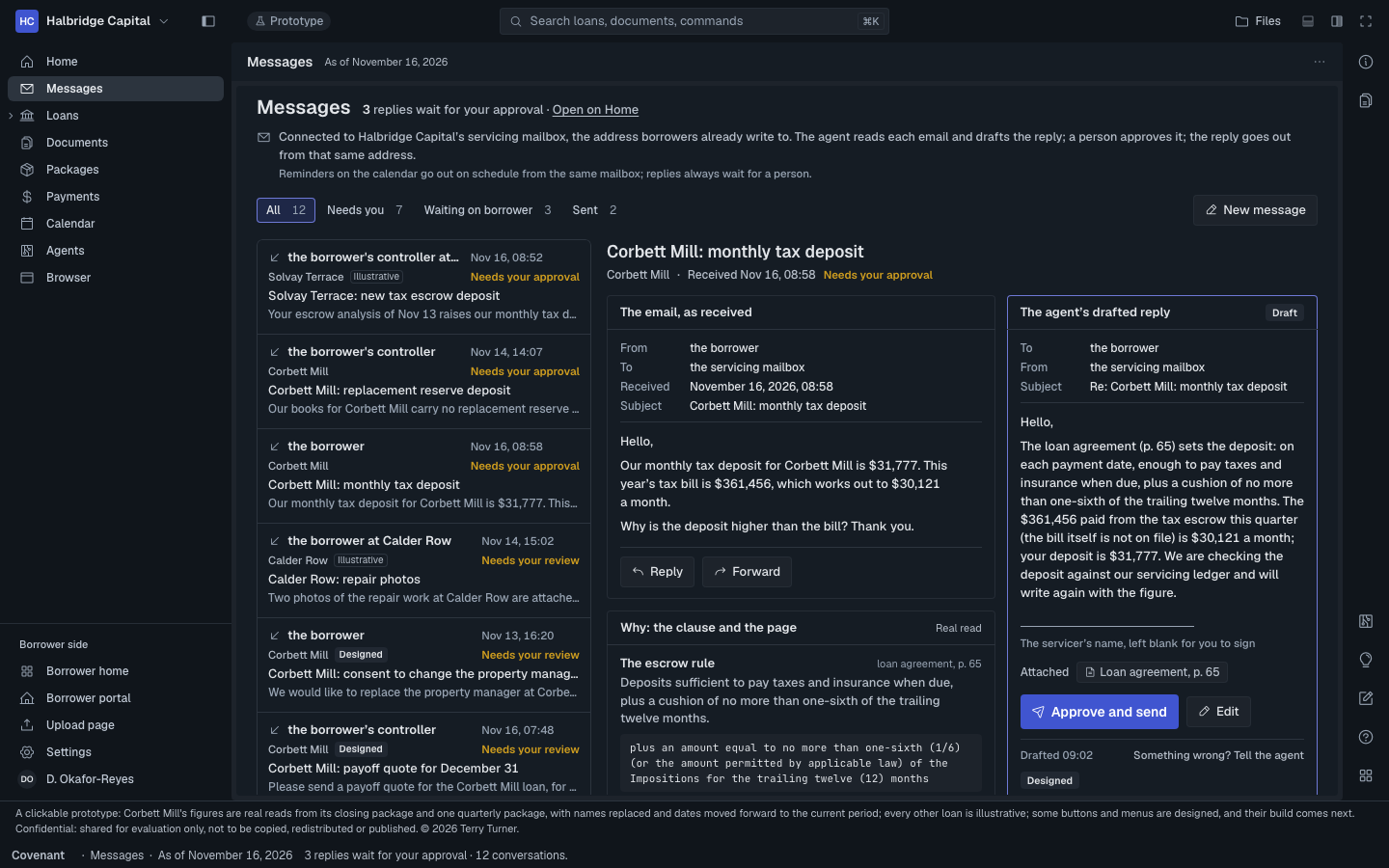
MessagesThree borrower emails wait with drafted replies. Corbett Mill's borrower asks why the $31,777 monthly tax deposit is above this year's bill, $30,121 a month; the reply attaches loan agreement page 65.
How it works: each email is read, the loan's documents are searched for the clause that settles it, and a reply is drafted with the page attached. Every reply waits for a person to send.
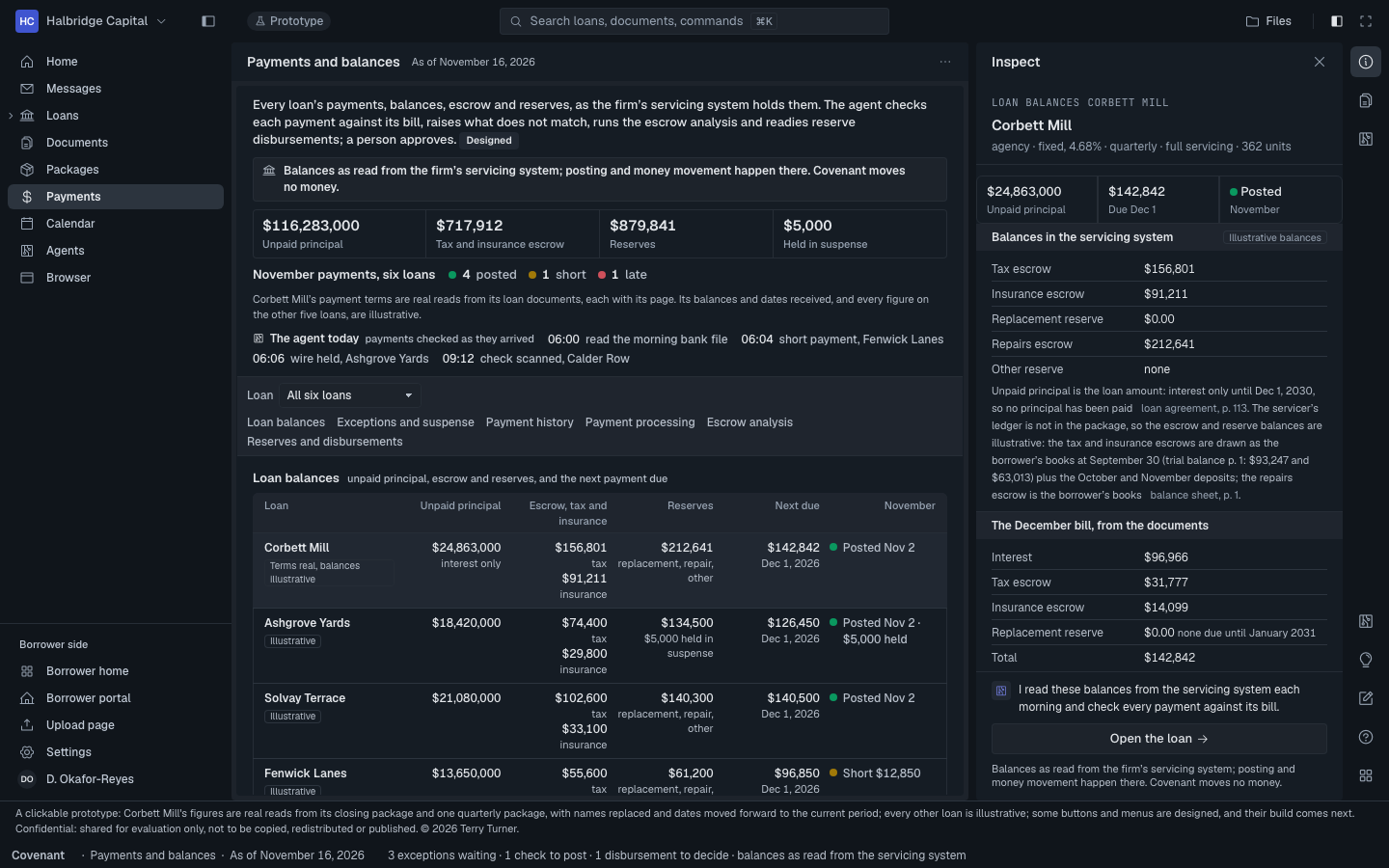
Payments and balancesThe agent checked November's payments on six loans against their bills and drafted a note for each of three exceptions: Fenwick Lanes short, Calder Row late, an Ashgrove Yards wire held.
How it works: Covenant reads payments and balances from the servicing system the firm already runs, and code checks each payment against its bill. The agent drafts a note on each exception. Covenant moves no money: the servicing system pays, after a person approves.
Rests on today (November 14, 2026): a prototype screen on illustrative payments. No servicing system is connected yet.
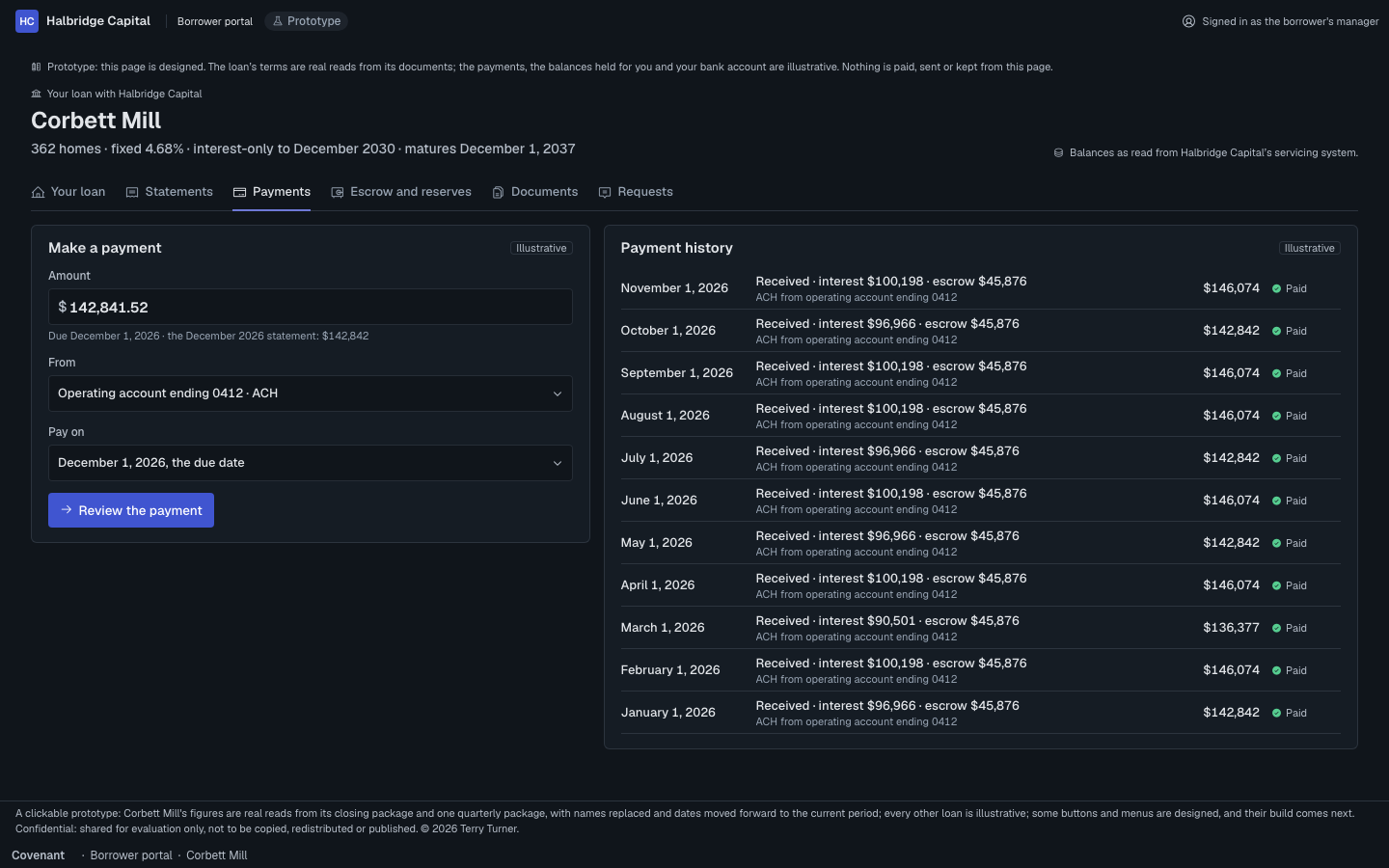
The borrower portalThe borrower's side of Corbett Mill, its payments and balances illustrative: the December statement of $142,842, each 2026 payment so far received by ACH within the grace period, escrow balances, documents and requests.
How it works: the borrower sees its own loan from the same record the servicer works from: statements, payments, escrow balances, documents and open requests. It is part of the servicer's app, and the borrower needs no other.
Three layers
An app, an agent, and work done before anyone asked.
1 · The app
An app that does its job.
Every loan, every package, every document and every date in one place, each figure tied to its source. A loan is read once, at setup: each term the servicer needs is recorded from the closing documents with its page, and every later package, question and request is read against those terms. On Corbett Mill that was 155 terms from 15 documents. Clickable prototype; the setup read is real on one loan.
2 · The agent, layered in
The work is done before the servicer logs in.
The agent reads each package as it lands and pins every figure to its quote. Code ties the figures to the statements' own totals and tests them against the loan's terms. The agent drafts the chase and the letter for a person to send. Keeping each correction the servicer makes is designed. Reading a package is real on one loan; the rest is a clickable prototype or designed.
3 · The part done unasked
Work done before anyone asked.
On Corbett Mill, cash fell $168,172 in a quarter with $413,914 of net operating income: $661,949 of capital spending sits below the line. The agent saw cash fall while profit held, put the two on one chart and drafted the question to the borrower. No one asked for it: a new read moved a figure, a test ran, and the finished work was waiting on the morning list. This part covers initiative, the analytics, and the email and messages that come through the app. Of the 32 things the agent does unasked, 12 rest on reading already done on one real loan; 20 are designed.
The showcase · clickable prototype · illustrative loan
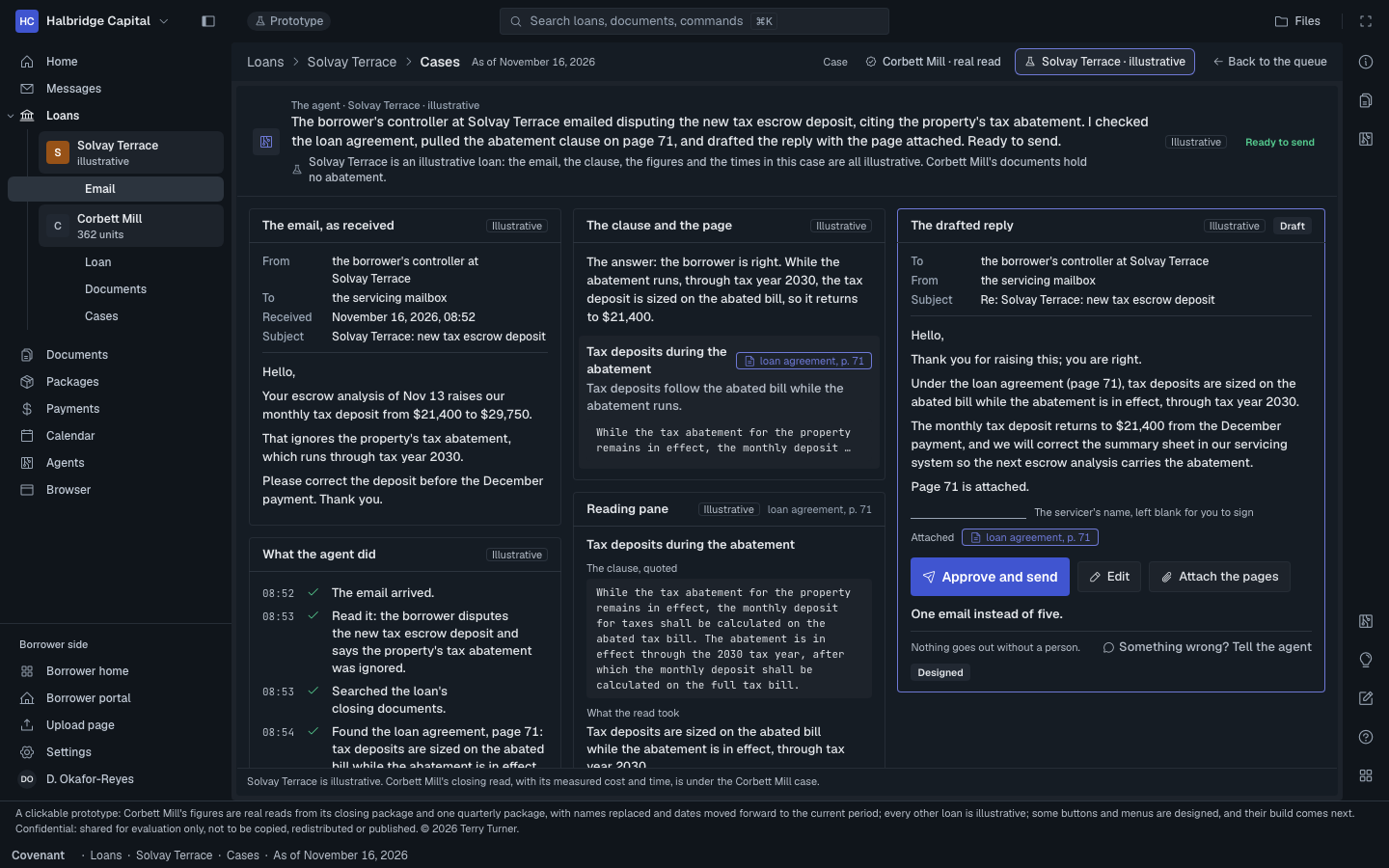
A borrower's controller emails to dispute the new tax escrow deposit, citing the property's tax abatement.
The agent read the email, checked the loan agreement, pulled the abatement clause with its page, and drafted the reply with the page attached. The clause is quoted in the reply and page 71 goes with it, so the borrower can check the answer. It sits on the morning list. The servicer sends it, or tells the agent what to change. No reply goes out without a person.
Why now
Why now.
Commercial real estate still runs on busy work. Skilled people spend their days collecting documents, retyping figures and reading packages, and the judgment they were hired for gets whatever time is left. A person can only read so much in a day. Packages wait their turn, and anything wrong inside them waits too.
The scale is large and growing. US commercial and apartment mortgage debt reached a record $5.1 trillion at June 30, 2026, and lenders made an estimated $706 billion of new commercial and apartment loans in 2025, 40 percent more than in 2024. Fannie Mae's apartment loans alone number 30,462 (September 30, 2026), and 85 firms report servicing books to the industry's trade association (December 31, 2025, self-reported). Every one of those loans was underwritten before it was made, and every one has a servicer: the borrower's financials have to be collected, read and checked against the loan's terms, on a schedule, for as long as the loan lives.
For years there was no way around it. Software stored the documents, and people still did the work. That changed in 2026. An agent can now carry a whole job between a person's decisions, bring in other agents for the parts it needs, and put the finished work in front of a person to approve. It reads everything that comes in, the day it comes in, and waits for approval. The person's part is the decision.
The technology is open to anyone. Knowing which work is busy work, and what a right answer looks like, comes from fifteen years across both sides of the deal: the investment side and the on-the-ground side. Covenant and Basis are both built on it.
People are this industry's biggest asset, and the aim is to put their time where value is created. Real estate is going to change this way. We intend to be at the front of it. Covenant is built for a servicer's book: every loan is read against its own documents, whoever made the loan (a clickable prototype, real on one loan). Basis does the same for a deal: it reads and ties every document, runs the firm's model on an engine that computes every number, and carries the deal from its arrival to the closing statement (a clickable prototype, with reading and tying real on one deal).
What changed in 2026
Two things, both on the model platform underneath, both in beta. Since May 6, 2026, an agent can hand parts of a job to other agents and get their work back. Since October 9, 2026, it can run many of them side by side. Read on November 14, 2026. The links are available on request.
What did not change is who decides. In both apps an agent's work is a proposal, the engine computes every number, and nothing is approved or released without a person. In Covenant, a reminder the servicer has set up goes out on schedule, and every reply and letter waits for a person to send it.
What it does · worked examples
Today, beside the agent.
Each "today" is how the servicing desk of a top-five servicer described its work to us in November 2026. Each "with the agent" says who does what: the agent reads and drafts, code computes and tests, reminders the servicer has set up go out on schedule, and a person approves or sends the rest. Each example carries its status: real on one loan, a clickable prototype, or designed.
The flagship
The trend, and the way back into compliance.
Today
The review starts when a package shows a loan below its occupancy or coverage line. The servicer asks the borrower for a plan, and the plan is filed.
With the agent
The history the app already reads (occupancy, revenue, cash, tenant delinquency, unpaid bills) is charted, and the loan is flagged while it is still heading toward the line. The flag comes from a test, not from a reading of the chart: when a person approves a package's figures, code compares them with the last period and with the line the loan's own documents set. Because the rent roll is in every package, the revenue engine, which projects twelve months of revenue by floor plan from one rent roll, runs inside Covenant: twelve months of sliders for move-ins and rent increases against trailing expenses show what it takes to get back into compliance and when, and test the borrower's own plan. "Twelve move-ins this month" either gets there or it does not. On Corbett Mill it does not: at 12 move-ins a month and the illustrative move-outs, occupancy ends September 2027 at 79.6%, and clearing the 85% line takes 14 a month. The lease move-outs sit beside it, month by month. The agent drafts the letter from the engine's figures, and the servicer decides what is said and to whom.
Clickable prototype on one loan's real rent roll and quarter. Earlier quarters on the charts are illustrative; the real read covers one quarter today.
Occupancy under about 85 percent gets an email and closer watching; coverage under about 1.15 gets questions; near 1.0 the loan heads for the agency's watchlist. Each check is made at the threshold, one quarter at a time.
With the agent
Occupancy and cash are charted quarter over quarter from the packages already read, and the hand goes up at the trend, not the threshold. Each point on the chart is a figure a person approved, and it opens the package page it came from. Code compares each new quarter with the last and with the servicer's own lines, and a loan heading for its line is raised with the chart as its evidence. The servicer decides what the borrower is asked.
Designed. The single-quarter reading is real on one loan; the trend begins with the second quarter.
Rests on today (November 14, 2026): one quarter of Corbett Mill, read with its sources. The second quarter's read and the comparison across quarters are still to build.
The payment cliff, twelve months out.
Today
When a loan switches from interest-only to full payments, the borrower gets a heads-up about six months before.
With the agent
The date the payments step up, and the new payment, are read from the loan's own documents at setup, each with its page. A year before the step, code tests the bigger payment against the property's trailing income, and the loans that will not cover it are listed for the servicer, each with its figures. The agent drafts the heads-up to the borrower, and a person sends it.
The dates and payments are read on one loan; the test is designed.
Rests on today (November 14, 2026): the payment step and its date, read at setup on one loan. The test is still to build.
The refinance test, eighteen months before maturity.
Today
The borrower gets a heads-up about six months before maturity.
With the agent
The maturity date is read from the loan's documents at setup. Eighteen months before it, the refinance is run at today's rates, loan by loan: the engine tests whether the property's trailing income would carry a new loan large enough to pay off the balance at maturity, and the ones that will not clear are named, each with its shortfall. The rate used and the day it was read print beside each result. The servicer decides which borrowers hear first.
Designed.
Rests on today (November 14, 2026): the maturity date, read at setup on one loan. The test is still to build.
The loan whose lender has no servicing desk.
Today
For CMBS lenders, debt funds and life companies, the servicer collects the financials, reads them once and raises a hand if something triggers. The lender hears when that hand goes up.
With the agent
Every package is analyzed the day it lands, on every loan in the book, so the first read no longer waits its turn. Code runs the loan's tests on the figures a person approved, and a result past the line raises the flag with its evidence. The servicer decides what the lender is told, and the lender hears the day the figures say so.
Designed.
Rests on today (November 14, 2026): one package read the day it was handed over, on one loan. Reading at the scale of a book, and the tests, are still to build.
Every package, read the day it lands.
Today
Packages arrive faster than people can read them, so they wait in a queue, and some go unread.
With the agent
Every package is read and checked on arrival. Each document is read into typed values, each with its quote, and the tie-out checks test the statements and the rent roll against each other. The analyst sees the exceptions and approves each figure before it counts. On Corbett Mill that was nine documents, 66 values and 26 tie-out lines in 9.2 minutes, for $2.76 of computer cost.
Real on one loan: one quarterly package read, nine documents, every value with its quote. The inbox step is designed.
The escrow and rate-cap question, answered in minutes.
Today
Answers on insurance, tax escrows and rate caps take time; insurance renewal dates slip on both the servicer's side and the sponsor's; the rate-cap escrow is recalculated by a third party every six months.
With the agent
Escrow and cap questions are answered from the loan's own terms the moment they are asked: the agent finds the clause in the closing documents, quotes it, attaches the page and drafts the reply, and a person sends it. Renewal dates and cap resets sit on one calendar built from the loan's confirmed terms, and the reminder for each is prepared ahead of its date. On a loan with a rate cap, the estimate is recalculated in code every month from the loan's own terms and shown beside the current six-month deposit, so a deposit that has drifted shows before the next six-month reset, not after.
The loan's terms are read with their pages on one loan; the drafted reply is in the clickable prototype. The monthly cap estimate comes with the first loan that has a cap.
The borrower's pattern.
Today
Each package is reviewed within its own quarter.
With the agent
It knows who is late three quarters of four, who always sends the rent roll last and who fails the same check every time. Each of those is a count over the calendar's own time stamps and the record of past checks, computed in code, not a note the agent keeps. So the next request is prepared earlier and names what went wrong last time, and a person sends it.
Designed.
Rests on today (November 14, 2026): the calendar and its time stamps in the prototype, on illustrative loans. The counts are still to build.
The quarter's bills in one view.
Today
Coverage is measured on trailing income, so a loan looks fine in the same quarter that a roof, the insurance renewal and the tax bill all land.
With the agent
Every bill landing on a loan this quarter, with amounts and dates, sits beside the cash on hand. Each amount and date is read from a document in the loan's file and opens its page, and code totals the quarter against the cash on the latest balance sheet. The servicer sees the squeeze in the quarter it lands, while coverage on trailing income still looks fine.
Clickable prototype, on an illustrative loan.
The request that arrives decision-ready.
Today
A reserve draw or a waiver request starts a five-email chain.
With the agent
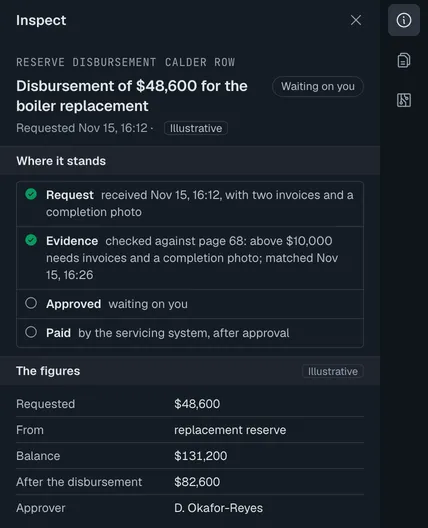
The servicer gets the governing loan-document page, the borrower's evidence, the math, the options and the right approver in one packet. The agent matches each invoice to the request and finds the page that governs it. Code does the reserve math against the balance in the servicing system. A person approves, yes or no, and the servicing system pays. Covenant holds no tool that moves money.
Designed. The prototype shows a reserve draw approval on an illustrative loan.
Rests on today (November 14, 2026): a prototype screen of one reserve draw on an illustrative loan. Matching invoices and the reserve math are still to build, and no servicing system is connected.
Repairs chased to the deadline. A person signs off.
Today
The inspection report lists the required repairs, and photos are the proof.
With the agent
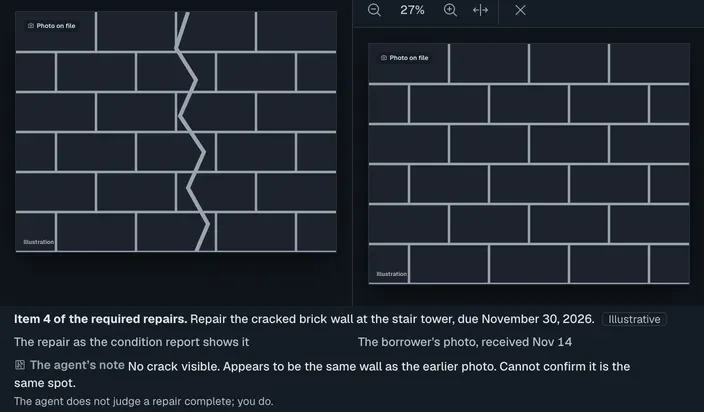
Every required repair on every loan sits on one calendar, taken from the inspection report. The agent prepares the reminder ahead of each date and the chase for each late one, and they go out on the schedule the servicer has set up. When a photo or a contractor's invoice arrives, the agent says which repair it appears to belong to, flags a photo that does not appear to match a repair, and flags one where the problem still looks unrepaired. For each photo it writes down what is visible, where, and what it could not confirm. It never judges completeness from the number of photos. The person ticks yes or no, always.
"No crack visible. Appears to be the same wall as the earlier photo. Cannot confirm it is the same spot."
Clickable prototype, on an illustrative loan, with a drawn illustration in place of the photos.
What changed in 2026
Agents that carry a job between a person's decisions.
Since May 2026 an agent can hand parts of a job to other agents and get their work back, and since October 2026 it can run many of them side by side. Both are in beta on the model platform underneath. The dates and links are available on request. The agent takes the job and hands out the parts: one reads the package, one drafts the reply, one draws the chart, and each reports back. When a session nears the end of what it can hold, a fresh one picks the work up from the record, so the work keeps moving through the day and a person sees the decisions. Covenant is designed to work this way. Our own build works this way today, with a person starting each fresh session. Inside Covenant, reading a package is real on one loan, and the rest is designed.
The underlying technology is available to anyone. What we add is knowing which work is busy work and what a right answer looks like: the rules from fifteen years of deals, each loan's own terms read once from its closing documents, the source behind every figure, and the history each package adds to its loan.
What Covenant's agent does between the servicer's decisions.
Read.Each document in a package is read, and every value is recorded with its quote.
Tie.Code adds up what was read and tests it against the statements' own totals. A figure that does not tie is held and named, never smoothed.
Test.Code runs each figure against the loan's own terms, which were read once from its closing documents, each with its page.
Draft.One agent holds the loan's thread and writes from the record: the questions, the reply, the letter.
Check.A second agent that saw none of the drafting reads the finished work against the record.
Wait.Everything sits in the servicer's queue for one action: approve, send or review.
Carry on.The loan's record holds every term, value, letter and decision, so a fresh agent picks up any loan where the last one stopped, quarter after quarter.
Reading a package: real on one loan. The rest: designed.
How Covenant is run
Covenant is run as a governed work system for a servicer's whole book. Every step on a loan belongs to one of three actors. The agent reads, ties, chases and drafts, and what it produces is a proposal. The engine computes every figure and every test in typed code, the same way every time. A person approves each figure before it counts, sends each letter, and decides what a lender or an agency is told.
A loan is read once, then watched for years. At setup the agent reads the loan's closing documents and records each term with its page: the rate, the maturity, the reserve and escrow rules, and every date on which the borrower owes something. From then on, every package, email and request on that loan is read against those terms.
The work starts when something happens. A package arrives, an email comes in, a date comes due, a figure moves, a draw or a repair comes in. Each starts a job. Readers take the documents side by side. Code ties what they read to the statements' own totals and tests it against the loan's own terms. One agent holds the loan's thread and drafts the questions, the reply or the letter from the record. A second agent that saw none of the drafting reviews the finished work. Then it waits in the servicer's queue for one action.
Nothing depends on what an agent remembers. A loan's record holds every term with its page, every value with its quote, every check, every letter, and every decision with a name and a time. A fresh agent can pick up any loan from its record, so a book of thousands of loans does not rest on a long session.
It improves with use, under the servicer's control. The servicer's team sets the lines, the letters and the checks. A change the team makes to one loan is kept as a setting on that loan. A change to how a figure is read becomes a rule after it is tested on past packages and a person approves it. No model is trained on a servicer's files.
Reading a loan's closing documents and one quarterly package is real on one loan, with its time and cost measured. The queue, the letters and the screens are a clickable prototype. The work the agent starts unasked is designed.
The two platform capabilities this rests on are dated May 6, 2026 and October 9, 2026, both in beta, as read on November 14, 2026. Links are available on request.
The lists
What it watches, and what it does unasked.
62measures the borrower's quarterly package can support, grouped by what they watch
The analytics · the twelve that lead
Cash, period over period, flagged when the balance sheet is missing
Coverage, with its marks
Occupancy, with its marks
The recovery projection, with the borrower's plan scored
Revenue
Profit against cash, on one chart
Lease expirations and move-outs, by month
Capital spending beside the replacement reserve
Unpaid bills, by age
Tenant delinquency, by age
The quarter's bills
The payment step and the maturity countdown, each with its test
Net operating income is charted too. Every measure is computed in code from figures read with their sources and approved by a person. Single-quarter readings are real on one loan; trends begin with the second quarter.
32things the agent does unasked, each written the way it sits in the servicer's queue
What wakes itWhat it doesLeft for a person
A package arrives
Files each document, reads every value with its quote, and runs the tie-out checks.
Left for a person: Review
An email comes in
Reads it, checks the loan documents, attaches the page that settles it and drafts the reply.
The tax email answered, with the loan page attached.
Left for a person: Send
A date comes due
Prepares each reminder ahead of its date and each chase when something is late. They go out on the schedule the servicer has set up, and each follow-up is stamped on the calendar.
The late package chased, with its time stamps.
Left for a person: Schedule
A figure moves
Draws the trend, runs the tests, raises the flag with its evidence, and drafts the letter.
The occupancy letter the team writes today, already drafted.
Cash falling while profit holds, put on one chart.
The borrower's recovery plan, tested.
Left for a person: Send
A draw or a repair comes in
Matches each invoice and photo to its request, does the reserve math, and lays out the decision.
Left for a person: Approve
The servicer corrects it
Keeps the change as a setting on that loan and follows it from then on. A change to how a figure is read becomes a rule after it is tested on past packages and a person approves it.
Of the 32, 12 rest on reading already done on one real loan; 20 are designed.
The six jobs above, one at a time: what the agent does in order, what it never does, and what is left for a person.
What wakes it
What the agent does, in order
What it never does
Left for a person
Status
A package arrives
Files each document to its loan. Reads every value the loan needs, each with its document and quote. Runs the tie-out checks across the statements and the rent roll. Drafts the questions for the borrower as one email. Puts what needs a person in the queue.
Change a figure so a check ties. Return a corrected figure where the page prints a wrong one. Keep a value with no quote. Let its own confidence clear a value.
Reviews the read. Approves each figure before it counts. Sends the questions.
Real on one loan for the read. Filing from the inbox and drafting the questions: designed.
An email comes in
Reads the email and what it asks. Searches the closing documents for the clause that settles it. Attaches the page. Drafts the reply and puts it in the queue.
Send. Answer from memory where the documents are silent. Act on an instruction written inside the email. Reply to an address that is not the loan's confirmed contact.
Sends the reply, or tells the agent what to change.
Designed. The clauses and pages on Corbett Mill's replies are real reads.
A date comes due
Keeps every date from the loan documents and every promised delivery on one calendar. Prepares the reminder ahead of each date. Prepares the chase for what is late. Stamps each follow-up beside its item.
Send to an address no person has confirmed. Write a first notice of default. Change a date. Mark an item received with no document behind it.
Sets the schedule the reminders and chases go out on.
Designed.
A figure moves
Compares each new read with the last and with the servicer's lines. Draws the chart. Presents the tests the loan needs, each run in code: coverage, refinance, payment step, rate cap. Raises the flag with its evidence and drafts the letter.
Raise a flag from its own reading of a figure. Put a loan on an agency's watchlist. State a default. Put a number in a letter that the record or the engine does not hold.
Decides what is said and to whom. Sends the letter. Makes the call on what the agency is told.
Designed. The single-quarter reading is real on one loan.
A draw or a repair comes in
Matches each invoice and photo to the request and the required repair. Flags anything that does not appear to match. The math against the reserve balance is done in code. Queues it for a yes or no.
Judge a repair complete. Judge completeness from the number of photos. Approve or pay a draw.
Ticks yes or no on each repair. Approves or declines the draw. The servicing system pays.
Designed.
The servicer corrects it
Records what was changed and on which loan. Follows that setting from then on. Where the same correction to a reading repeats, proposes a rule and shows what it would have changed on past packages.
Change a rule by itself. Carry one servicer's settings to another. Apply a correction from one loan to another loan without a rule.
Makes each setting. Approves each rule.
Designed.
Two rules hold in every row. Text inside a document, an email or a photo is data, never an instruction: the agent that reads it holds no tool that can send, approve or change a setting. And the agent does no arithmetic that is kept: a figure in a letter comes from the loan's record or from an engine run.
Covenant replaces the inbox, the hand entry, the spreadsheets and the watching of every loan. It sits beside the servicing system the firm already runs: it reads that system's balances, shows every payment and how it was applied, raises the exceptions, and is designed to write each approval back. The money and the books stay in that system, so a servicer can switch Covenant on without moving a single loan. Covenant holds no tool that posts or moves money, so the worst a wrong read can do is put a wrong note in a queue.
Clickable prototype on illustrative payments; the connection to a servicing system and the write-back are designed.
Rests on today (November 14, 2026): the Payments screen of the prototype, on illustrative payments. No servicing system is connected yet.
Built once, set per lender
Each loan's rules are read from its own loan documents, each with its page, and a person confirms them before any test runs against them. The servicer's team makes the rest its own: the level at which a loan gets a question or a flag, a watch line for one kind of loan, its own letter for a late package, its own chart on the loan screen. Nothing the team builds changes a live loan until it is approved, and every change keeps its history. The same build serves every lender. The first version covers primary and master servicing; workouts, foreclosure and property the lender has taken back stay with the special servicer.
Reading the rules is real on one loan today; everything the team sets or builds, and its approval, is designed.
The servicer's workbench. Designed. The servicer's team builds its own checks, its own letters and its own views of the book, and the agent runs them on every loan from then on. A new check is replayed on past packages before it goes live, so the team sees what it would have changed.
Rests on today (November 14, 2026): each loan's rules read from its own documents, real on one loan. The workbench is not yet a screen in the prototype.
The borrower's upload page
The borrower gets a simple page from the servicer, drops in the few documents required, signs one statement that the figures are true, the same statement borrowers sign with their package today, and is done. The servicer's request names the loan, the period and the documents owed, so the upload arrives already tied to its loan and period. The agent labels each file as it lands and names what is still missing. Covenant does the rest. The borrower needs no other app.
Rests on today (November 14, 2026): a prototype screen drawn with the real package's own file names. Labeling files as they land and taking in the signed statement are still to build.
The numbers
Tied to the source. Timed to the minute.
People cannot read everything that comes in, and they cannot read it the day it lands. The agent reads every package the moment it arrives, does the work and waits for a person to approve it.
9.2 minOne quarterly package read end to end: nine documents, 66 values, 26 tie-out lines, 34 items raised to check and 15 named as missing
$2.76Its computer cost
14.4 minThe loan's closing documents, 15 documents, made ready to answer any question
$5.68Its computer cost
155Loan terms read at setup, such as the rate, the maturity date and the escrow rules, each with its page
5 of 5Basis, on Bexley: the rent roll's printed totals, tied to the cent across 301 units. The operating statement ties to within $1 on the year. See the run
9.7 minBasis, on Bexley: two documents, 26 pages, read, tied and run through the underwriting engine.
Each package is a task of its own, so packages are read side by side, not one after another, and the last package of the quarter is read the day it lands, like every other. Measured on one package today; reading at the scale of a book is designed. A person's review comes on top, and that review is what we will time: the saving is measured against a servicer's own team, on its own packages, and printed then.
The industry's own clocks say the same. Freddie Mac's guidance for its bond deals expects a loan's latest financial results to reach investors about a month after the borrower sends them, and the bond market's trade group reported in July 2026 that those investors "continue to seek more timely, transparent, and consistent reporting".
Every value carries its quote, every package is tied out (26 tie-out lines on that package), and a disagreement is raised, never smoothed. A person approves each figure before it counts.
Computer cost only, before a person's review. Measured in November 2026 on one real loan's documents, and for Basis on one real deal's. A second real loan and a second real deal have been read since; their figures are in the measured reads below. The source is each run's own record.
The measured reads
Three reads of one real loan, Corbett Mill, measured in November 2026. Names are replaced and dates are moved forward to the current period. Computer cost only, before a person's review.
The loan's closing documents
One quarterly package
One past package
The priced job it stands behind
Setting up a loan
Reading each new package
Entering its past packages
Documents
15 documents
Nine documents: 50 pages and two workbooks
Nine documents
Read
155 terms, each with its page (162 readings)
66 values, each with its quote
14 values
Tie-out lines
21
26
5
Clock, end to end
14.4 minutes
9.2 minutes
4.6 minutes
Computer cost
$5.68
$2.76
$1.45
Status
Real on one loan
Real on one loan
One read measured. At the scale of a book: designed.
One loan stands behind every number in the table. None is a cost per loan across a book.
Bexley, November 10, 2026
Documents
2 (a rent roll, 23 pages, 301 units; an operating statement, 3 pages)
Ties
all 5 printed totals on the rent roll, to the cent; the statement's net operating income to within $1 on the year
Unit rows
301 of 301 agree on status, market and rent; 300 of 301 on square feet
Clock
9 minutes 44 seconds end to end
Computer cost
$1.73
Status
Real on one deal
A second real loan and a second real deal have been read since, both before a person's review. The loan: 117 terms from 15 closing documents, then one quarterly package in 8.4 minutes for $2.66 of computer cost. The deal, Stonemill Row: a rent roll of 30 pages and 248 units, 17 of 17 checks tied to the cent, in 7.4 minutes for $1.31 of computer cost. Neither is on the screens yet.
Accuracy: pending. No accuracy figure prints until a second loan is read cold and scored against a hand read, with its rows named.
The source is each run's own record.
The business
Any servicer can adopt it.
Every commercial real estate loan in America has a servicer, whoever made it: a bank, an agency, an insurer, a bond deal or a fund. Fannie Mae alone guarantees 30,462 apartment loans (September 30, 2026) and HUD insures 11,555 more (September 1, 2026), while one of the largest servicers reports 18,857 US commercial and apartment loans and 85 firms report servicing books to the industry's trade association (December 31, 2025). Each of those loans needs its borrower's financials collected, read and checked against its terms, on a schedule.
The schedule is written into the agencies' own rules. For a standard Fannie Mae apartment loan over $6 million, the servicer files the property's operating statements within 75 days after the second and third quarters and every year by June 1, and writes a comment on any loan whose income, expenses, capital spending or debt coverage moves 20 percent or more in a year. Freddie Mac requires a report every month on which of its portfolio apartment loans meet the industry's watchlist criteria. HUD-insured properties file within 90 days of their year end. Three calendars, and on every one of them the reading is done by people.
Not every lender has a servicing desk. Lenders such as bond-deal shops and debt funds hire an outside servicer to collect and read their borrowers' financials and to raise a hand when something looks wrong. For those lenders, the servicer's first read is the early warning.
New servicers keep entering. The number of servicers seeking a public rating rose from six to 10 in 18 months, with up to eight more expected in 2026, and some investors are building their own servicing arms (CRE Finance Council, July 2026). A new desk has no old system to leave, and it has to work on day one.
For scale: all US commercial and multifamily mortgage debt outstanding was $5.1 trillion at June 30, 2026, every loan of it with a servicer. That is all debt outstanding, shown for scale rather than as our market or our revenue. By holder: banks 38 percent, the agencies and their bond pools 23 percent, life insurers 15 percent, bond deals 13 percent.
Sources: the Mortgage Bankers Association's debt release of September 29, 2026, its annual lending report of April 28, 2026, and its servicer rankings for year-end 2025 (the servicer figures are self-reported, and a loan is counted once for each servicer role it has, so books are never added across firms); Fannie Mae's Form 10-Q for the third quarter of 2026; HUD's FHA commercial portfolio report for August 2026; Fannie Mae's Multifamily Selling and Servicing Guide (effective October 26, 2026); Freddie Mac's Multifamily Seller/Servicer Guide, Chapter 40, Section 40.16(f) (Bulletin Update August 25, 2026); 24 CFR 5.801; the CRE Finance Council's July 2026 servicing report; Freddie Mac's Best Practices for Securitized Deals (November 2025).
How we charge.
One fee per live loan a month: $199 in the plan's base case. The floor is the measured computer cost: $2.76 to read a quarterly package and $5.68 to make a loan's closing documents ready. No servicer has been quoted; the first pilot sets the final figure as a share of the servicing fee the loan already earns.
What the fee covers
Setting up a loanThe loan documents made ready to answer any question.
Real on one loan: 15 documents, 14.4 minutes, $5.68.
Entering its past packagesThe history the trends are drawn from.
One read measured. At the scale of a book: designed.
Reading each new packageEvery package, read and checked as it lands.
Real on one loan: nine documents, 9.2 minutes, $2.76. At the scale of a book: designed.
Account size follows the book. A servicer with 5,000 live loans pays the fee on 5,000 loans; the books in the trade association's survey run from two loans to more than 50,000 (December 31, 2025, self-reported).
The proof plan.
Replay a servicer's past packages through the agent, then run about 100 loans live beside the servicer's own team. Scored on how much of the agent's work the team accepts and how many minutes of its people's time each job takes, against a timed baseline. Size and spend are set when a servicer hands over real packages.
The pilot, dated. Counted from the close of the round. Months 1 to 3: a first servicer partner signs a short pilot letter, and its past packages are replayed with names blacked out. From month 4: a paid pilot on 100 of its loans, at half the plan's price for six months, run beside its own team. Months 7 to 12: the pilot widens across the partner's loans and a second servicer starts. These dates are estimates. No servicer has signed.
What is built before it. Six steps, in order. Each has a test it must pass.
Copy as printed, tie in code, hold what fails. The reader returns each figure exactly as the page prints it. Code checks each unit's lines against that unit's own total, and each statement against its own totals. A figure that fails is held and named. The test: a rent roll with one wrong figure planted in it. The figure comes back as printed, and its unit fails its check.
A blind term list, and a second loan. The list of terms to find carries no loan's answers. The test: a second loan is read cold and scored against a hand read, and each figure printed from it names its rows.
A contract on every job. Before it runs, each job declares what it may read, what it must return, what needs approval and what it may spend. The test: a job with no contract does not start, and a job that passes its budget stops and says so.
Identity at the door. A document is tied to its loan and period before its values can count. An upload through the borrower's page is tied by the request it answers. Anything that arrives by email waits for a person. The test: an emailed package that names two loans waits untied.
The loan's agent and the checker. One agent per loan, rebuilt from the loan's record at every job, and a checker that sees the finished work and the record and nothing else. The test: an agent stopped mid-job and restarted reaches the same draft, and a letter with one wrong figure planted in it is refused every time.
The send control. No reply or letter leaves without a person's send tied to the exact text, and a reminder leaves only on a schedule the servicer has set up. The test: a letter changed after approval loses its approval.
After these comes the connection to a servicing system, built with the first partner servicer. Its rule is fixed now: Covenant holds no tool that moves money. Designed: the build comes next.
What we learned
What a global lender and servicer confirmed.
On November 10, 2026, we showed both apps to the head of agency servicing at a top-five servicer, and to one of its underwriters. He was very impressed with the interface and with how the agent handles everything, so that employees only have to log in and approve the decisions and can focus on what adds value. The underwriter named what his desk would want next from Basis; each item is on the Basis page with its status.
Where the time goes.
The same servicer told us that, in its view, many smaller servicers are at the start with this technology. Those servicers are Covenant's fit.
On the underwriting side, its underwriter told us a typical agency loan already gets a yes or no in about ten minutes. The time goes elsewhere. A monthly pro forma for a bridge, lease-up or construction loan takes his desk a day or two by hand. Chasing the borrower for diligence, reviewing each document and running the closing is the work he pointed to as still open. By our read, the same holds at lenders generally. Basis carries that work from the deal's arrival to the closing statement, as a clickable prototype on demo data today.
Where one firm both lends and services, the data makes Basis smarter: its own loan history in Covenant becomes the benchmark its lending team tests a new deal against, one way and inside the firm. Designed.
Standalone, and smarter together
Each app stands alone. The data makes Basis smarter.
A servicer can run Covenant without Basis, and a lender or an investor can run Basis without Covenant; each is bought on its own. They connect through the data. A servicer's own loan history becomes the benchmark a new deal is tested against: a new deal's rent growth, expenses and occupancy, set beside what the firm's own loans achieved. The link runs one way and stays inside the firm, from the loans it both made and services to its own lending team. So the longer a firm keeps the loans it both made and services in Covenant, the sharper its own underwriting in Basis becomes. The engineering runs the other way: the revenue engine built for underwriting is the one Covenant runs to test a borrower's plan for getting back into compliance. The link between the two is designed.
CovenantThe servicer's appStands alone
The firm's own loan historyDesignedone way
BasisThe underwriting appStands alone
A new deal, tested against what the firm's loans achieved
What passes, and what never does
What passes. One thing: a firm's own loan history, for the loans it both made and services. The figures a person approved, by period, and nothing else. It goes one way, from Covenant to Basis, and stays inside the firm. Designed.
Who approves. Two people inside the firm. A named person on the servicing side authorizes each snapshot. A named person on the lending side accepts it into Basis's benchmarks. Code checks that every loan in the snapshot is one the firm both made and services. Designed.
What Basis does with it. The firm's own figures are shown where an assumption is set, beside the new deal's own. They are never applied. The person underwriting sets the lever.
What never passes. Documents and intake: each app keeps its own. Agents, memory and settings: no agent works in both. Anything back: Basis writes nothing into Covenant. Another lender's loans: a loan the firm services for someone else stays out, and code checks it. Access: one sign-in may open both apps and never widens what either can see.
Who it serves. A house that both lends and services, running both apps: its own loan history. A servicer with no lending desk: nothing crosses, and Covenant stands alone. A lender that does not service: nothing crosses, and Basis stands alone. An investor running Basis: nothing from Covenant. Its history in Basis is its own closed deals.
Built once. The revenue engine that projects twelve months of revenue from one rent roll runs in both apps. In Basis it underwrites a deal. In Covenant it tests a borrower's way back into compliance.
Up close
Six panels, up close.The work, with its proof.
The side panels and pop-up windows of two separate apps, cropped from their live prototypes; each picture opens its screen. Corbett Mill's reads are real, Calder Row is illustrative, and Bexley is demo data from a real underwriting, names removed.
, opens live in a new tabBefore and after, the agent's noteThe borrower's photo of the stair-tower wall, beside the condition report's. The agent sees no crack but cannot confirm it is the same spot. A person decides.Open the document viewer, opens live in a new tab, opens live in a new tabA disbursement checked, waiting on approvalCalder Row requests $48,600 from the replacement reserve for a boiler. The agent checked the invoices and photo against the loan agreement, page 68. A person approves; the servicing system pays.Open Payments, opens live in a new tab
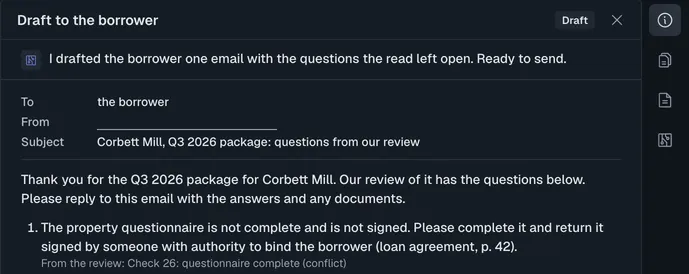
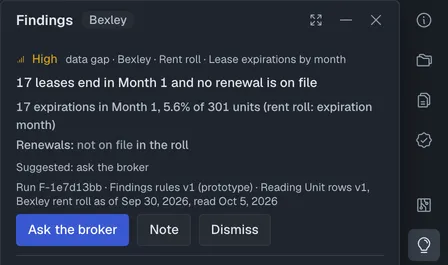
, opens live in a new tabQuestions for the borrower, already draftedThe agent drafts one email to Corbett Mill's borrower with the questions its package read left open. Question 1 cites loan agreement page 42 and Check 26, the review's test that the property questionnaire is complete.Open the package, opens live in a new tab, opens live in a new tabIn Basis, findings await the analystFrom the light-bulb button on the right edge: 17 of Bexley's leases end in October 2026, no renewal on file. Basis suggests asking the broker; the analyst decides.Open the Basis Overview, opens live in a new tab
Nothing inside Covenant. Fannie Mae and Freddie Mac never see inside it. Covenant flags a loan for the portfolio manager, and telling the agency stays that person's call, as it is today.
Do you have a SOC 2 report?
It is at the top of our list the day this round closes. The audit begins with the first servicer partner: a report on how the controls are designed, then one covering how they run over time. Today the product runs on the founder's own loan, so the data it holds is the founder's, and a first pilot runs on documents with the names blacked out.
Does it replace our system?
It replaces the hand work: the inbox, the hand entry, the spreadsheets and the watching of every loan. It works beside the servicing system the firm licenses; that system stays the record of the loan and keeps the money and the books. Covenant reads its balances, shows every payment, raises the exceptions and is designed to write approvals back to it.
Isn't the agent technology itself a commodity?
The underlying technology is, and it changed this year: since May 2026 an agent can hand a task to another agent that reports back to it, and since October 2026 it can run many side by side, so a whole job can run between a person's decisions. Both apps are designed to run on that. The edge is what we add to it: the rules from fifteen years of deals, the source behind every figure, and the data each package adds.
Why not Claude or Copilot inside Excel?
They make a workbook faster to build, and firms should use them. A workbook is still one file for one deal. Basis keeps the deal itself: every document, every figure tied to its page, a model the firm owns and can change line by line, and each decision with a name on it. Agents work that record between a person's decisions, and a live workbook comes out at the end for anyone who needs the file. The firm's own model and the workbook export are designed; reading, tying and the engine are real on one deal.
Counted from the close. Months 1 to 3: Covenant is made ready for its first servicer. Month 4: a paid pilot starts, 100 loans at half price, for six months. By month 6: Basis is live. Month 12: revenue covers spending and cost to serve in the base case. These are the plan's steps. No servicer has signed.
Write to the founder for the financial plan and a walk through the loan and the deal the agents read.
Terry TurnerFounder · $1B multifamily closed · $300M+ equity raisedFifteen years in multifamily, as an investor and as an operator. I began on the investment side at real estate private equity firms, where I co-founded both property-management and construction companies. I then founded my own private equity firm, along with my own property-management and construction companies. I have bought apartment properties, underwritten them, run them day to day and reported on them to investors. I know this work from the loan documents down to the last line item. I have never had more conviction about anything in my career than I do about what these two apps can do for this industry. Someone is going to take this work out of Excel and the inbox. I did it by hand for fifteen years, and I intend it to be us.In the past year I taught myself software development and interface design, and I build both apps, Covenant and Basis, myself. The operating spine of my own underwriting model, 30,132 formulas across 43 sheets, now runs as software: in November 2026 a real deal's rent roll and operating statement were read and underwritten through it in under ten minutes.Bachelor's in finance, summa cum laude, and master's in real estate finance, Texas A&M University.
Clickable prototypes
Real reads on one loan and one deal, names replaced
 Compliance · opens live, opens live in a new tab