Basis · for lenders and investors
Underwriting,
out of Excel.
First out of Excel, and still tied to the penny.
AI makes it possible now: the founder's Bexley model runs as software, its operating spine tied to the penny, and a person approves every change.
The engine and its tie are built. The rest is designed.
Basis keeps a firm's underwriting model as software the firm owns, tied to the deal's documents from the first rent roll to the closing statement. Agents read and tie every document, the engine computes every number, and a person makes every decision. The tie is computed in code against the document's own printed totals. Lender or investor, it is the same work.
Investor's flow: Prototype, on demo dataLender presets: DesignedA firm's own model: Designed
Designed means the build comes next. Each designed screen names what it rests on today: a run of the engine, a screen of the prototype, or a platform capability read on a stated date.
Real on one deal, November 10, 2026. Bexley's rent roll (23 pages, 301 units) and its twelve-month operating statement went in. The rent roll's 5 printed totals tied to the cent and the statement's net operating income came within $1 on the year, and the underwriting engine that ties to the penny ran it. End to end: 9.7 minutes and $1.73 of computer cost. See the run
For an investorPurchase agreements, letters of intent and diligence documents, from the broker's email to the closing statement.
For a lenderLoan documents and the borrower's diligence, from the deal's arrival to the quote. Designed
In both, the agents read, tie, draft and chase; the engine computes; a person decides at every gate.
I want to be the first. I want to be the best. And I never want to stop evolving, so that we always stay ahead.
This is an industry-changing concept, and someone has to make the first move: the company selling the software, or the firm adopting it. I am confident enough that this is the future to make it myself, and to prove how valuable this tool is. I built a 30,132-formula Excel model because, at the time, it was the most efficient option, and I closed $1B of multifamily deals. As an Excel power user, I would not have spent five minutes building this if I did not think it was much, much better. If I need to prove that to a firm before it adopts, I am happy to. I would feel the same way in its shoes. So let me show them: I will set up the first firms myself, at no charge, before they decide to adopt.
Terry Turner, founder
Why now
Why now.
Every apartment deal is underwritten before anyone lends or buys, and usually more than once: by the buyer, and again by the lender. That work still runs on busy work. Rent rolls, operating statements, purchase agreements and loan documents come in a different format from every broker, seller and borrower, and skilled people spend their days finding the figures, retyping them and checking them. The judgment they were hired for gets whatever time the deal's deadline leaves.
The scale is large. In 2025, 2,530 different lenders made $381.8 billion of new loans on US apartment buildings with five or more units, 32 percent more than in 2024. Nearly half of those lenders made five or fewer loans. The stock behind it is large too: about 485,000 US rental properties have five or more units, with about 26.3 million rental units between them (national survey of 2024, published February 19, 2026). Every one of those loans was underwritten before it was made, and a building is underwritten again each time it is sold or refinanced.
For years there was no way around it. People found the numbers, typed them in and checked them, one document at a time. That changed in 2026. Agents can now read every document in a deal and pin each figure to the page it came from. Code ties what they read to the document's own printed totals, and a person starts from a model that is already filled in, the day the documents arrive. The person keeps the decision: what to pay, what to lend, and when to walk away. Reading and tying are real on one deal. The filled model on screen is a clickable prototype.
This year the workbook itself got agents. Since April 22, 2026, Microsoft's Copilot edits Excel workbooks directly by default, and Anthropic's Claude for Excel builds and fills models from inside the file. Building a model is no longer the slow part. Knowing the model is right, on these documents, for this deal, is. Basis is built for that part.
What changed in 2026
April 22, 2026. Microsoft made Copilot's editing of the workbook, formulas included, generally available and the default in Excel.
May 6, 2026. On the model platform underneath, an agent can hand parts of a job to other agents and get their work back. In beta.
October 9, 2026. An agent can run many of them side by side. In beta.
November 10, 2026. Basis read one real deal's rent roll and operating statement, tied both to their printed totals and ran the deal through the underwriting engine. See the run
Each date was read on its publisher's own page on November 14, 2026. Links are available on request.
Knowing what a right answer looks like, which figure is off, which assumption is thin and which deal deserves the time, comes from fifteen years across both sides of the deal: the investment side and the on-the-ground side. Basis is built on it.
People are this industry's biggest asset, and the aim is to put their time where value is created. Real estate is going to change this way. We intend to be at the front of it.
Sources: the Mortgage Bankers Association's annual report on multifamily lending, published August 13, 2026; the US Census Bureau and HUD's 2024 Rental Housing Finance Survey, published February 19, 2026 (the counts of properties and units are our sum of its published size bands of five or more units). On Excel: Microsoft's announcement of April 22, 2026, and Anthropic's documentation for Claude for Excel, read November 14, 2026.
Seventeen stops, one deal · Bexley, Gulfport Crossing, TX
Seventeen stops, one deal.
Every stop is captioned twice: what a lender's desk does and what an investor's desk does. Where the lender's step differs from today's screens, it is marked designed. Each stop says what the agents do, what code computes and what a person decides, and ends with its status: real on one deal, a clickable prototype, or designed.
What is real today
| The part | Its status |
|---|---|
| Reading and tying one deal's rent roll and operating statement | Real on one deal: Bexley, November 10, 2026 |
| The twelve-month revenue engine | Built. It runs in the prototype. |
| The underwriting engine: the founder's model's operating spine | Built and tied to the penny on Bexley. It ran Bexley's own documents on November 10, 2026. Wiring it to the prototype's screens is to come |
| Intake, the Screen, Rent Roll, Financials, the Model, Financing, the Pipeline and Workshop | Clickable prototype on demo data |
| Net returns on the screens | The founder's model's own figures |
| Out of Excel: the firm's own lines and tabs, a firm's own model, the live workbook out | Designed |
| Contracts and diligence coordination | Clickable prototype on sample content |
| The agents' unattended runs, forwarding, final sources and uses | Designed |
| Lender presets and the agency's template | Designed |
Ten stations
One deal, start to finish.
Investor's deskFrom the broker's email to the closing statement: ten stations, each split into what the agents do, what the engine computes and what a person decides. What an agent produces is a proposal. The deal's record carries the work from one station to the next: every fact with its page, every decision with a name and a time. Reading and tying are real on one deal. The screens are a clickable prototype on demo data.
Lender's deskThe same stations in the lender's words: the loan request, the sizing screen, the quote, the application, the commitment, conditions precedent and funding. Designed
The ten stations
| The station | What the agents do | What code computes | What a person does | The status |
|---|---|---|---|---|
| 01 · The deal arrives | File the arrival, open the deal, name what is missing, start the reads | Recognizes the format and freezes the source | Proceeds or holds. Confirms which deal each document belongs to | Clickable prototype |
| 02 · Intake | Read each document into facts, each pinned to its page | Ties what was read to the document's own printed totals | Accepts or overrides each value, with a reason | Clickable prototype. Reading and tying: real on one deal |
| 03 · Screen | Draft the cited no or the screening brief, and the broker's questions | The engine tests the deal against the firm's bar | Records the verdict. Releases the questions | Clickable prototype |
| 04 · Underwrite | Challenge each assumption. Prepare each change a person asks for | The engine computes every number and reads each change back | Sets every lever. Commits the decision case | Clickable prototype. The revenue engine runs live |
| 05 · Contracts | Draft the letter of intent and a first-pass purchase agreement for counsel. Put the contract's dates in the record | Compares each version with the last | Approves the letter. Settles the agreement with counsel | Clickable prototype on sample content. The contract read: designed |
| 06 · Debt | Write the memo from the engine's figures | The engine sizes the loan, builds the schedule and ties sources to uses | Approves the memo. Owns the recommendation | Clickable prototype. The presentation: designed |
| 07 · Diligence | Build the checklist. File, read and compare each document. Draft each chase and forwarding | Compares each new version with the last, unit by unit | Rules on each disagreement. Releases each chase and forwarding | Clickable prototype. Forwarding: designed |
| 08 · Close | Track each condition. Assemble the binder | Refuses any money act that is not a person's | Approves in committee. Approves the wire. Declares the deal closed | Clickable prototype |
| 09 · Final sources and uses | Read the closing statement. Prepare the final sources and uses | Ties the closing statement to the underwriting, line by line | Confirms the final | Designed |
| 10 · Into the firm's history | File the closed deal as a benchmark. Propose rules from what was seen | Replays each proposed rule against past deals | Confirms what enters. Rules on each proposed rule | Clickable prototype. The lender's side: designed |
For a lender the stations are the same, in the lender's words. Every lender line is designed.
The investor's desk, one deal
The Basis agent is working
- Read the rent roll and trailing twelve months
- Tie 301 units to the summary
- Route the missing lease date
- Ask the broker for two items
- Draft the committee memo
- A person releases it
Deal Intake is a clickable prototype on demo data. The agent's unattended run is designed. Rests on today (November 14, 2026): Bexley's rent roll and operating statement were read, tied and run through the engine on November 10, 2026, and the Deal Intake screen is in the prototype. To build: unattended runs.
The lender's view of the same ten stations
The Basis agent is working
Designed
- Read the loan request package
- Tie the rent roll to its source
- Screen against the lender's criteria
- Chase the borrower for diligence
- Draft the credit memo
- A person releases the quote
Designed. Rests on today (November 14, 2026): the investor's flow in the clickable prototype, station by station, and the reading and tying that are real on one deal. To build: the lender's presets.
Station 01 · The deal arrives
The deal arrives and the work starts.
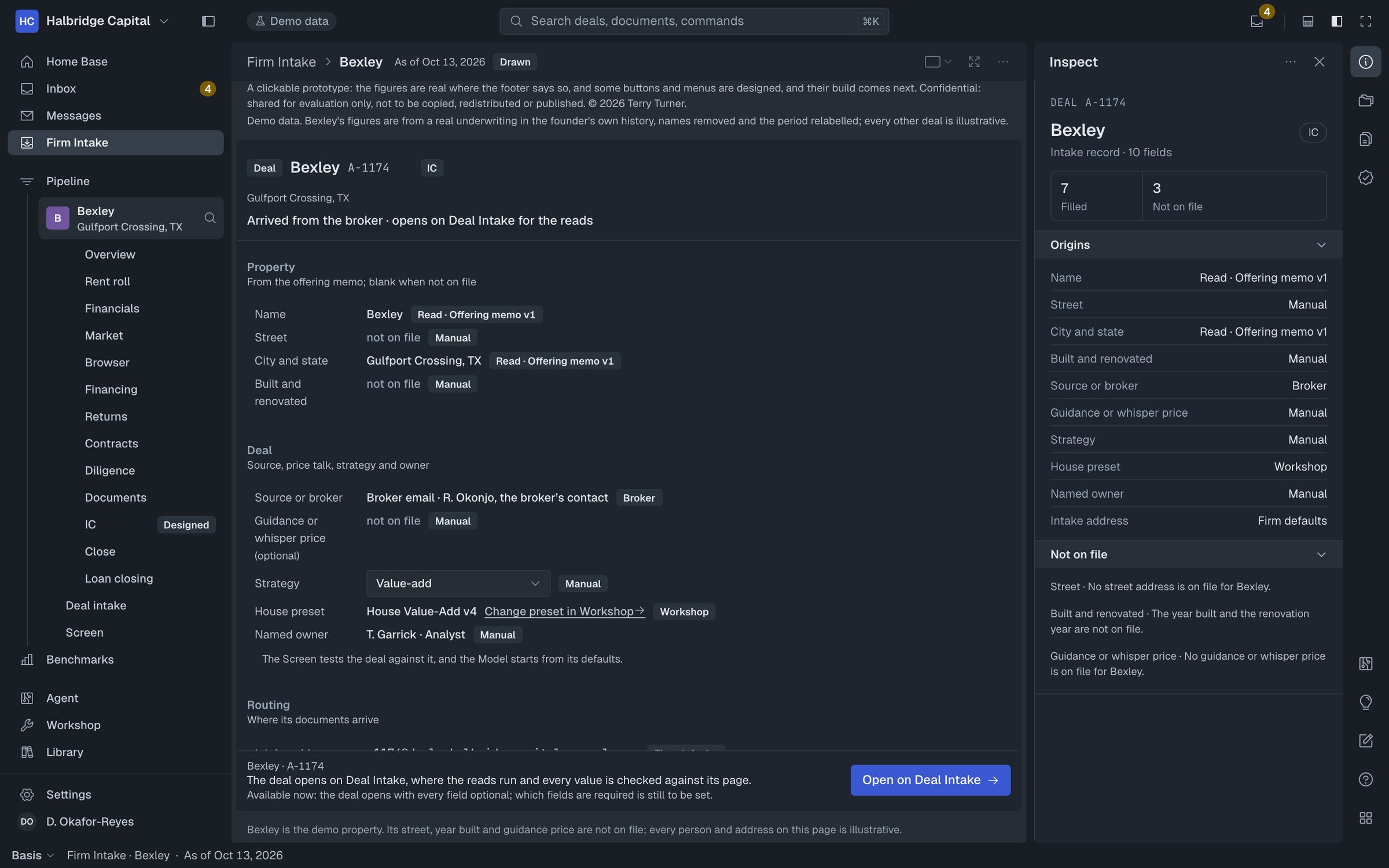
Investor's deskA broker's email or an upload. Code records where the file came from and when, and freezes it so nothing overwrites it. The agent files it and sets what came against what a package of this kind should hold, so what is missing is named on arrival. The deal opens with a named owner, and reading starts at once. Clickable prototype on demo data.
Lender's deskThe borrower's loan request package arrives the same way, by email or upload, and opens with its source and owner before any document is read. Designed
How arrival runs
What the agents do. File the arrival against the firm's own intake. Open the deal with its source, its time and a named owner. Sort a file the code does not recognize into a candidate, with the kind of document, the property and the period, for a person to confirm. Set what came against what a package of this kind should hold, and name what is missing. Draft the first questions for the broker.
What code does. Recognizes the file's format, checks for a duplicate, and freezes the source as a version that is never overwritten.
What a person does. Proceeds or holds. Confirms which deal each document belongs to. At launch a person confirms every one: a match score orders the queue and clears nothing.
What never happens. The agent does not bind a document to a deal, act on anything written inside a document, reply to the broker, or drop a duplicate or an unreadable file without a record.
The test it has to pass. A broker's email with an instruction planted in it changes nothing and is flagged. The same file arriving twice yields one frozen version and a note. The deal shows its source, time and owner before any document is read.
Status. Firm Intake and Deal Intake are a clickable prototype on demo data. The agent's unattended run is designed.
 , opens live in a new tab
 , opens live in a new tab
Station 02 · Intake
Read from two documents.
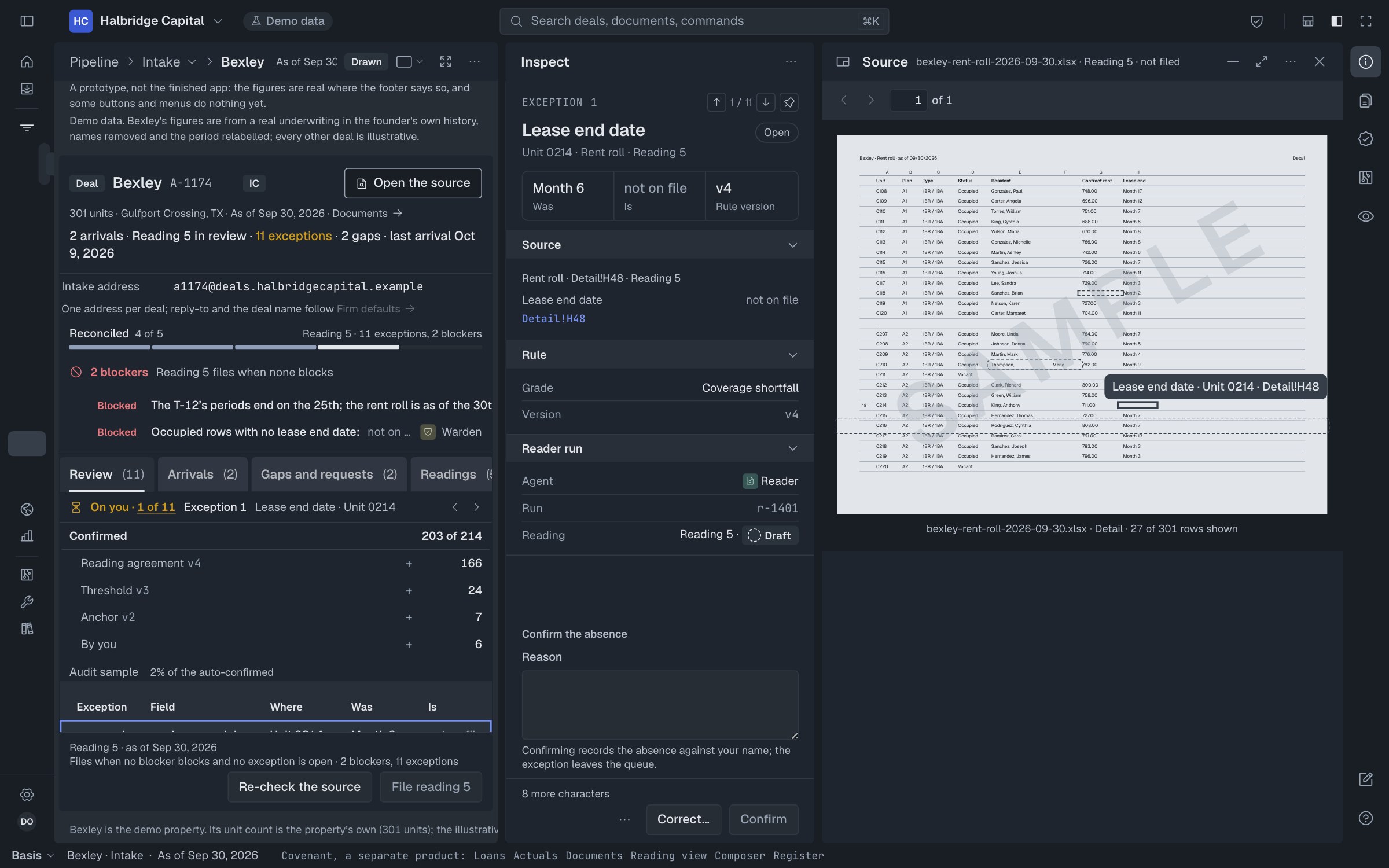
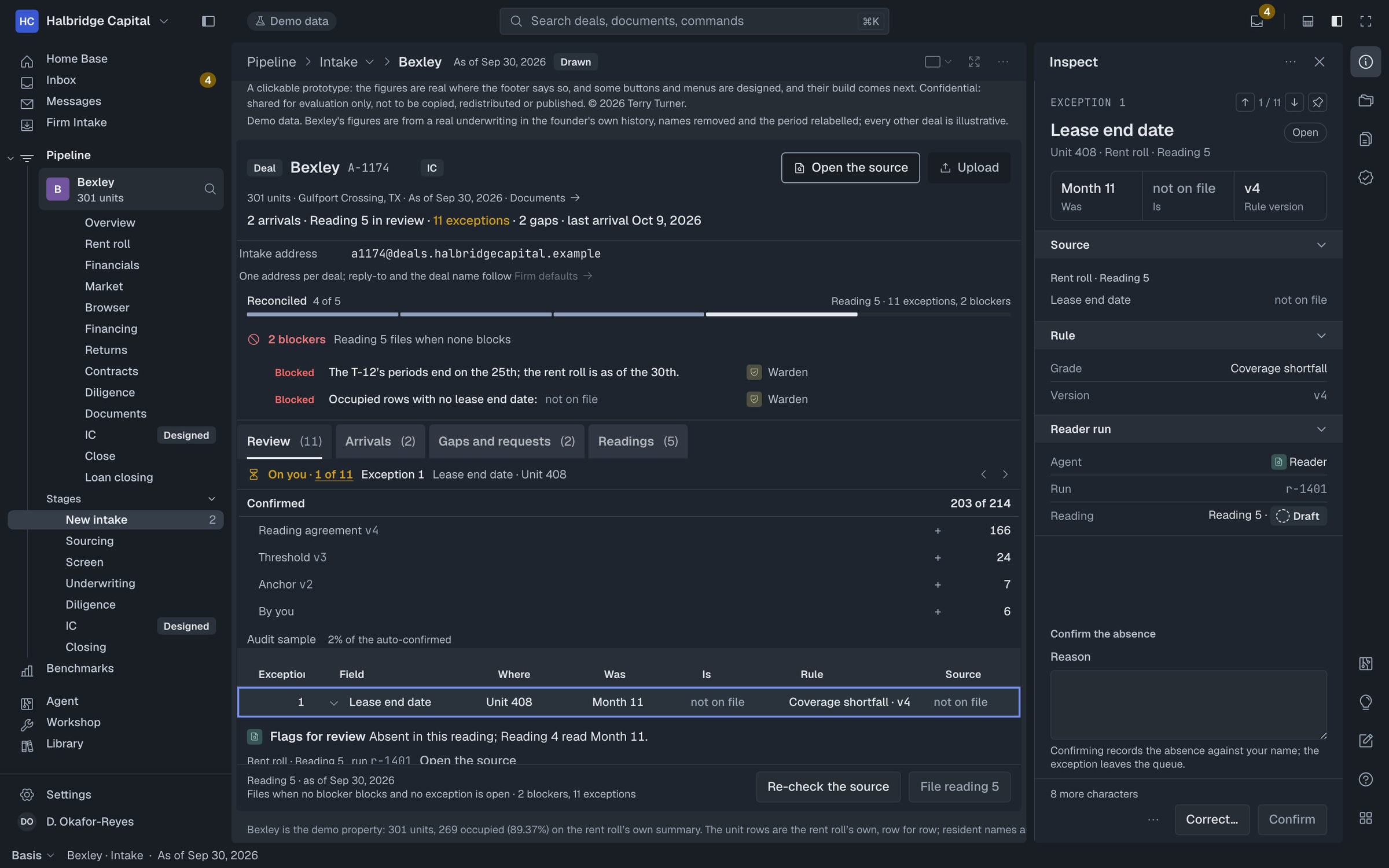
Investor's deskThe rent roll and the trailing twelve months in. Each page is read, and every value is pinned to its page. Code adds up what was read and tests it against the document's own printed totals, and a disagreement is named, never smoothed. Basis fills intake, the engine screens the deal against the firm's bar, and the underwriter starts from a populated model. Reading and tying are real on one deal: Bexley, November 10, 2026. The screens are a clickable prototype on demo data.
Lender's deskThe same two documents sit in every loan request package, and the lender's analyst starts from the same populated read. Designed
How intake runs
What the agents do. Read the rent roll, the operating statement and every other document into typed facts, each with its page. Name what could not be read.
What code does. Adds up what was read and tests it against the document's own printed totals. Where a format is one the code already knows, code reads it with no model call.
When a page fails its tie. It is read again by a stronger model, with the failing total named. If it still fails, a person sees both readings beside the page. Designed.
What a person does. Accepts or overrides each value against its source page, with a reason.
What never happens. No figure is changed so a total ties. No value is filled in that could not be read. No value is kept without its page. An agent's own confidence never clears a value. The row that disagrees is never hidden.
The test it has to pass. Every printed total ties to the cent. A scan with one altered digit is refused, with the page named. The clock and the cost are logged for each document.
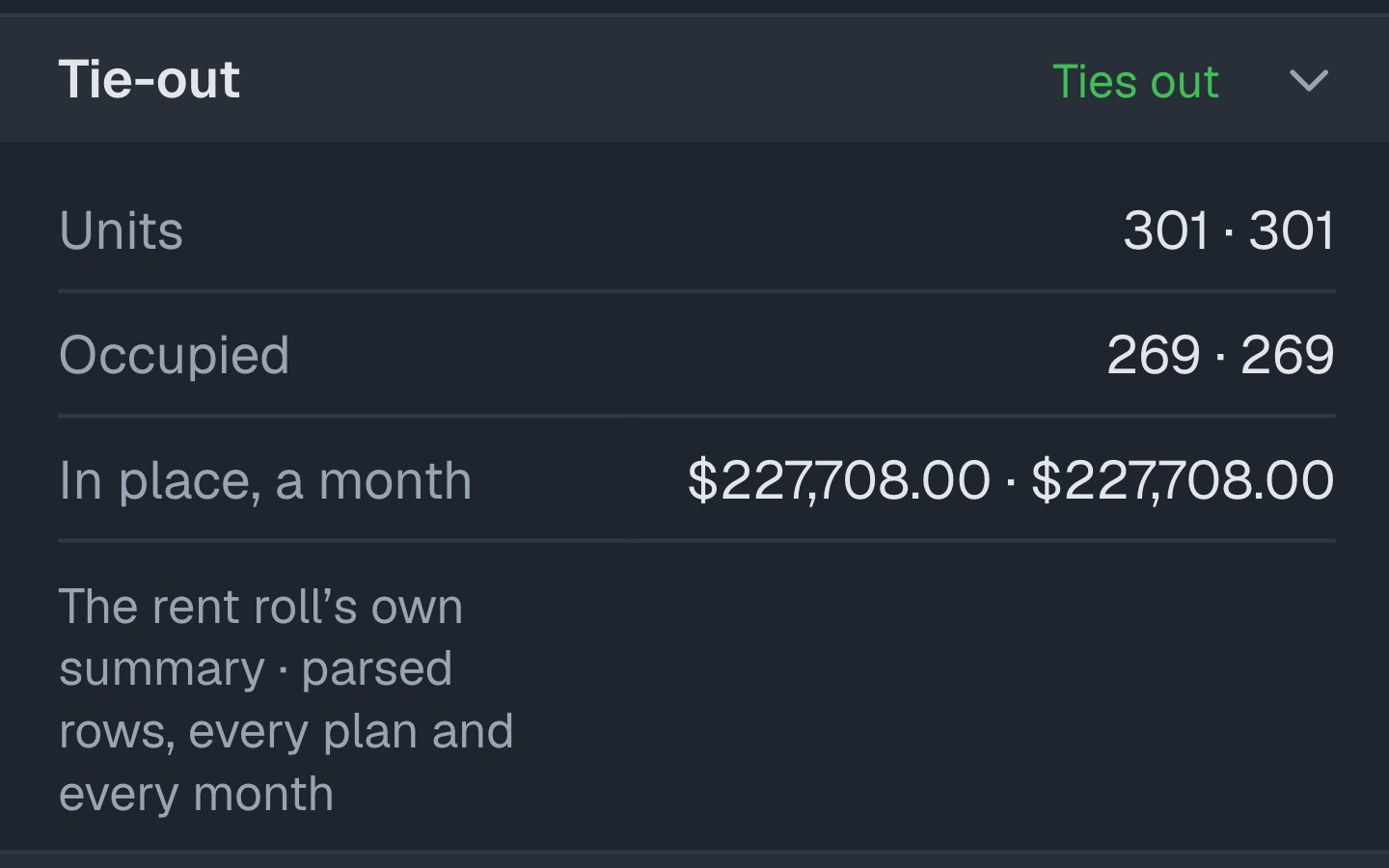
Status. Real on one deal. On Bexley, November 10, 2026, all 5 of the rent roll's printed totals tied to the cent, and 301 of 301 unit rows agreed on status, market and rent (300 of 301 on square feet: one unit read differently in the scan). Deal Intake is a clickable prototype on demo data. Holding a figure that fails its tie, and the second read, are designed.
Bexley, counted from the prototype screens' own data. Demo data.
Station 02 · Intake
Every value pinned to its page.
Investor's deskEach value read from a document is confirmed or corrected against its source page, with a reason, before the deal moves on. Nothing an agent reads counts as a fact until its total ties and a person confirms it. The agent's own confidence never clears a value. Clickable prototype on demo data.
Lender's deskThe same screen, unchanged: every figure opens on the page it came from, so nothing is re-keyed.
, opens live in a new tabStation 03 · Screen
Tested against the firm's own bar.
Investor's deskOnce intake is confirmed, the engine tests the deal against the firm's screening preset, line by line. The agent writes the result up from the record: a decline that cites the lines below the bar, or a screening brief for a yes. Code checks every number in the draft against the record before a person sees it. Questions for the broker are drafted from the lines below the bar. A person records the verdict and releases the questions. Clickable prototype on demo data. Unattended agent runs are designed.
Lender's deskThe bar is the lender's own lending criteria, agency or not: coverage, leverage and debt yield. The questions chase the borrower for diligence. Designed
How the screen runs
What the engine does. Tests the deal against the firm's screening preset as soon as intake is confirmed, every line with its headroom.
What the agents do. Write the screening brief for a yes, or the decline that cites the lines below the bar. Draft the broker's questions from those lines. Each sentence opens the record row behind it.
What code does. Checks every number in a draft against the record before a person sees it.
What a person does. Records the verdict from the firm's own list. Releases the questions. May waive a line below the bar, with a reason.
What never happens. The agent does not record a verdict, decline a deal to a broker, put a number in a brief that the record does not hold, or screen on values a person has not confirmed.
The test it has to pass. A brief with one wrong number planted in it is refused every time. A deal below the bar yields a decline that lists exactly the lines below it.
Status. The Screen is a clickable prototype on demo data, with the decline and the questions drawn. Unattended agent runs are designed.
Bexley on the Screen
Bexley meets 9 of the firm's 10 criteria
Basis flagged the one below the bar. A person waived it. Demo data.
Station 04 · Underwrite
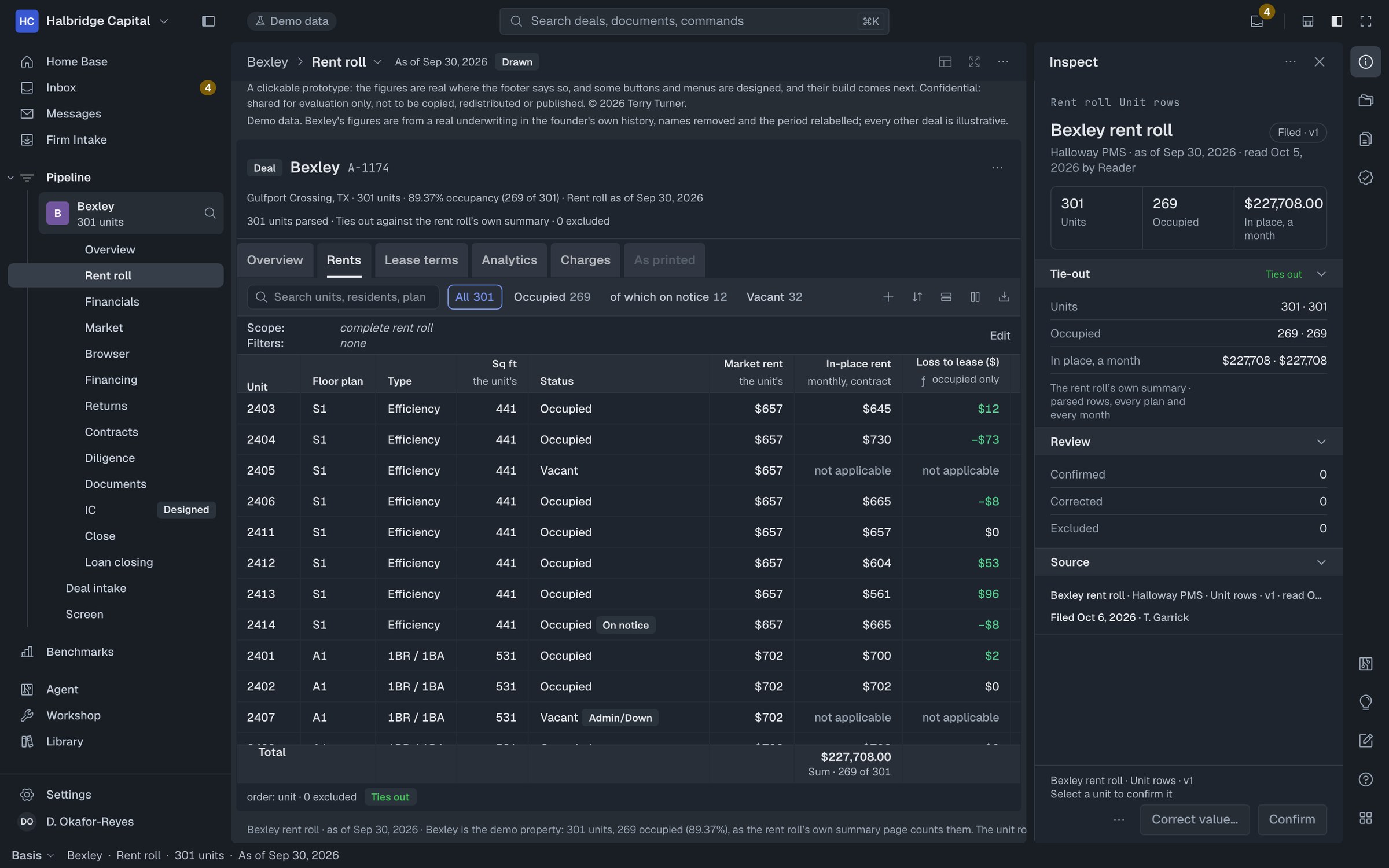
The rent roll, unit by unit.
Investor's deskAll 301 units checked before they feed the model, then one summary page: occupancy, in-place rent and exposure by plan, every figure summed from the unit rows. On the real run of November 10, 2026, all 5 of the rent roll's printed totals tied to the cent: 301 units, 269 occupied, $227,708.00 a month in place. The screen is a clickable prototype on demo data.
Lender's deskThe same screen, unchanged: in-place occupancy and rents tied to the source, unit by unit.
How underwriting runs
Challenges. The agent tests each material assumption against the firm's own closed deals and approved benchmarks, names the driver, and writes both the strongest challenge and the strongest answer to it. Designed.
Proposes. On a person's instruction the agent prepares a typed change. The engine runs it dry and reads it back: the line, the periods, the old and new values, and what moves. The person's approval is what applies it. Designed.
Keeps up with the documents. When a revised document lands, the agent stages a branch that shows what moved. The approved case never moves by itself. Designed.
Looks things up where a person can watch. Tax records and comparable listings, on sites the firm has approved. It reads, and it never signs in or submits a form. Each page it reads from is saved as a dated capture, and each comp row cites its capture. Designed.
Reads comp photos. The subject's interiors sit beside each comp's interiors and rent in one grid. Finishes are read from the saved captures, a cost source prices what was seen, code adds it up, and the result prints as an estimate, with its photo count, beside the lever a person sets. Designed.
What a person does. Sets every lever. Approves each change. Commits the decision case.
What never happens. The agent does not set or move a lever by itself, write to the engine, present an estimate as a fact, or leave the approved list of sites.
The test it has to pass. A change with no approval is blocked in code. Each comp row opens its dated capture. A revised rent roll yields a branch whose unit differences add up to its change in income.
Status. The revenue engine is built and runs live in the prototype, and the bar re-tests as a lever moves. The screens are a clickable prototype on demo data. Each line marked designed above is designed.
 , opens live in a new tab
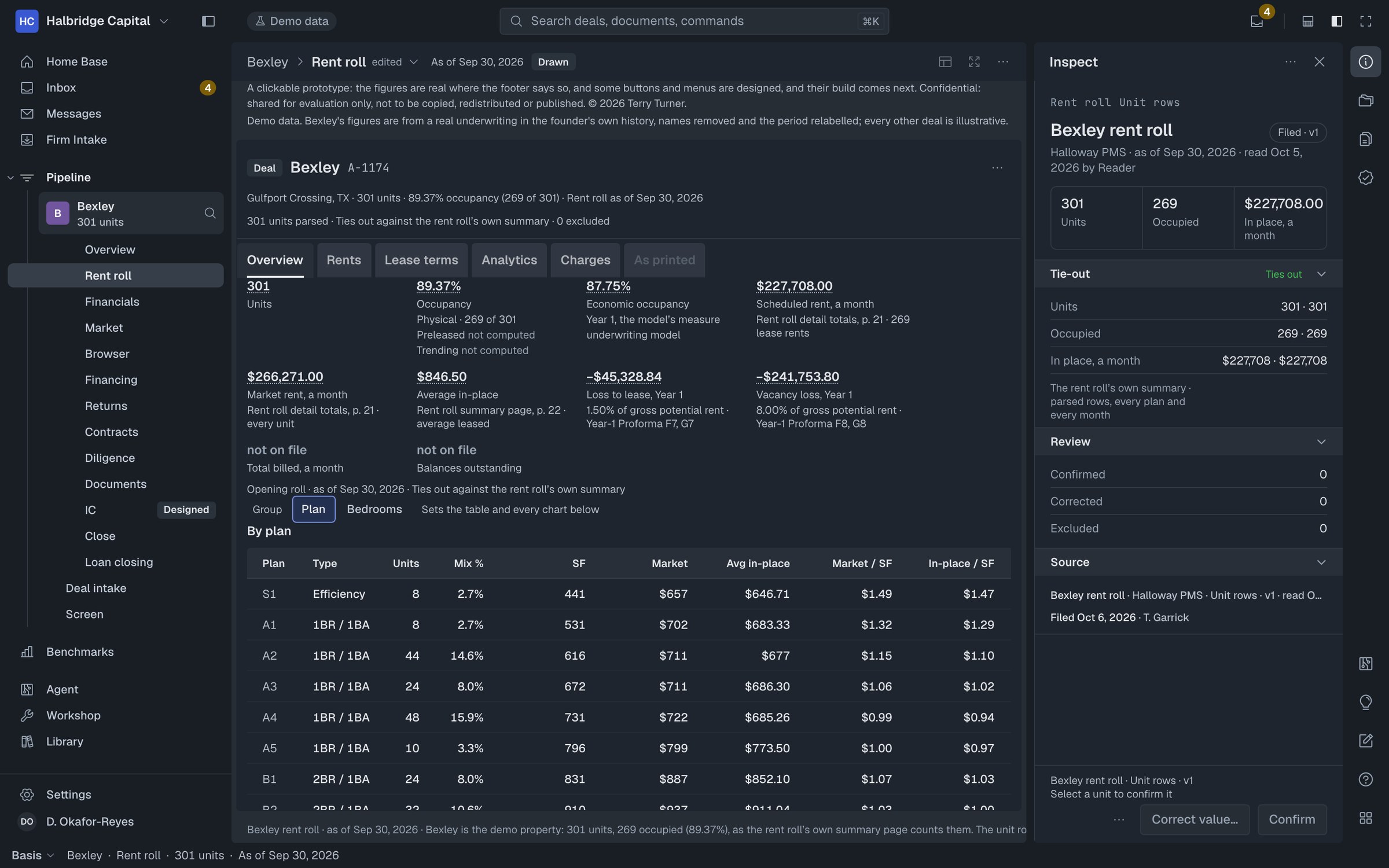 , opens live in a new tab
Station 04 · Underwrite
The trailing twelve months, mapped and tied.
Investor's deskEach line of the trailing twelve months mapped and tied beside the Year-1 projection; the Inspect pane shows where every figure came from. On the real run of November 10, 2026, every section of Bexley's statement tied to its printed total for each of the twelve months, and net operating income matched to within $1 on the year, because the statement prints whole dollars. The screen is a clickable prototype on demo data.
Lender's deskThe trailing twelve months normalized to underwritten NOI, with every adjustment traced to its cell. Designed
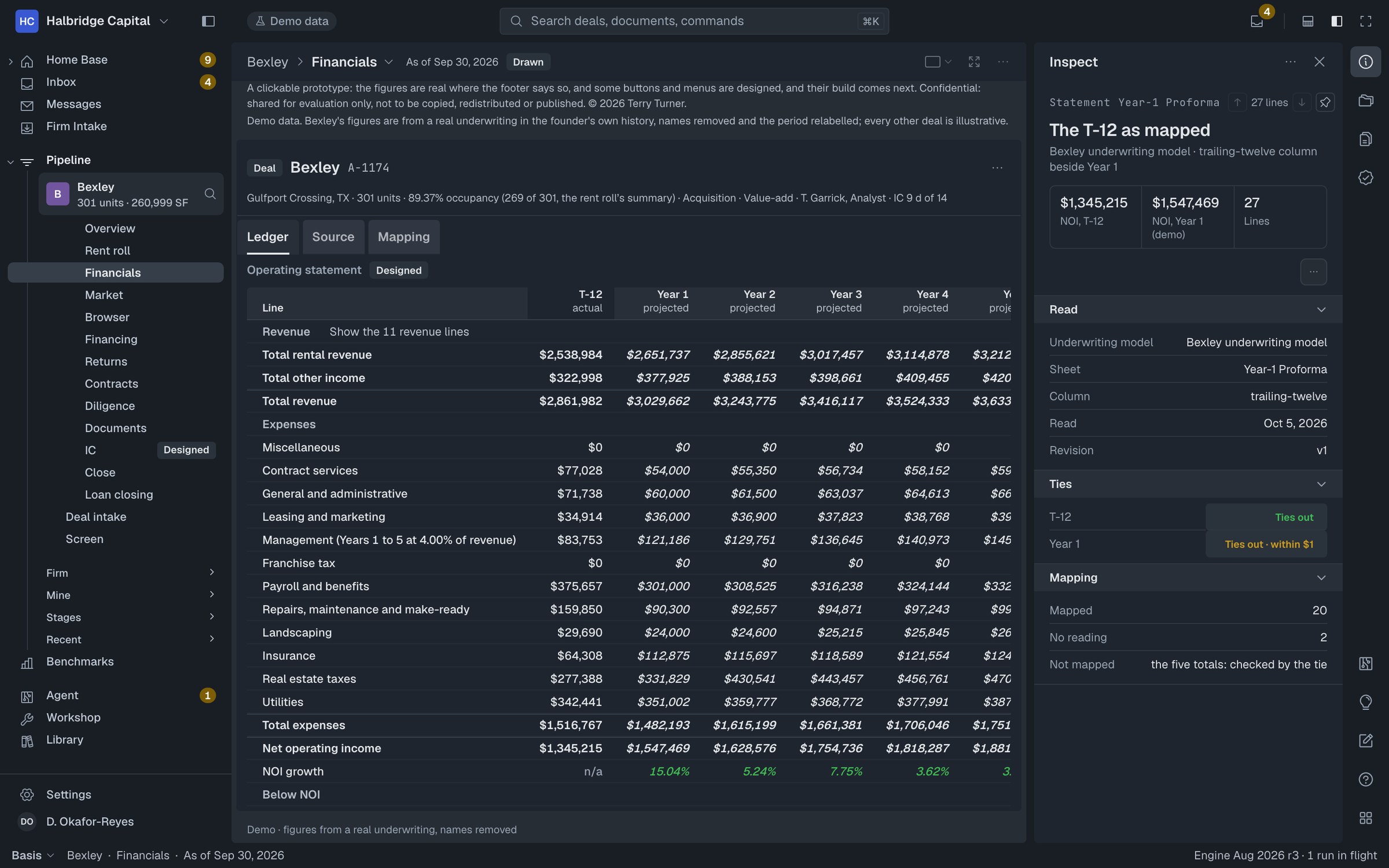 , opens live in a new tab
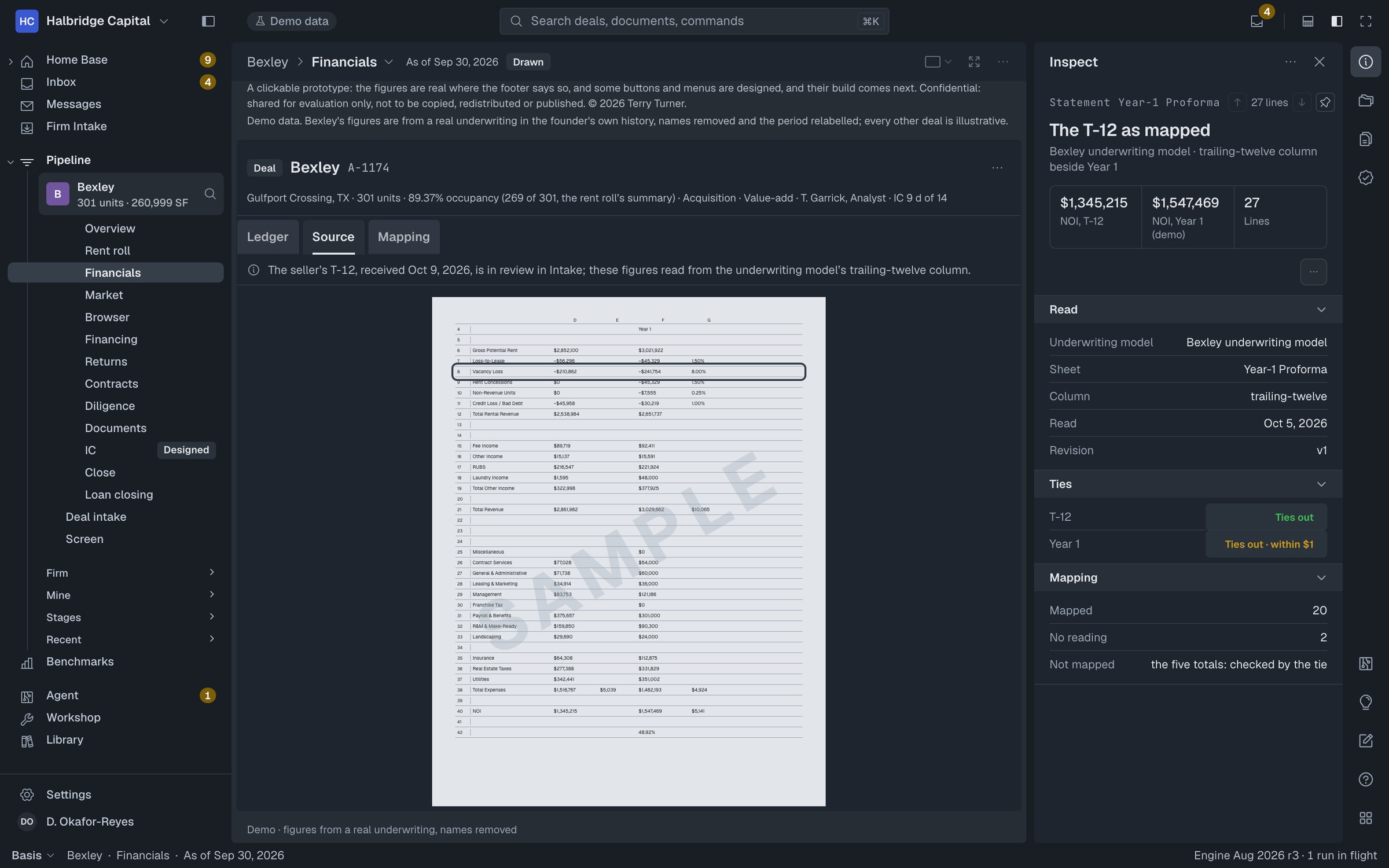 , opens live in a new tab
Station 04 · Underwrite
The house model is the founder's own.
Investor's deskThe founder's Stonemill Row underwriting model: 30,132 formulas across 43 sheets. Its operating spine now runs as software. It is the house model: where a firm starts, never where it has to stay. One engine ran all three of the founder's source models, with no deal-specific code. Each firm's changes, kept as visible edits on top of it: designed.
Lender's deskA lender's sizing model gets the same treatment: Basis emits the agency's template from its engine, never running inside one. Designed
The engine, measured
What it is. One function takes a deal's inputs and returns its outputs. The same inputs give the same outputs every time, and no model computes a figure at any point.
What it carries today. The operating spine of the founder's model, with base returns and a base waterfall, over a 60-month hold with one fixed rate per loan.
How it ties. Bexley ties to the penny on its full operating spine. Renwick Mills' revenue-and-expense spine also ties to the penny across all five years.
How fast it runs. A full run of a 301-unit deal takes 17 milliseconds, measured on November 14, 2026 on a test deal shaped like Bexley. That is what lets a change be run and read back before a person approves it.
What comes next. The model's lines, loans and waterfall as data a firm can change, with the checks on every run. Designed: stop 09.
The underwriting model · 43 sheets · 15 hidden
Basis · the deal's navigation
- Deal intake
- Screen
- Overview
- Rent roll
- Financials
- Market
- Model
- Financing
- Contracts
- Documents
- Diligence · Coordination
- Close
Station 04 · The Model
A firm's freedom. A platform's discipline.
Investor's deskEvery firm underwrites its own way. The Model keeps that freedom on a platform that computes every number deterministically, traces every figure to its source and keeps the firm's own rules in force.
Lender's deskOn lender presets the Model carries the underwritten income and coverage, with every assumption on the table for loan committee. Designed
Out of ExcelThe model's lines, loans and waterfall are the firm's to change. Any tab the firm wants, a schedule, a checklist, a calculation in Excel's own functions, is made by asking for it. Every tab reads the model by name. Nothing moves a figure until a person approves it, and the whole Working exports as a live workbook. Designed
Out of Excel, in four acts · Bexley
Anything a person asks for inside a deal becomes either a tab or a typed change to the model. An agent writes it. The engine runs it. The checks hold. A person approves it. Replaying it later calls no model.
One card repeats in the screens below. It states the change by name, shows what moves, names the check that holds, and waits for Approve. A person makes the change by hand, types it or says it, and the card is the same.
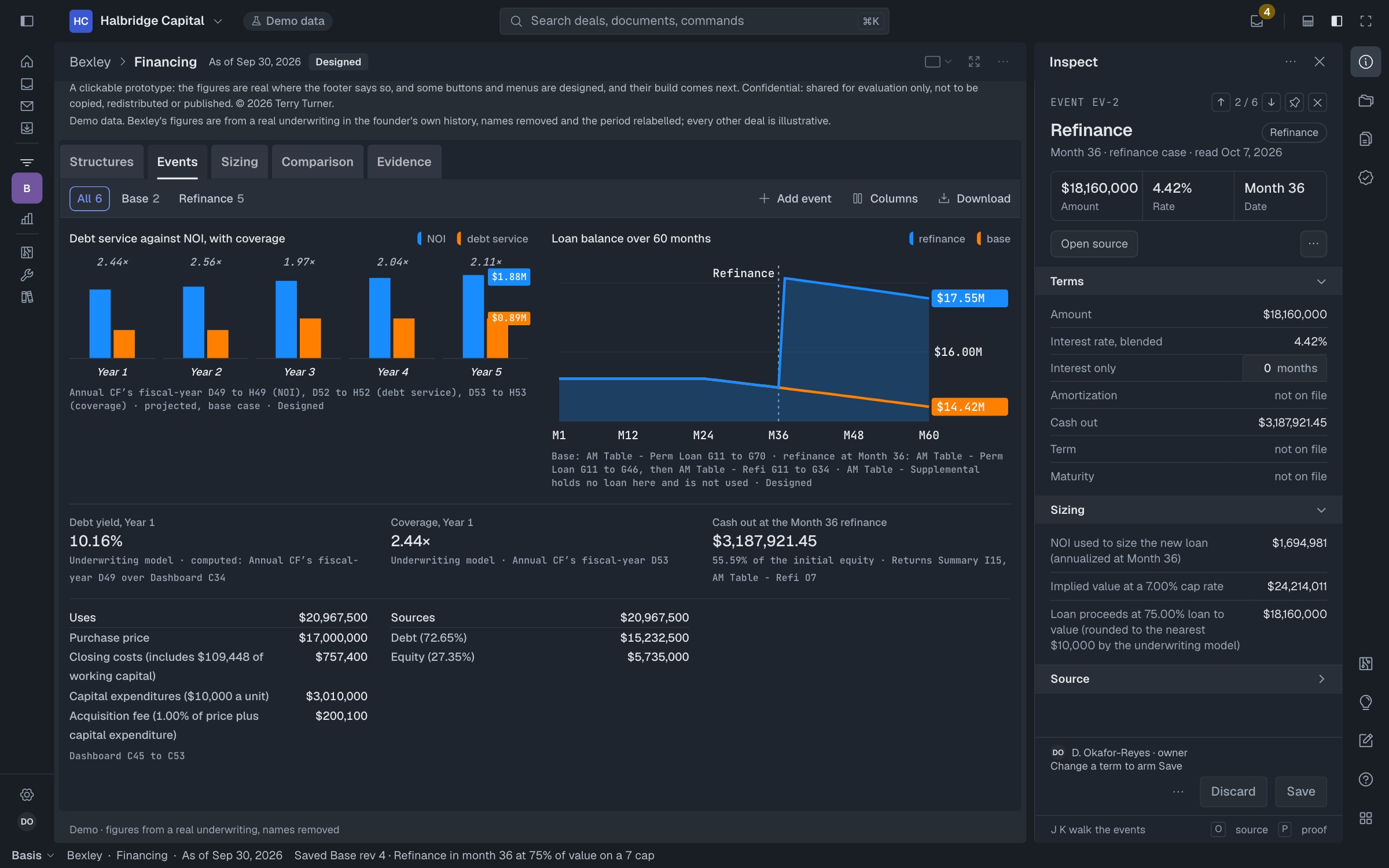 , opens live in a new tab
- How it works
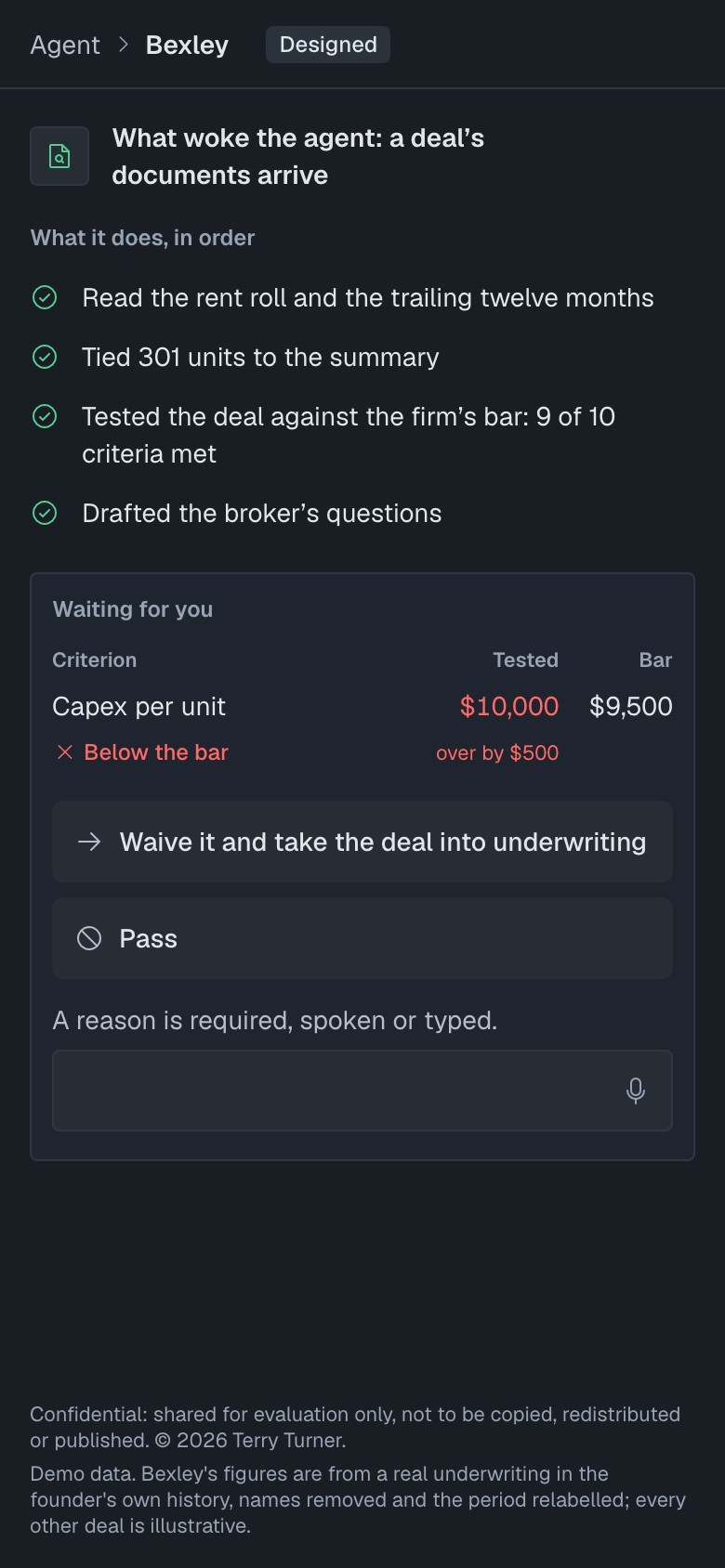
- When a deal's documents arrive, the agent reads and ties them and the engine tests the deal against the firm's bar. The phone shows what was done and the one decision that waits. A person records it, with a reason.
Rests on today (November 14, 2026): Bexley's documents were read, tied and run through the engine on November 10, 2026, in 9 minutes 44 seconds, and the Screen and its decision card are in the prototype. To build: unattended runs and a phone surface.
- How it works
- Spoken words become a named change. The server runs the engine and reads the change back. Nothing applies until a person approves.
Rests on today (November 14, 2026): typed outputs and custom tools are available on the model platform underneath, as read on November 14, 2026. The read-back's figures come from the engine's own dry run. Speech is the phone's own dictation. To build: the change format, the propose and approve tools, and a phone surface.
What stays at the desk unless the firm sets a second step: committing the decision case, releasing a document to another party, approving a wire, publishing a firm rule.
Act 1 · Refinance at month 36
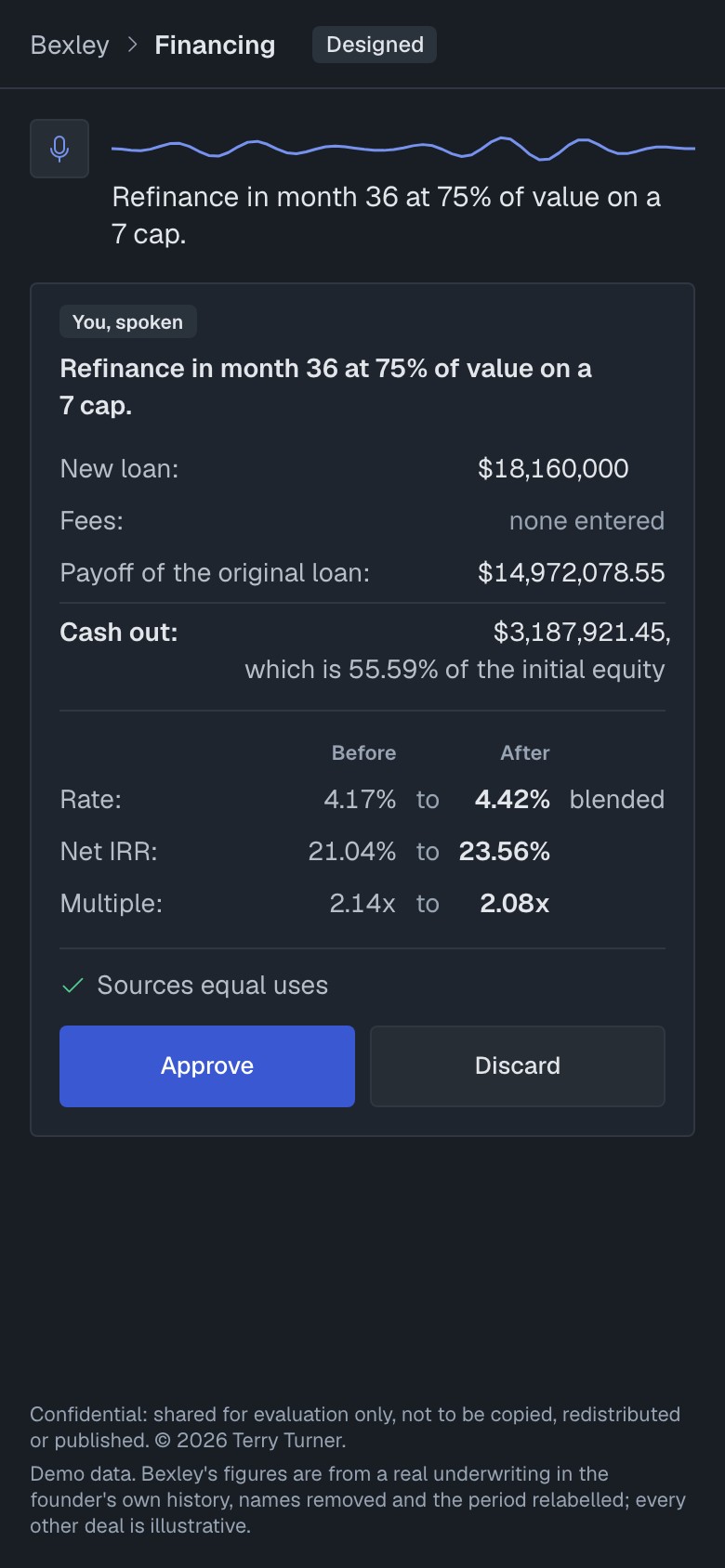
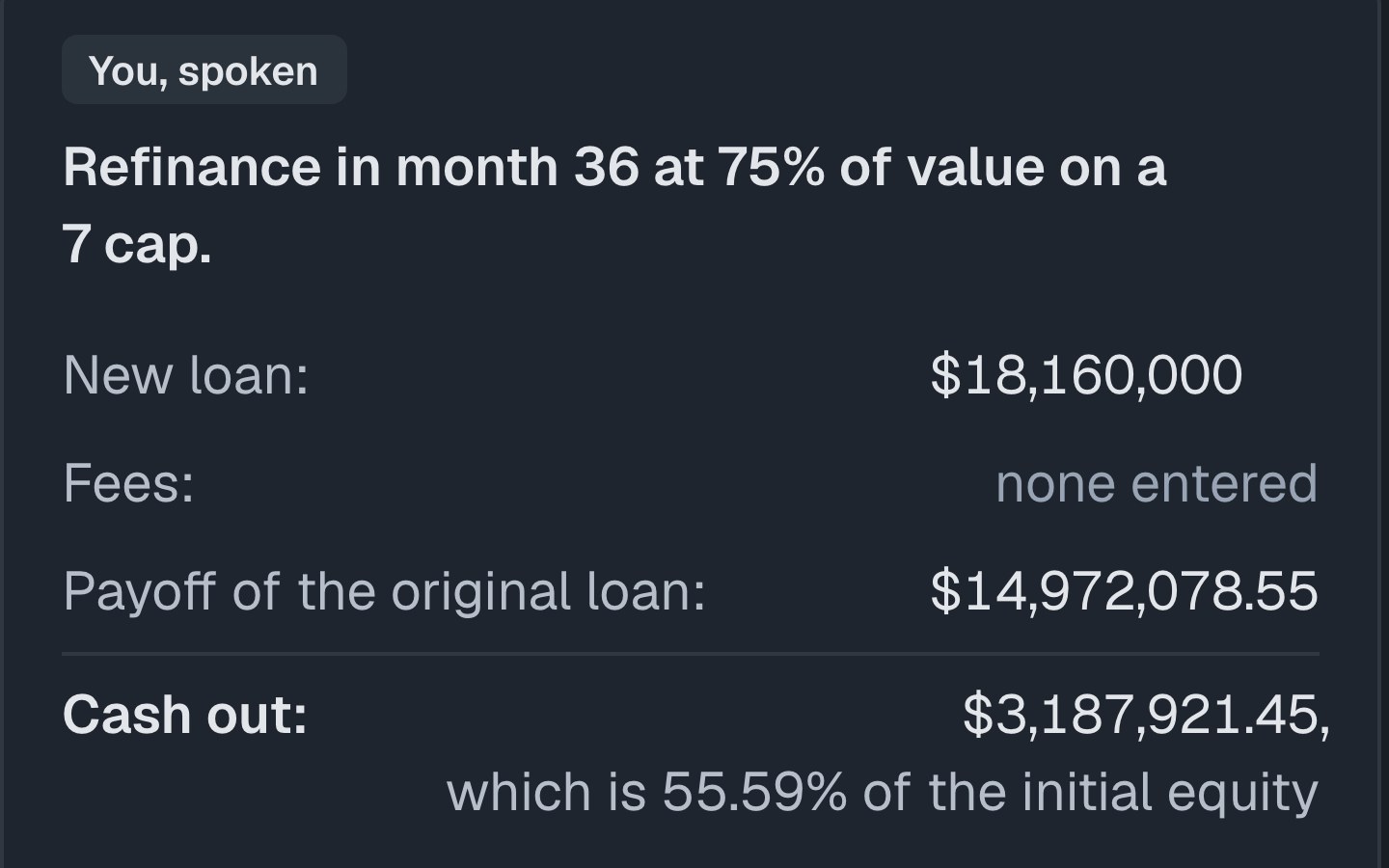
Refinance in month 36 at 75% of value on a 7 cap.
Financing, Events · Designed · Bexley's own figures, from the founder's model
- How it works
- Cash out is the new loan, less fees, less the old loan's balance from its amortization table at that month. A refinance pays off one loan and adds another; a supplemental adds a loan and pays off none. The cash goes through the waterfall in the month it funds.
Rests on today (November 14, 2026): the payoff ties on the engine today. It gives $14,972,078.55 after payment 36, so $3,187,921.45 of cash out against the $18,160,000 loan. To build: loan events in place of the refinance inputs, which are not wired today.
Act 2 · Change the promote
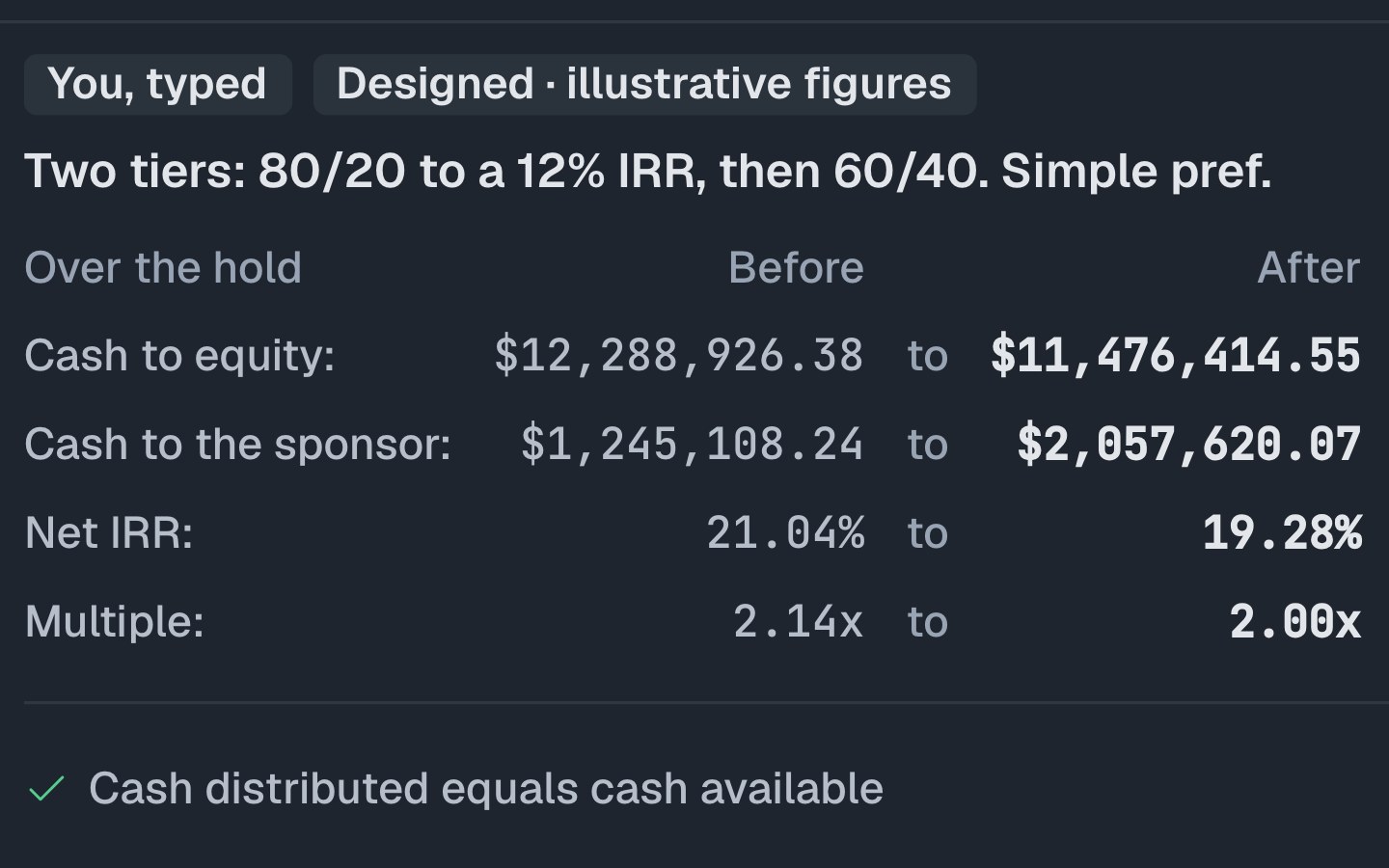
Two tiers: 80/20 to a 12% IRR, then 60/40. Simple pref.
Returns, Waterfall · Designed · illustrative figures
- How it works
- The waterfall is an ordered list of steps that ends in a residual, so cash distributed equals cash available. A step is added, removed or reordered, and the engine shows cash to each party before and after. A person approves.
Rests on today (November 14, 2026): a waterfall built as a list of steps, with a separate check of its arithmetic, was run in a working session on November 14, 2026 and passes. To build: the step list in Basis's engine, behind the check that cash distributed equals cash available.
Act 3 · Any cell opens its run
Returns, Sensitivity · Designed · illustrative figures
- How it works
- Each cell of a grid is a full run of the engine, and any cell opens the run behind it. A target is found by bisection on one input. Every cell reproduces from its run.
Rests on today (November 14, 2026): measured on the engine on November 14, 2026, on a test deal shaped like Bexley: a 1,296-run grid in 19.8 seconds, and a target found in 25 runs. To build: the grid and goal-seek tools.
Act 4 · The workbook going out, checked
Model, Outputs · Designed
- How it works
- Every Working leaves as a live workbook: real formulas where Excel has an equivalent, labeled values for the rest. Before download it is recomputed and compared with the engine to the cent.
Rests on today (November 14, 2026): done once, by hand: Bexley ties to the penny on its full operating spine. Writing Excel files is a listed capability of the model platform underneath, read November 14, 2026. To build: the importer and the exporter, each with its check. Any workbook whatever is out of scope.
How it works
An instruction becomes a typed change. Typed, clicked, spoken or prepared by an agent, every instruction is written in one change format: a named line, the months it covers, the old value and the new. The format is fixed, so a change always parses.
The engine reads it back. Before anything applies, the engine runs the deal with the change and without it. The read-back card is computed from those two runs. No model writes it. It shows the line, the periods, the old and new values, and the effect on net operating income, coverage and return.
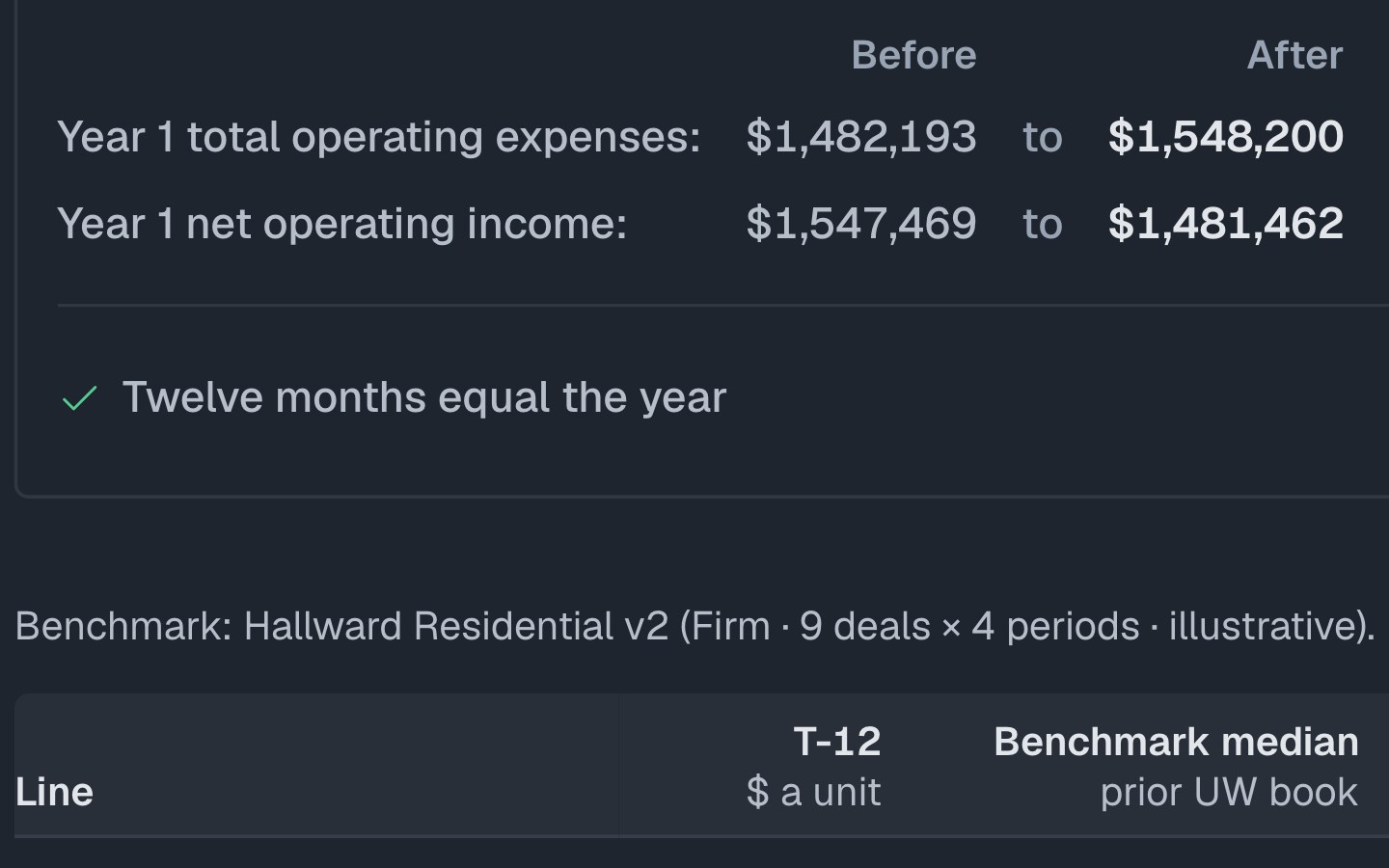
The checks hold. Sources equal uses. Twelve months equal the year. Every dollar available is distributed. A change that breaks a check is refused, with the failing check shown.
A person approves. Approval is what applies the change. Until then nothing in the model has moved.
It replays without a model. Each run records the model's version, the facts it used and the engine's version. Opening the deal a year later re-runs the record and calls no model.
What a tab is. A tab has one of five kinds: a grid, a list, a schedule, a document or a chart. It reads any line, document fact or date by name, live, and changes nothing by itself. One named, approved step moves its work into the model.
Status. Designed. What makes a read-back before every approval practical is measured: a full run of the engine takes 17 milliseconds, as of November 14, 2026.
The climb
The order of the build. Each step has a test it has to pass.
- 1. Harden the engine. Its checks run inside every run, the waterfall holds its cash check at any number of tiers, and a refinance becomes a loan event. The test: no run prints with a check open, and Bexley's month-36 cash out equals $3,187,921.45.
- 2. The change format and its tools. Read, propose, dry-run, approve, grid, goal seek. The test: the same instruction from an agent and from a person yields the same typed change, and nothing applies without an approval.
- 3. Tabs that read the record. The test: asking for a master list of the diligence items produces a tab, and changing the closing date moves its rows.
- 4. Lines as data. The test: a thirteenth expense line needs no code, and the result ties to the cent.
- 5. Structure as data. The waterfall as steps, investor classes, the hold, declared loops. The test: all three of the founder's source workbooks tie, returns and waterfall included, with no engine code changed.
- 6. Excel out, and a firm's model in, once. The test: Bexley's export recomputes to the cent, and a firm's own template, brought in once at setup, ties on three of its own past deals.
The dates, counted from the close of the round. By month 3, lines as data and structure as data pass their tests. By month 6, Excel out and the one-time setup pass their test, and Basis is live. By month 12, deals close that never went back to Excel.
What is not in it
Stated plainly, so the rest can be believed.
- Macros. Rules in Workshop and scheduled runs take their place.
- Functions that point at a cell's position, such as OFFSET and INDIRECT, and ones that change by themselves, such as NOW and RAND. Lines are read by name. Such cells come in as values.
- A general spreadsheet. Excel is one, and every Working exports to it. A grid tab earns its place by being tied to the deal.
- Any workbook whatever, kept exactly. A firm's template comes in where its rows map and tie. The rest comes in as labeled values, and a report says which.
- Pivot tables as objects. A query tab over the rent-roll and ledger rows.
- A loop left unstated. A loop is declared, with its method and its tolerance.
- Optimizing many inputs at once. Grids and goal seek.
- A model computing a figure. Not at any point. The engine computes.
- Asset classes beyond multifamily. Later.
Nineteen reasons an underwriter goes back to Excel, and the screen that answers each
The list is the founder's own. Each tab says what the reason is in Excel, what it is in Basis, how it works, and what it rests on today.
This strip is also the scoreboard. A case is scored when it runs on the engine and ties on a real deal. No score prints today: all nineteen are designed. The first score prints here, with its date, after the engine's hardening step.
Override some months
- In Excel
- Type over one cell for the months that differ.
- In Basis
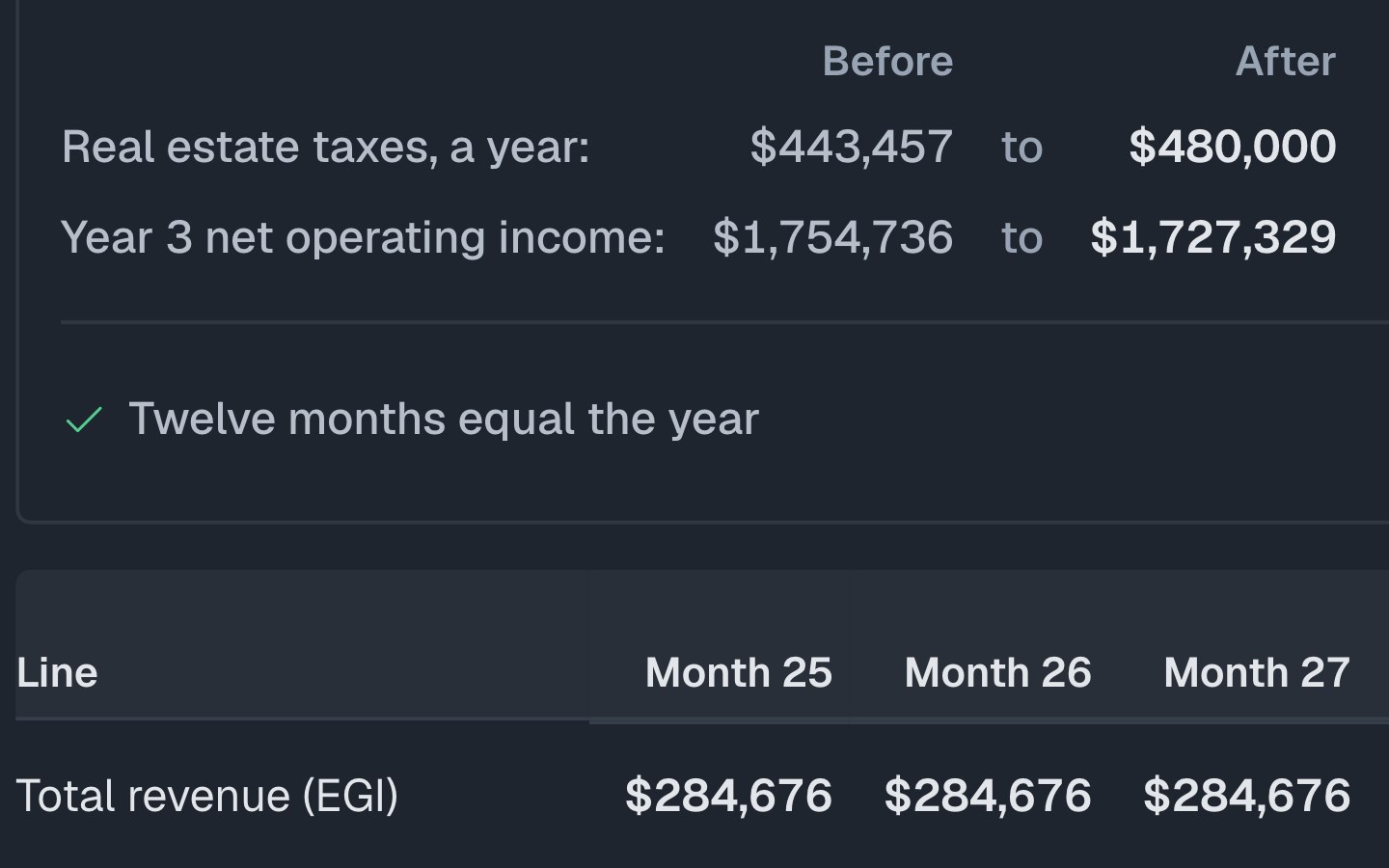
- On the real estate taxes line, months 28 to 60 carry the firm's own figure, marked "Your override", with the reason beside it. The read-back card shows the old and new annual figure and what moves.
- How it works
- An override sits on the line for the months named, with its reason. The line's own formula stays underneath and returns when the override is removed. The engine re-runs the deal before a person approves.
Rests on today (November 14, 2026): a full run of the engine takes 17 milliseconds, so a change can be run before it is approved. The override form is in the prototype. To build: an override by period on any line.
Add a line
- In Excel
- Insert a row and extend the sum.
- In Basis
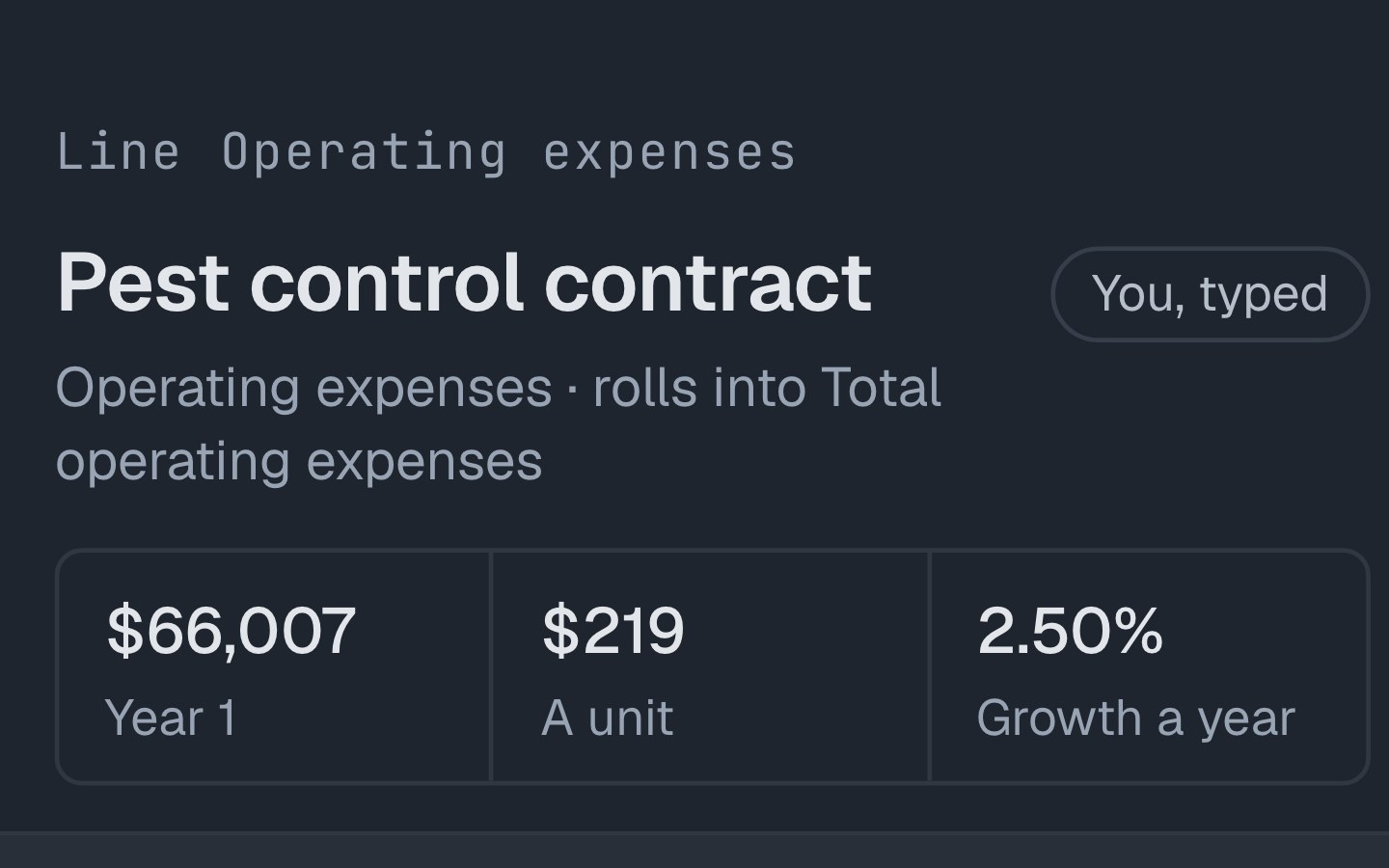
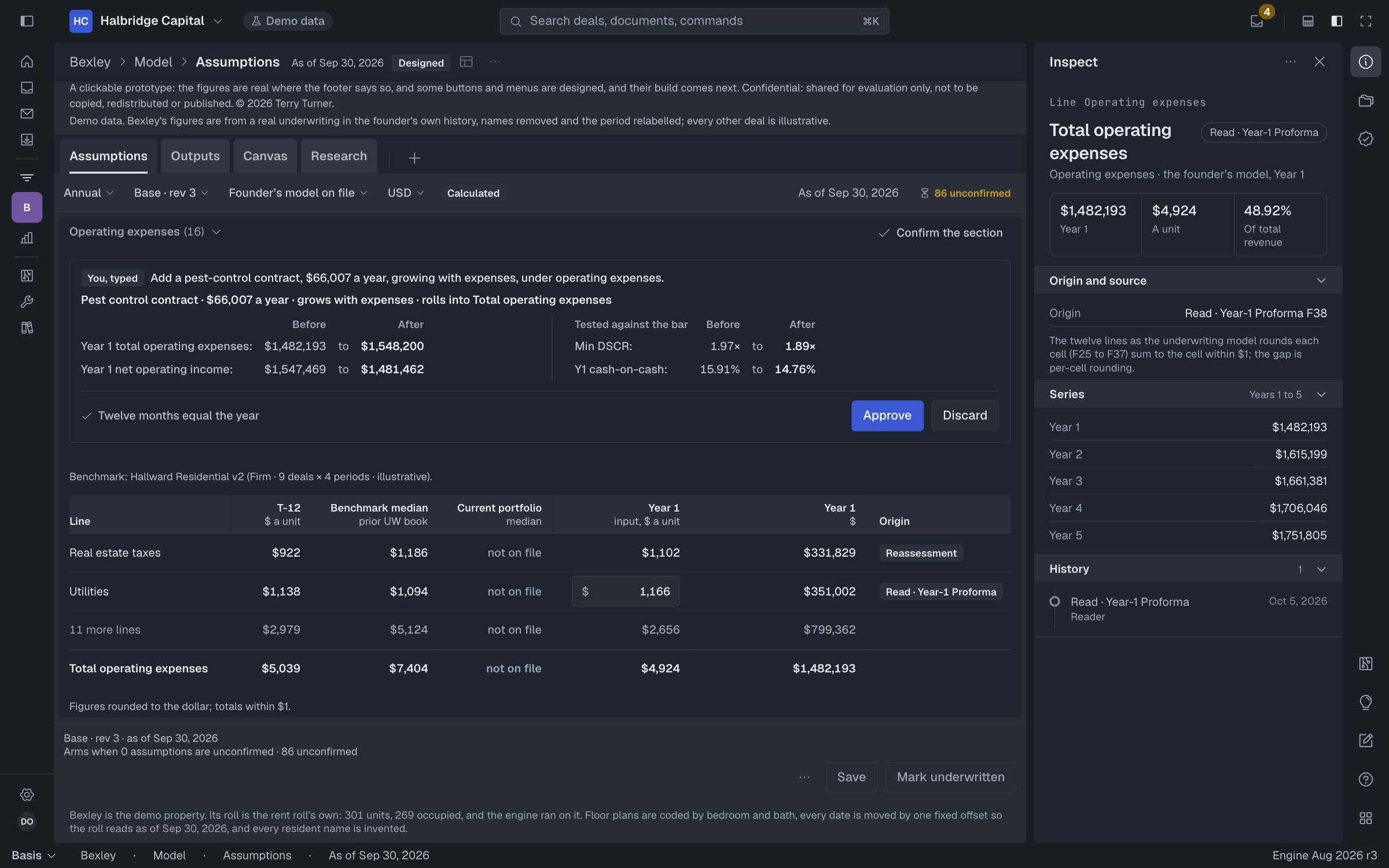
- A new row, "Pest control contract", $66,007 a year, sits inside the operating expenses block above its total, and the total rises by the line.
- How it works
- A line is added by name. The engine re-runs the deal and the checks hold. A person approves before any figure moves.
Rests on today (November 14, 2026): a full run of the engine takes 17 milliseconds, so a change can be run before it is approved, and the bar's re-test when a lever moves works live in the prototype. To build: the cash flow as lines that roll up into their totals.
Change a formula
- In Excel
- Edit the cell's formula to the firm's own basis.
- In Basis
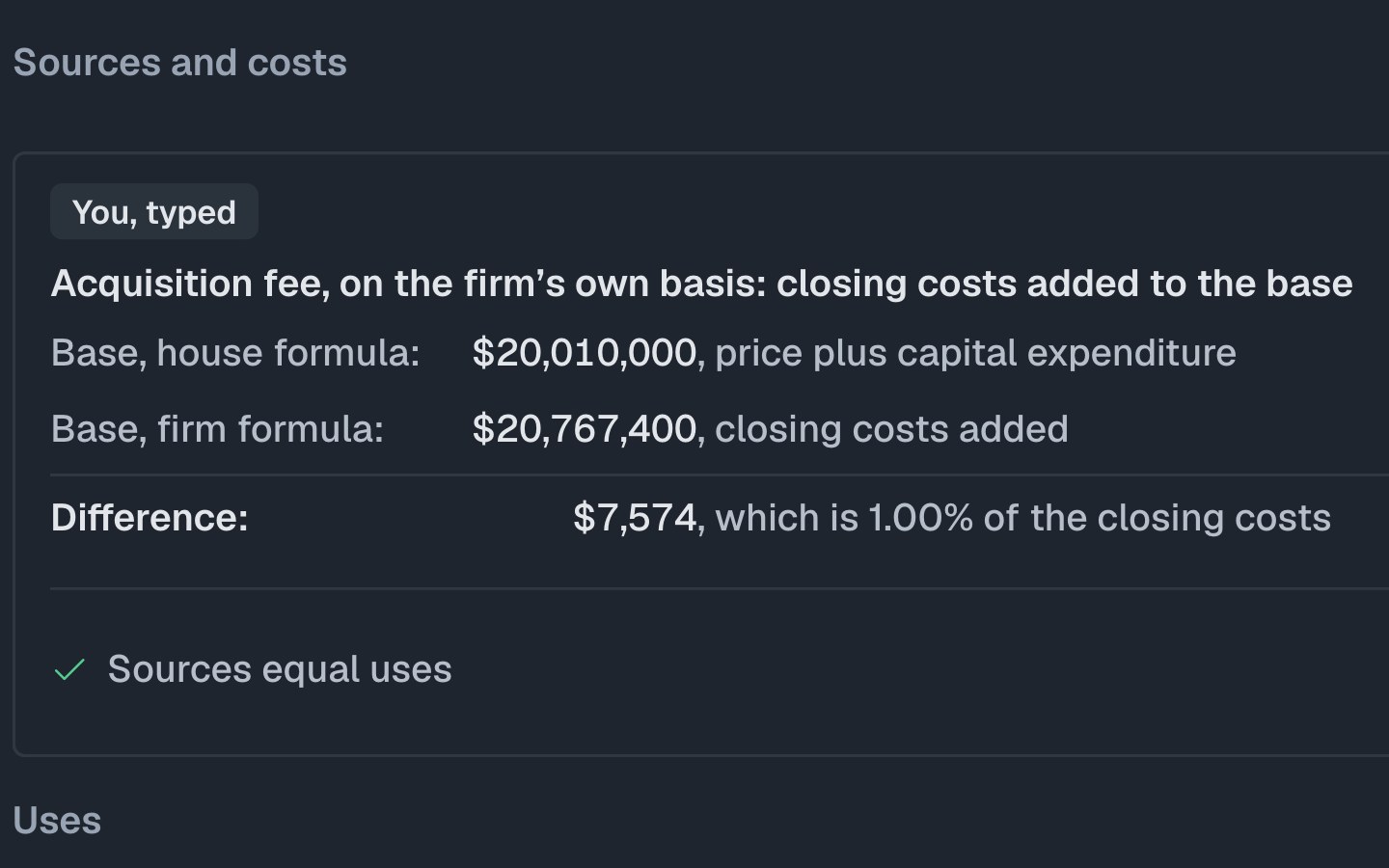
- The acquisition fee's basis changes from price plus capital expenditure to the firm's own. Both formulas show, the house's and the firm's, with the dollar difference beside the row and a reset to the house formula.
- How it works
- The firm's formula sits in the firm's layer, with the house formula kept underneath. The difference from the house prints beside the line on every deal. A person approves the change.
Rests on today (November 14, 2026): nothing is run or built behind this step yet. The difference it answers is cataloged in one of the founder's own workbooks. To build: a formula for each line, by layer.
Add a test
- In Excel
- A formula cell and a conditional format.
- In Basis
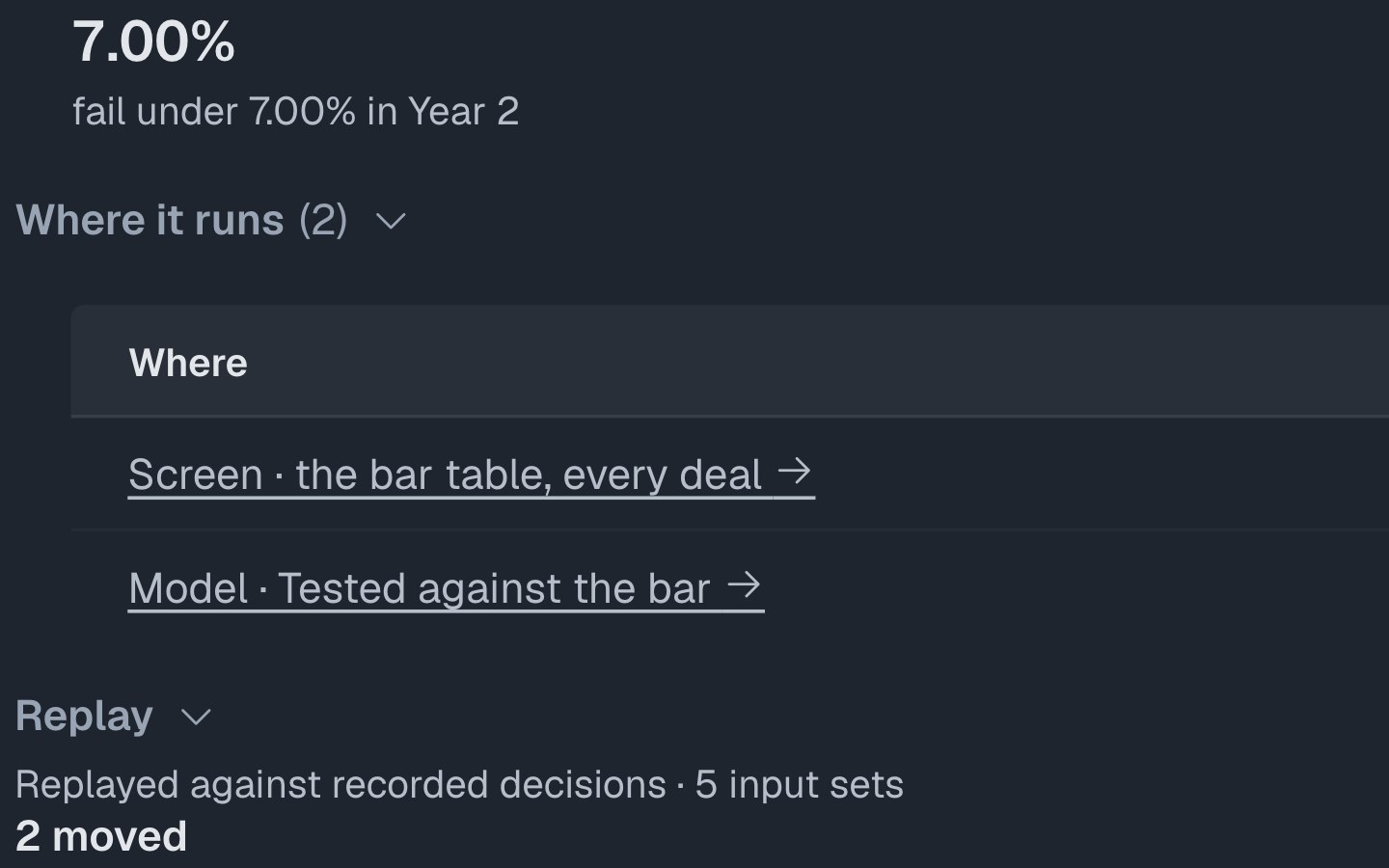
- A test's page in Workshop: the metric as a formula over the model's lines by name, its threshold, where it runs, and a replay against the firm's recorded decisions with the count that moved. On the Model, the bar gains a tile for the new test.
- How it works
- A metric is a formula over the model's lines, by name. A test is a metric with a threshold. It is replayed against the firm's past decisions and approved before it publishes.
Rests on today (November 14, 2026): Workshop's rule page and its replay are in the prototype, and the engine's run time makes a replay a batch of runs. To build: metric lines and test objects.
Change the waterfall
- In Excel
- Rebuild the waterfall tab.
- In Basis
- The promote is a list of steps, each a sentence with its blanks and its split, ending in the residual. One month's cash passes down the steps, with the amount to each party.
- How it works
- The waterfall is an ordered list of steps that ends in a residual, so cash distributed equals cash available. A step is added, removed or reordered, and the engine shows cash to each party before and after. A person approves.
Rests on today (November 14, 2026): a waterfall built as a list of steps, with a separate check of its arithmetic, was run in a working session on November 14, 2026 and passes. To build: the step list in Basis's engine, behind the check that cash distributed equals cash available.
Investor classes
- In Excel
- A returns sheet per class.
- In Basis
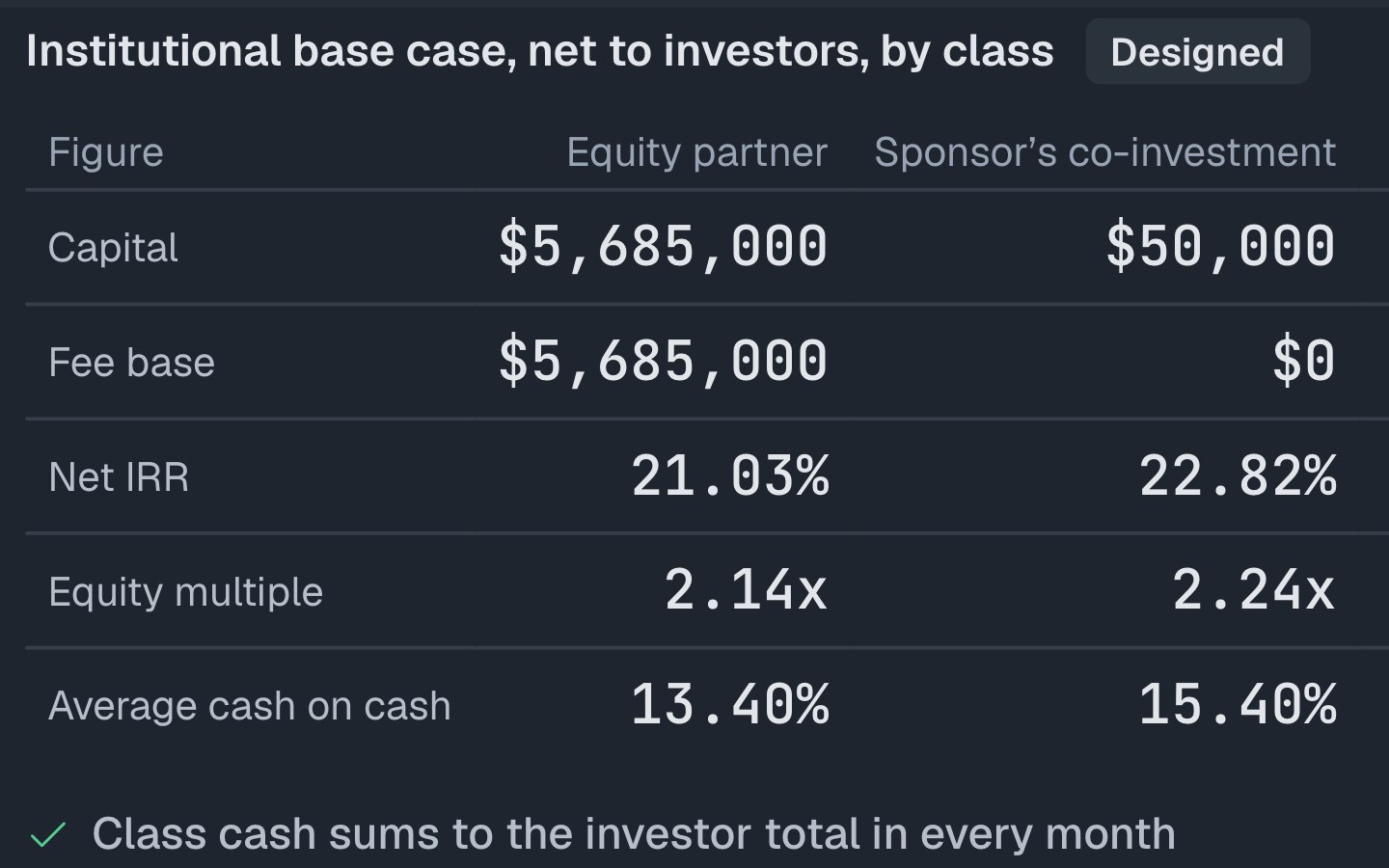
- Two return columns from one waterfall, one per class: capital, fee base, net IRR, multiple and cash on cash. Under them: "Class cash sums to the investor total in every month".
- How it works
- Each class has its own accounts at every step of the waterfall, with its own capital, fees and returns. Class cash sums to the investor total in every month, and the check prints.
Rests on today (November 14, 2026): the step-list waterfall run on November 14, 2026 passes. Classes were not in it. One of the founder's source workbooks reports two classes, which sets the test to pass. To build: classes as accounts in the step list.
Debt that changes
- In Excel
- Edit the amortization tab.
- In Basis
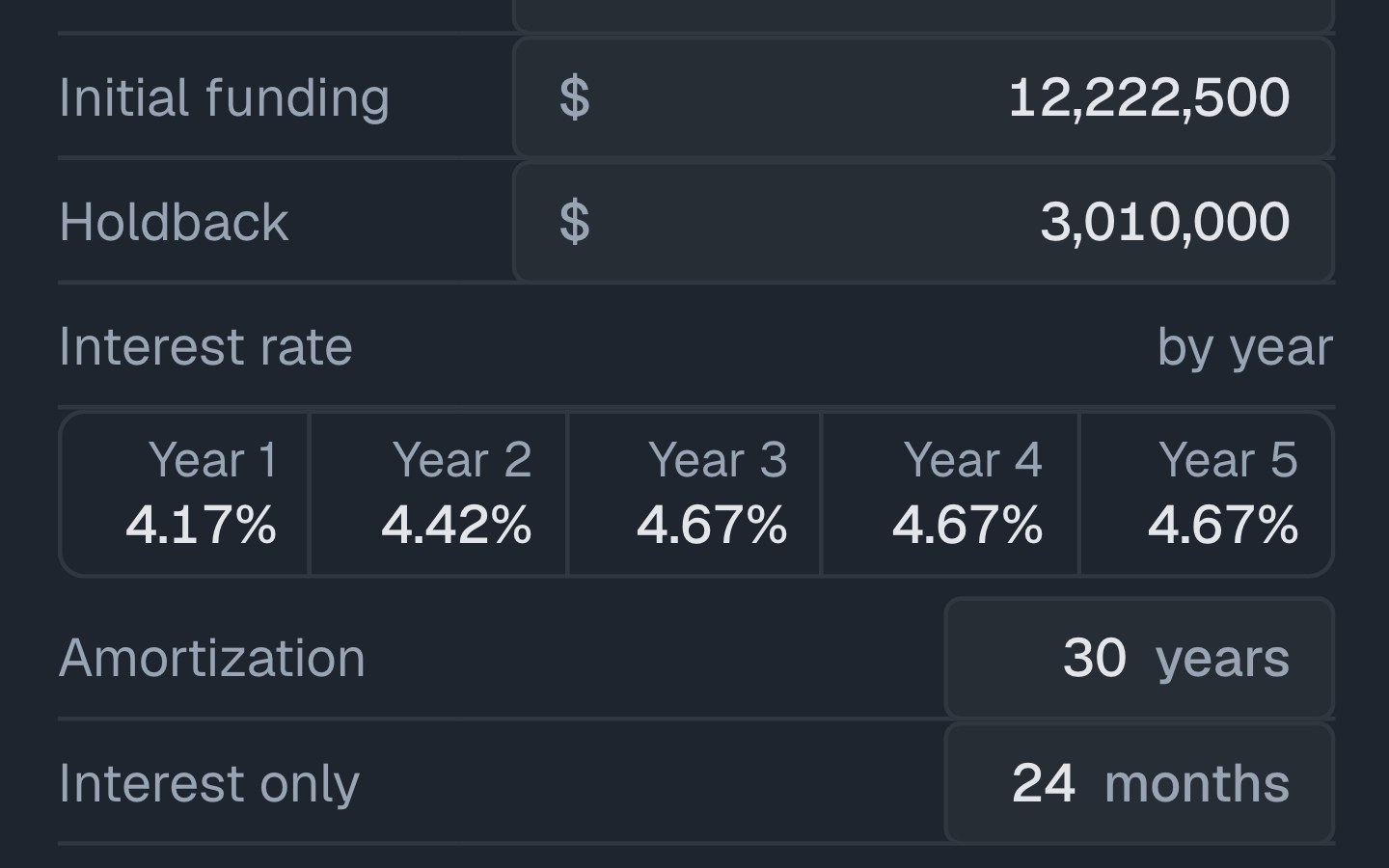
- The loan's rate is a series by year, and its events sit in a table: a rate step, a draw, a prepayment cost on the payoff. The balance chart carries a tick at each event, and coverage re-runs by year.
- How it works
- A loan is a schedule built from terms that can vary by month, plus a list of events: a draw, a rate step, a payoff with its cost. A person adds an event, and the schedule and coverage re-run before approval.
Rests on today (November 14, 2026): Financing's events table is in the prototype, and the page marks the debt schedule as built (Station 06 · Debt). To build: the rate as a series, and loan events.
Refinance
- In Excel
- A refinance amortization tab and a second waterfall tab.
- In Basis
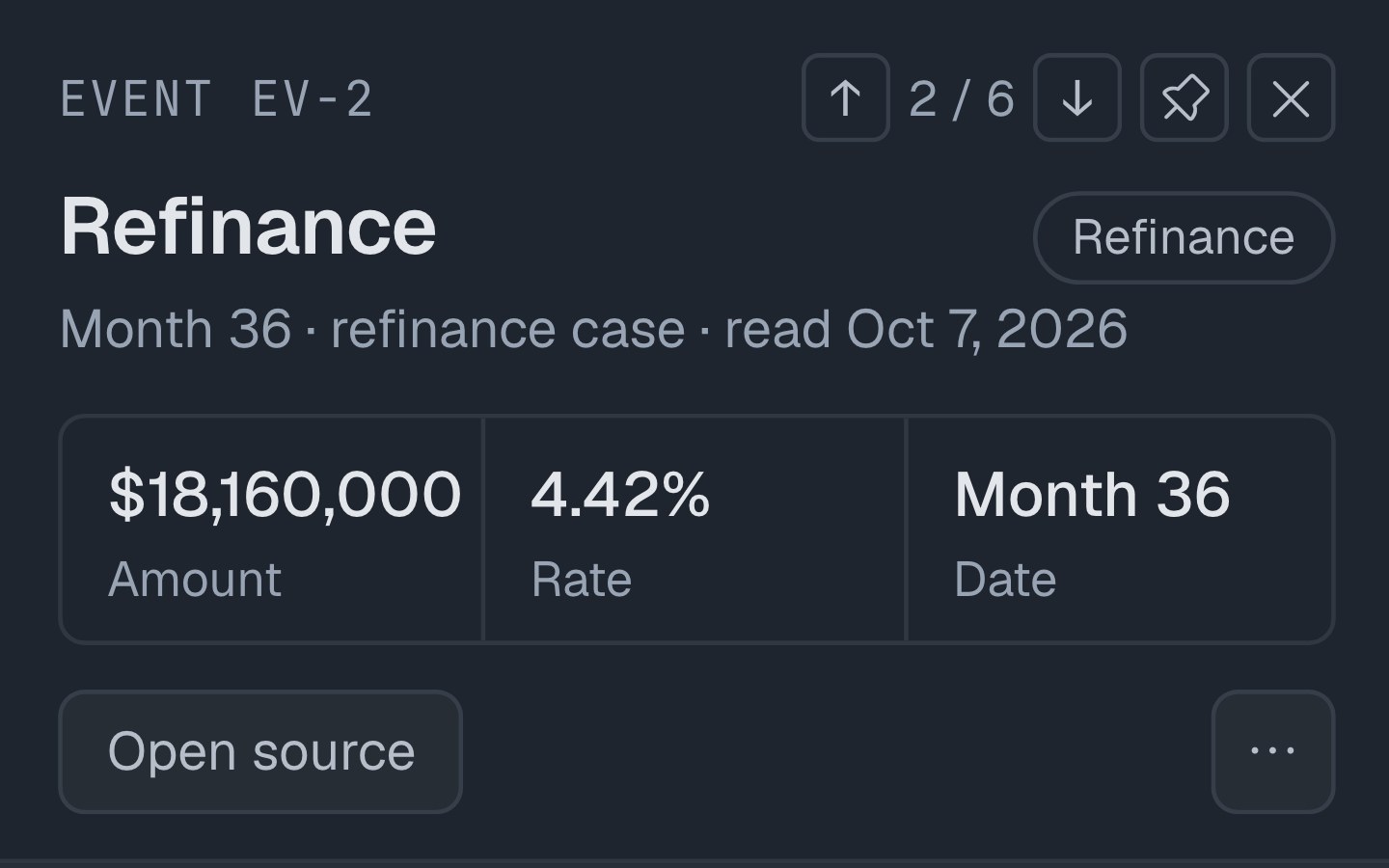
- One card, one subtraction: new loan $18,160,000, fees, payoff of the original loan $14,972,078.55, cash out $3,187,921.45. Under it the rate, net IRR and multiple, before and after.
- How it works
- Cash out is the new loan, less fees, less the old loan's balance from its amortization table at that month. A refinance pays off one loan and adds another; a supplemental adds a loan and pays off none. The cash goes through the waterfall in the month it funds.
Rests on today (November 14, 2026): the payoff ties on the engine today. It gives $14,972,078.55 after payment 36, so $3,187,921.45 of cash out against the $18,160,000 loan. To build: loan events in place of the refinance inputs, which are not wired today.
Size the loan
- In Excel
- Three cells and a MIN.
- In Basis
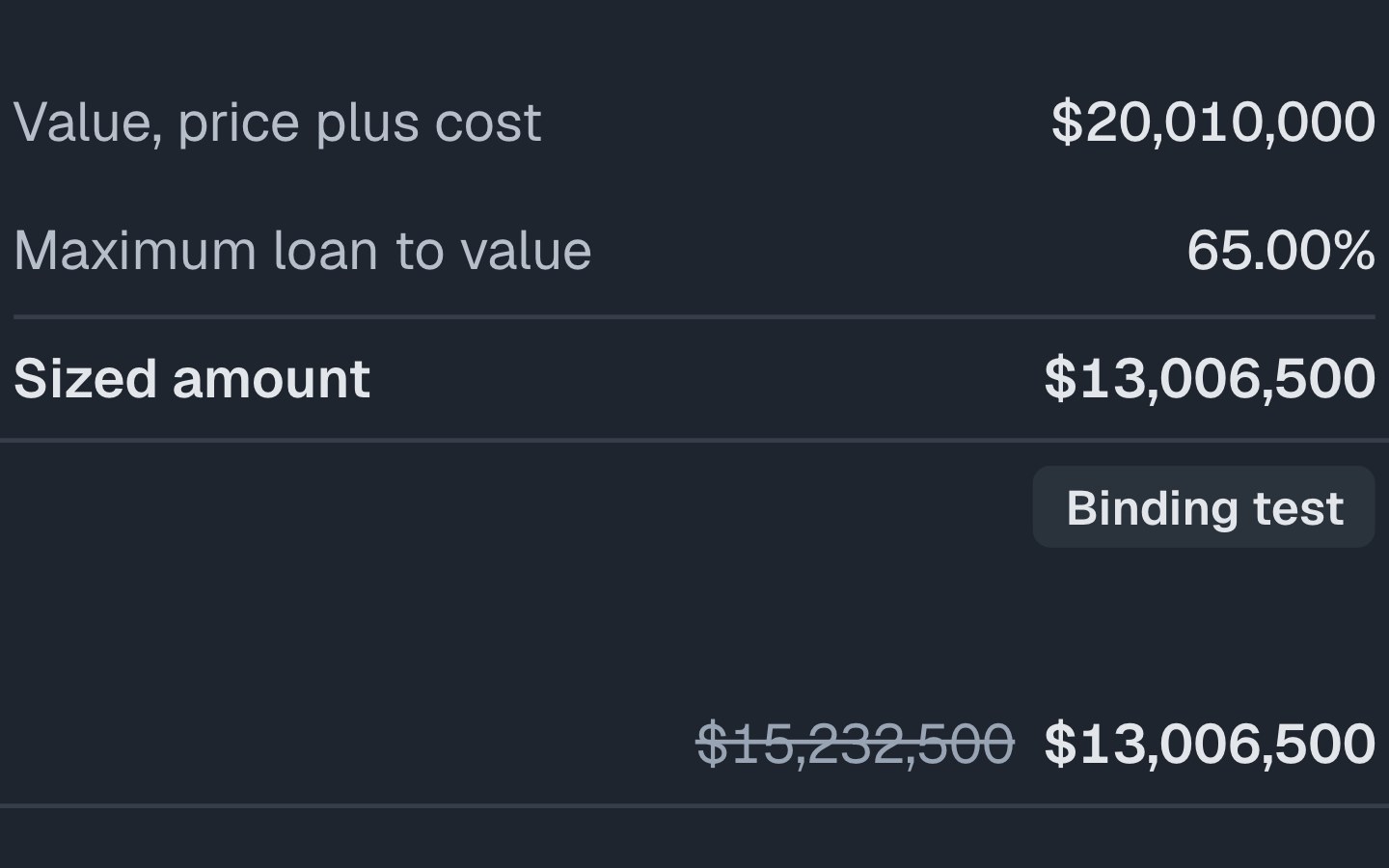
- Three sized amounts side by side: by coverage at a stress rate, by loan to value, by debt yield. The lowest carries "Binding test", the other two show their headroom, and the loan equals the binding amount.
- How it works
- Three sized amounts are lines in the model, and the loan is their minimum. The binding test is named. At the sized loan the binding test sits at its limit and the other two pass.
Rests on today (November 14, 2026): Sizing names a binding test in the prototype. No run stands behind three-way sizing yet. To build: three sizing lines and their minimum.
Solve a loop
- In Excel
- Iterative calculation switched on, or a paste-values macro.
- In Basis
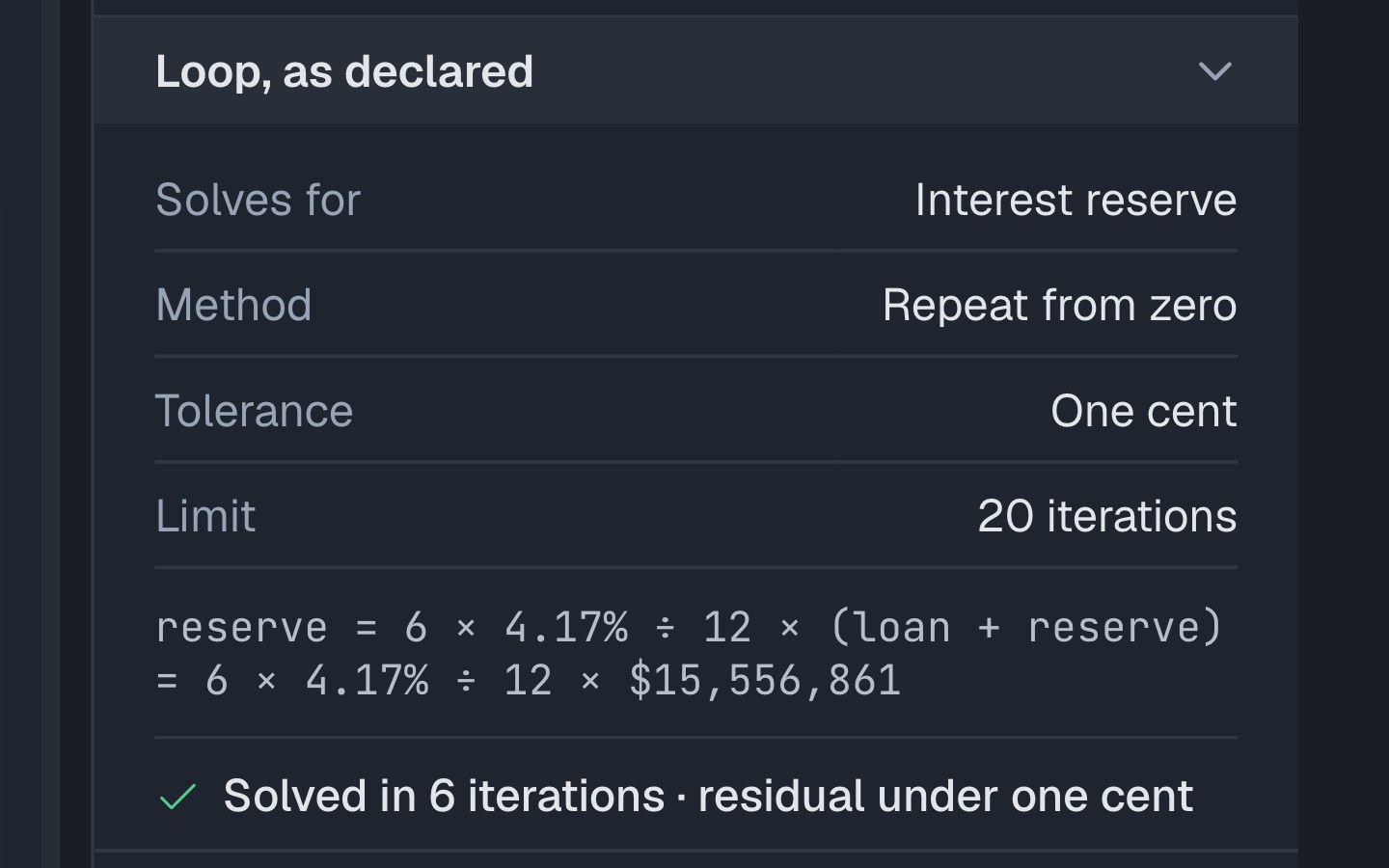
- A new use, "Interest reserve", marked solved, with the loop as declared: what it solves for, the method, the tolerance, the limit, and its result, "Solved in 6 iterations · residual under one cent". If it fails, the value is withheld and each figure downstream reads "not computed".
- How it works
- A loop is declared: what it solves for, the method, a tolerance and a limit. Each result prints whether it converged and with what residual. A loop that does not converge withholds its value, and every figure downstream says so.
Rests on today (November 14, 2026): a loop test with a known answer was run on November 14, 2026 and passes in 37 steps; the picture's six iterations are an illustration. To build: the loop declaration, starting with the return solver the engine already has.
Tables and targets
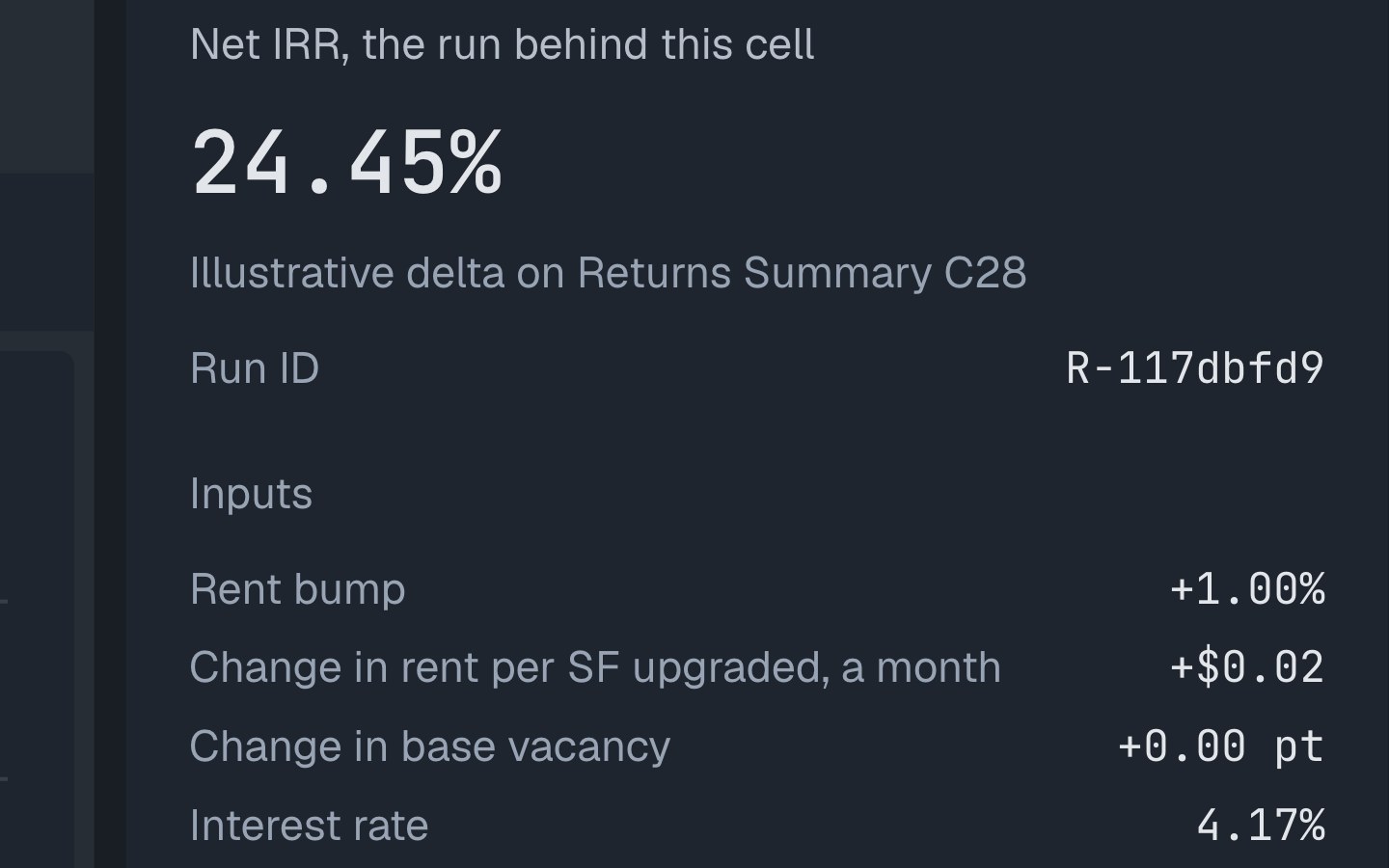
- In Excel
- Data Table and Goal Seek.
- In Basis
- A sensitivity grid where any cell opens the run behind it, with its inputs and its run ID. Above it, one row for a target: "LP return 15.00%", the input "Price", the answer, and "found in 25 runs".
- How it works
- Each cell of a grid is a full run of the engine, and any cell opens the run behind it. A target is found by bisection on one input. Every cell reproduces from its run.
Rests on today (November 14, 2026): measured on the engine on November 14, 2026, on a test deal shaped like Bexley: a 1,296-run grid in 19.8 seconds, and a target found in 25 runs. To build: the grid and goal-seek tools.
A longer hold
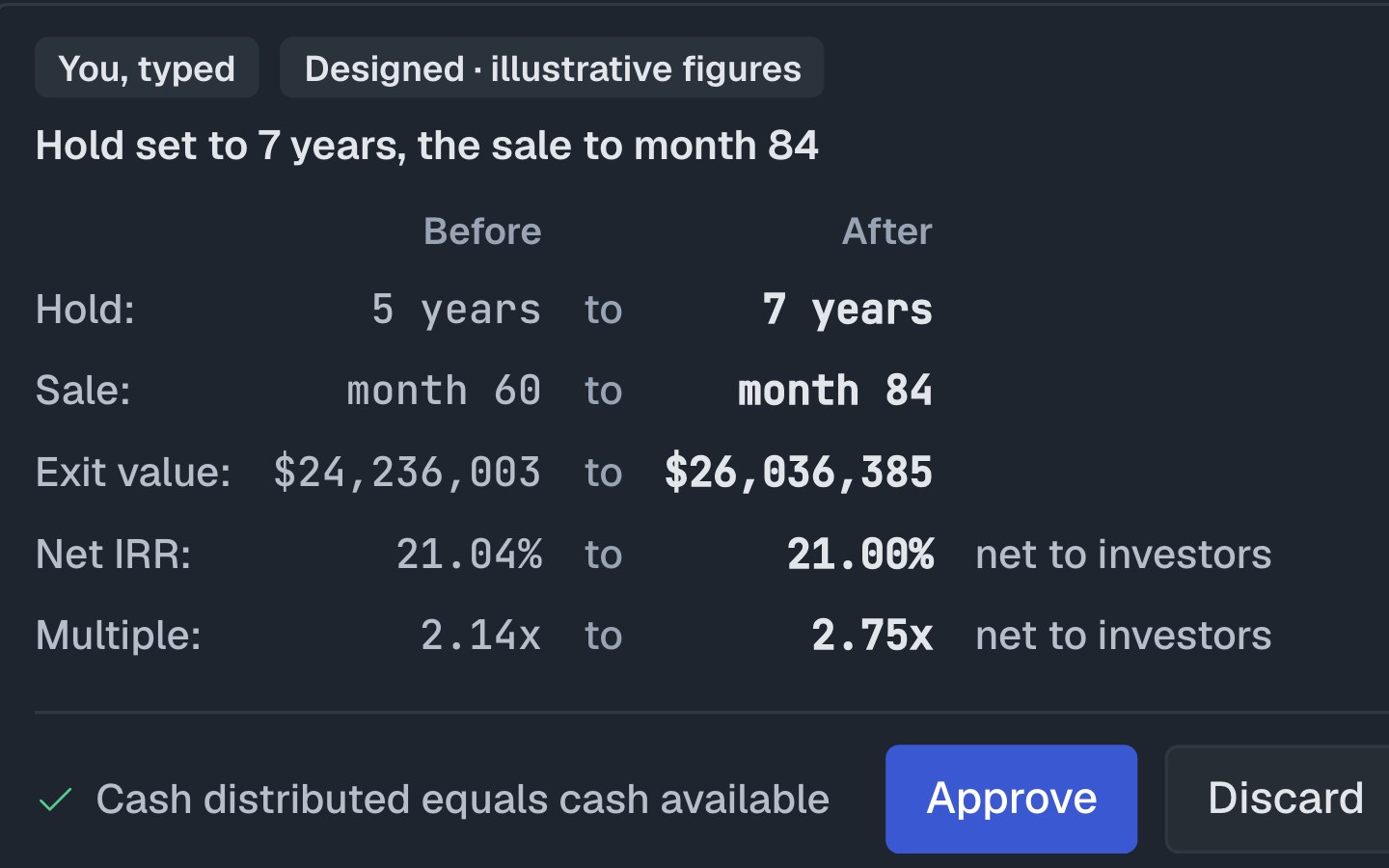
- In Excel
- Extend the columns and repair every range.
- In Basis
- The hold set to 7 years and the sale to month 84. Years 6 and 7 appear in the cash flow, each yearly input carrying the rule that extended it, and the read-back card shows exit value and return before and after.
- How it works
- The hold and the sale month are inputs. Yearly inputs extend past Year 5 by a rule printed on the screen. The deal re-runs to the sale month before a person approves.
Rests on today (November 14, 2026): nothing is run or built behind this step yet. Today the hold is 60 months. A seven-year case is set as the test to pass. To build: the hold as an input.
A monthly pro forma
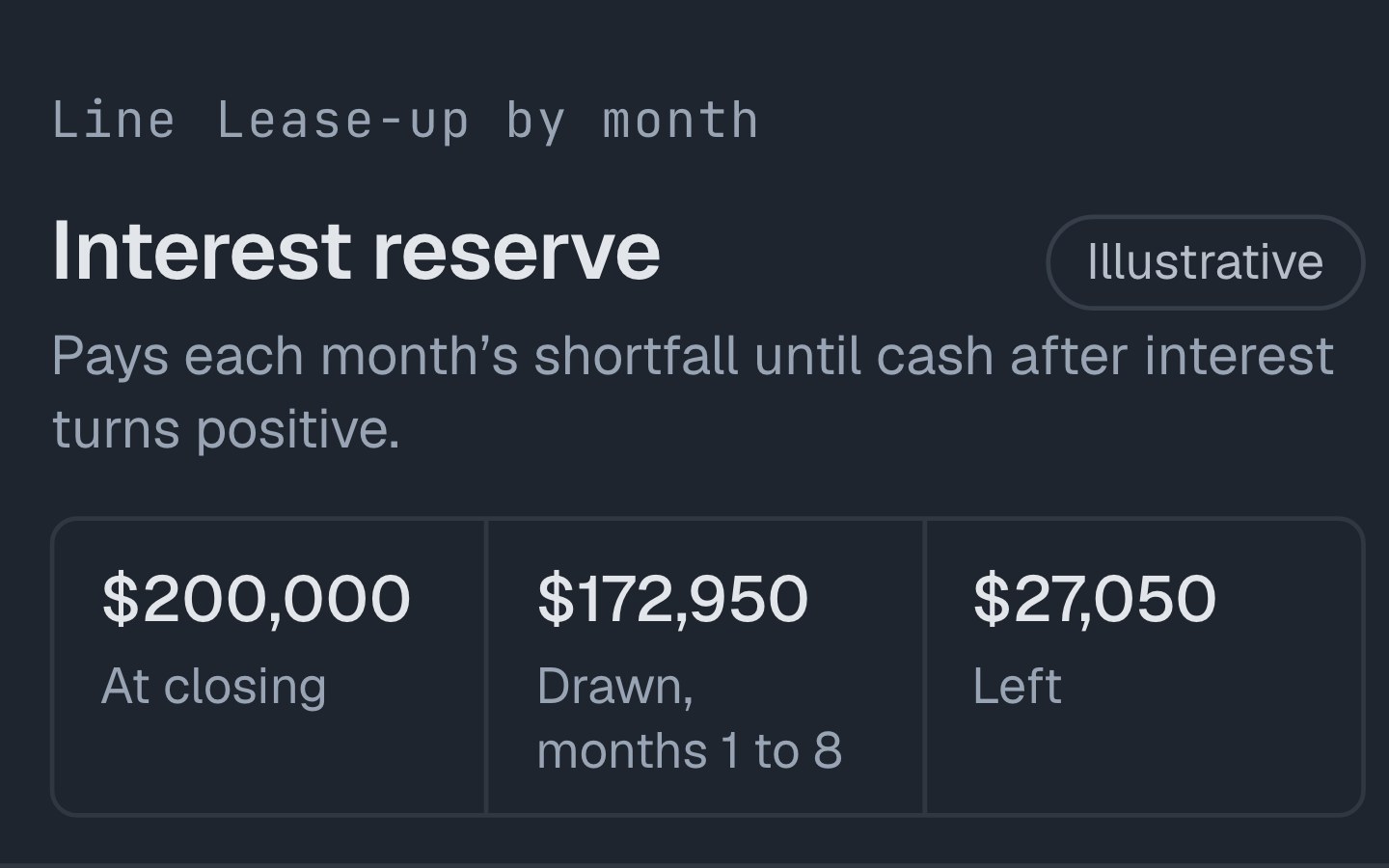
- In Excel
- A separate monthly workbook.
- In Basis
- A lease-up by month on the Model's own Outputs: occupancy rising from 55% to 93% over 15 months, concessions as a monthly row, the loan's draws, and the interest reserve stepping down until cash turns positive.
- How it works
- Absorption and concessions are monthly series. Draws, an interest reserve and a longer hold are the same pieces the rest of the model uses. The pro forma is the engine's run at monthly detail.
Rests on today (November 14, 2026): the revenue engine runs twelve months by floor plan in the prototype, built and live. To build: nothing of its own. It follows from the override, the loan events, the loop and the longer hold.
Lookups and pivots
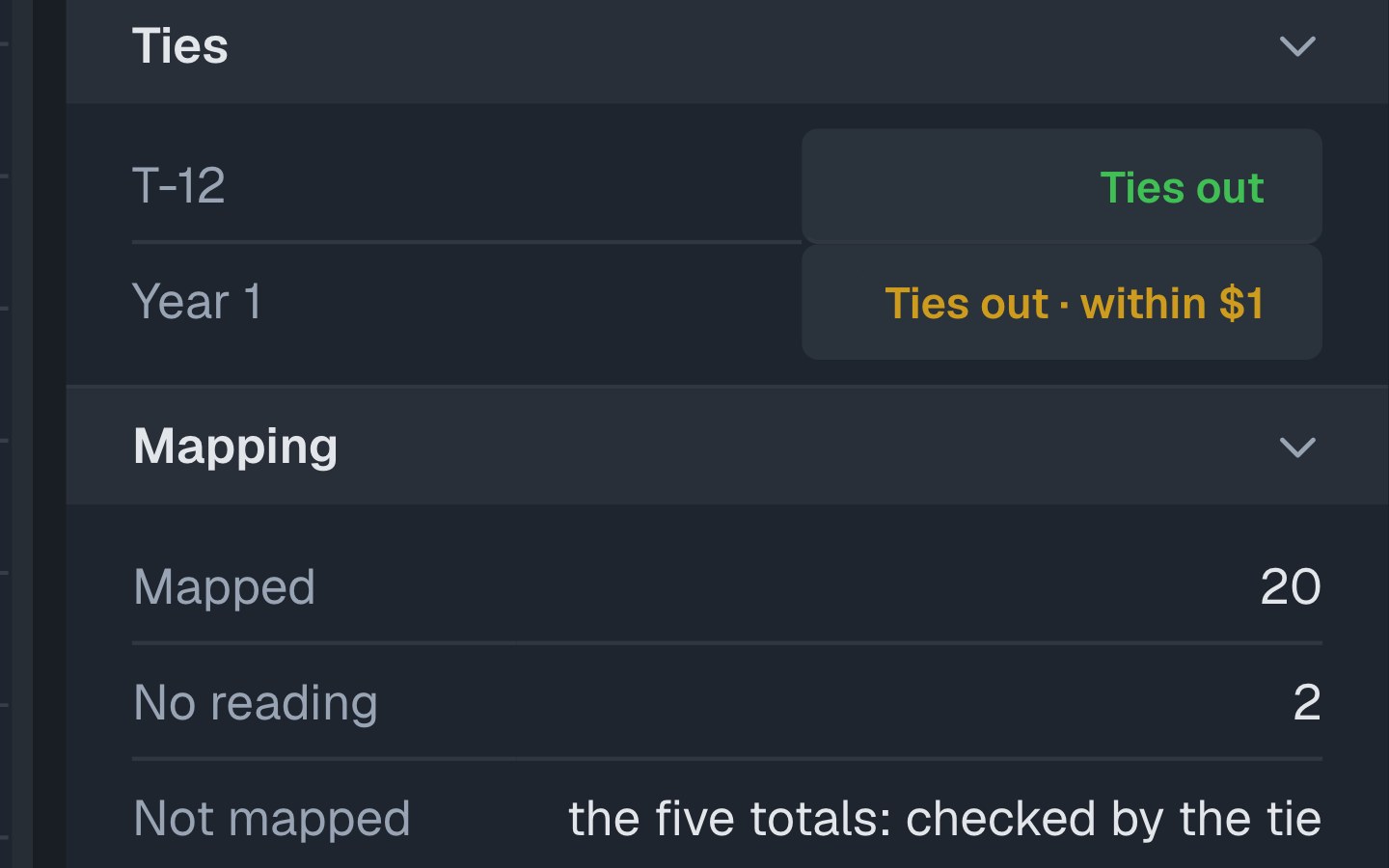
- In Excel
- VLOOKUP, SUMIFS, a pivot table.
- In Basis
- Two small screens. The firm's account mapping, with the one unmapped account named and waiting at the top until a person maps it and the tie reads "Ties out". And a query tab: vacant units by plan, from the rent-roll rows.
- How it works
- The account mapping is the firm's own data. An account with no mapping is named and left for a person, never guessed. A pivot is a query over the rent-roll rows, shown in a tab.
Rests on today (November 14, 2026): Bexley's statement was read and tied to its printed totals on November 10, 2026, and the Mapping view is in the prototype. To build: the mapping as the firm's own data, and a query tab.
A blank tab
- In Excel
- A new sheet.
- In Basis
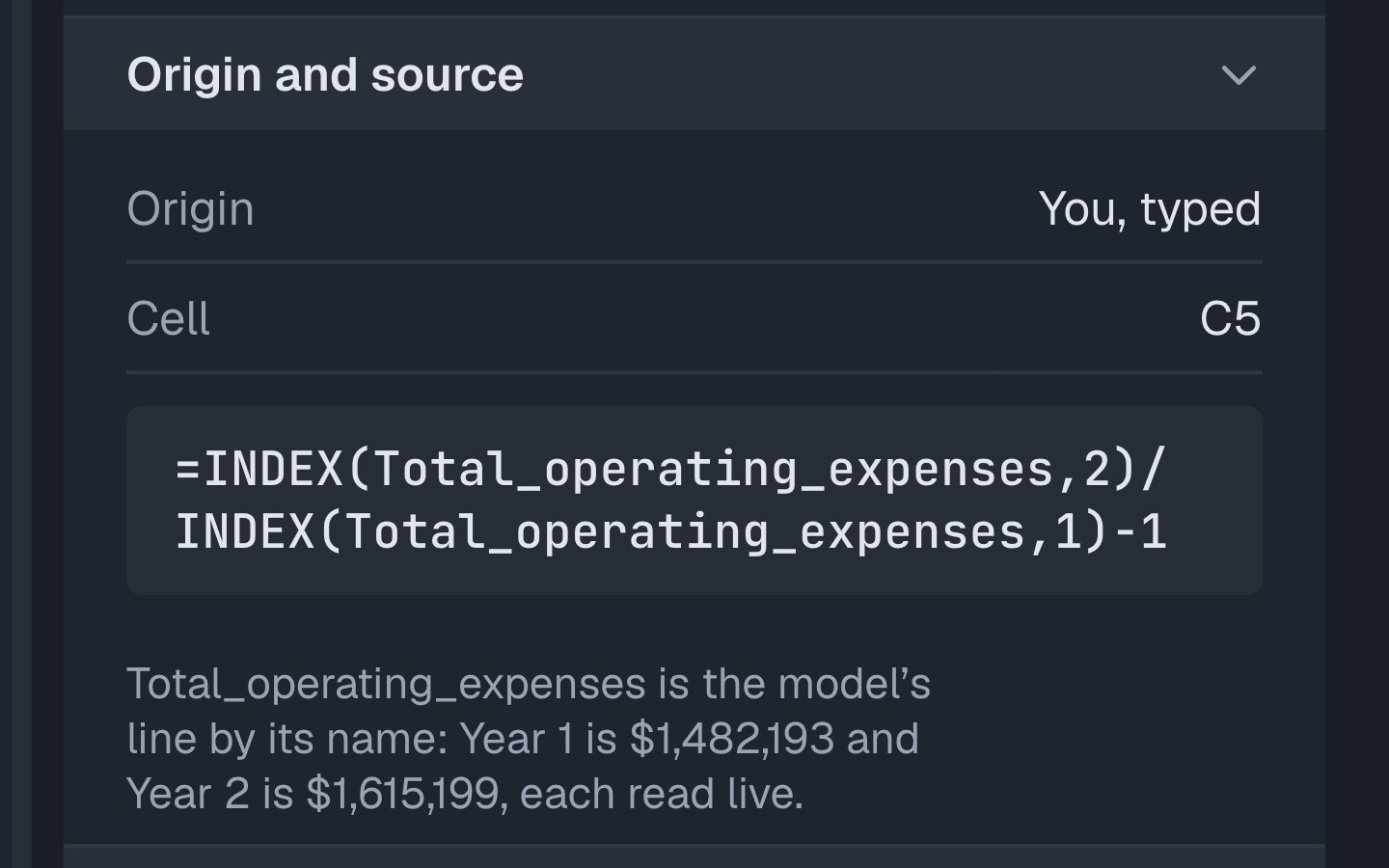
- The Model's strip with a firm's own tab after the built-in ones and a "+" at the end. A grid sets rent growth beside expense growth by year. A selected cell shows the line it reads by name and its formula in Excel's own functions. One step writes: "Promote to the model".
- How it works
- A tab has a kind and reads any model line, document fact or date by name, live. It changes nothing in the model by itself. One named, approved step moves a range into the model, and the checks pass or the step is refused with the failing check shown.
Rests on today (November 14, 2026): nothing is run or built behind this step yet. The pattern it follows, a tab of a set kind that an agent fills, was read in the model platform maker's own apps on November 14, 2026. To build: the kinds of tab, a grid on a formula engine that runs on the server, names in a cell, and the promote step.
The whole workbook
- In Excel
- The firm's model is the workbook.
- In Basis
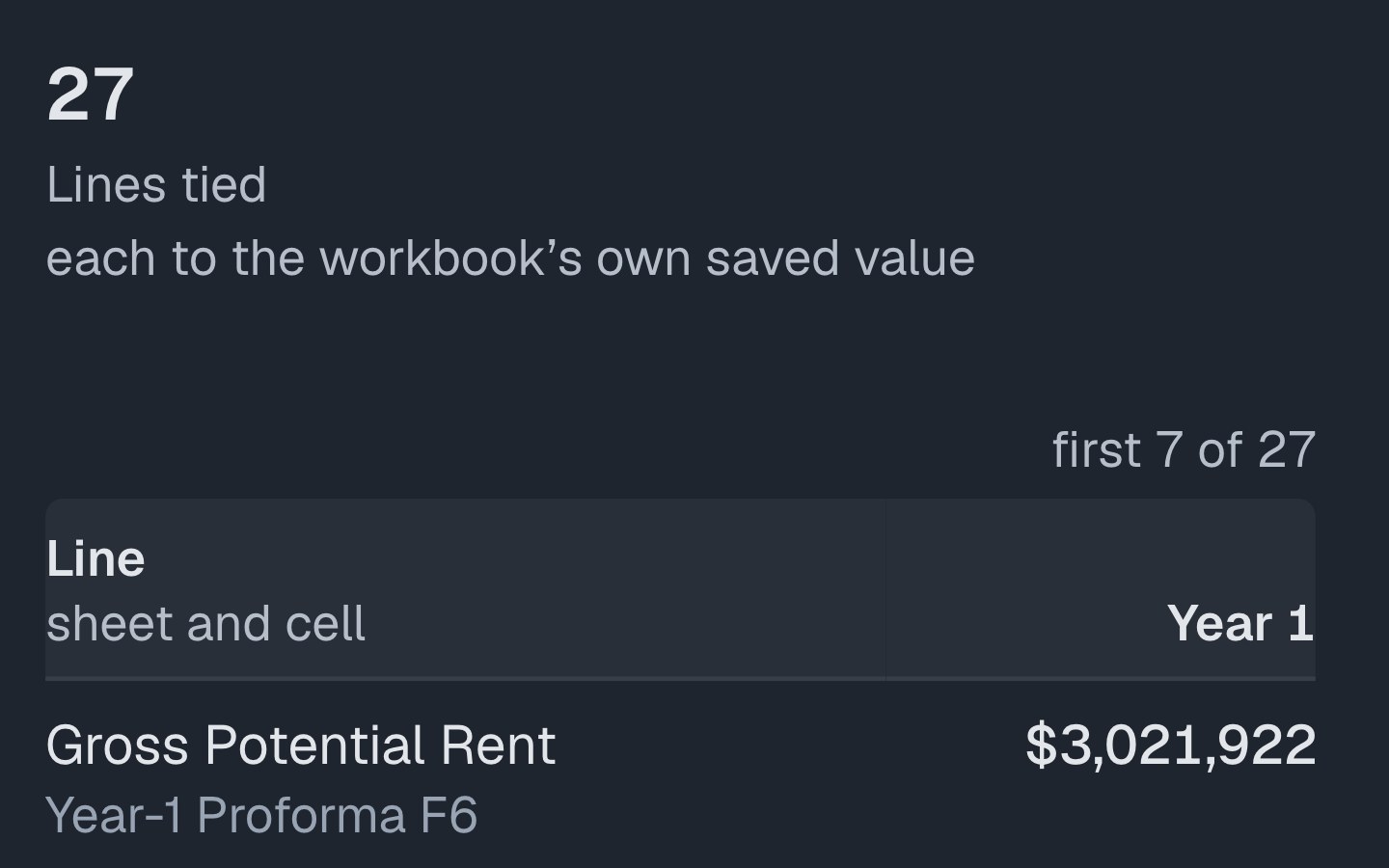
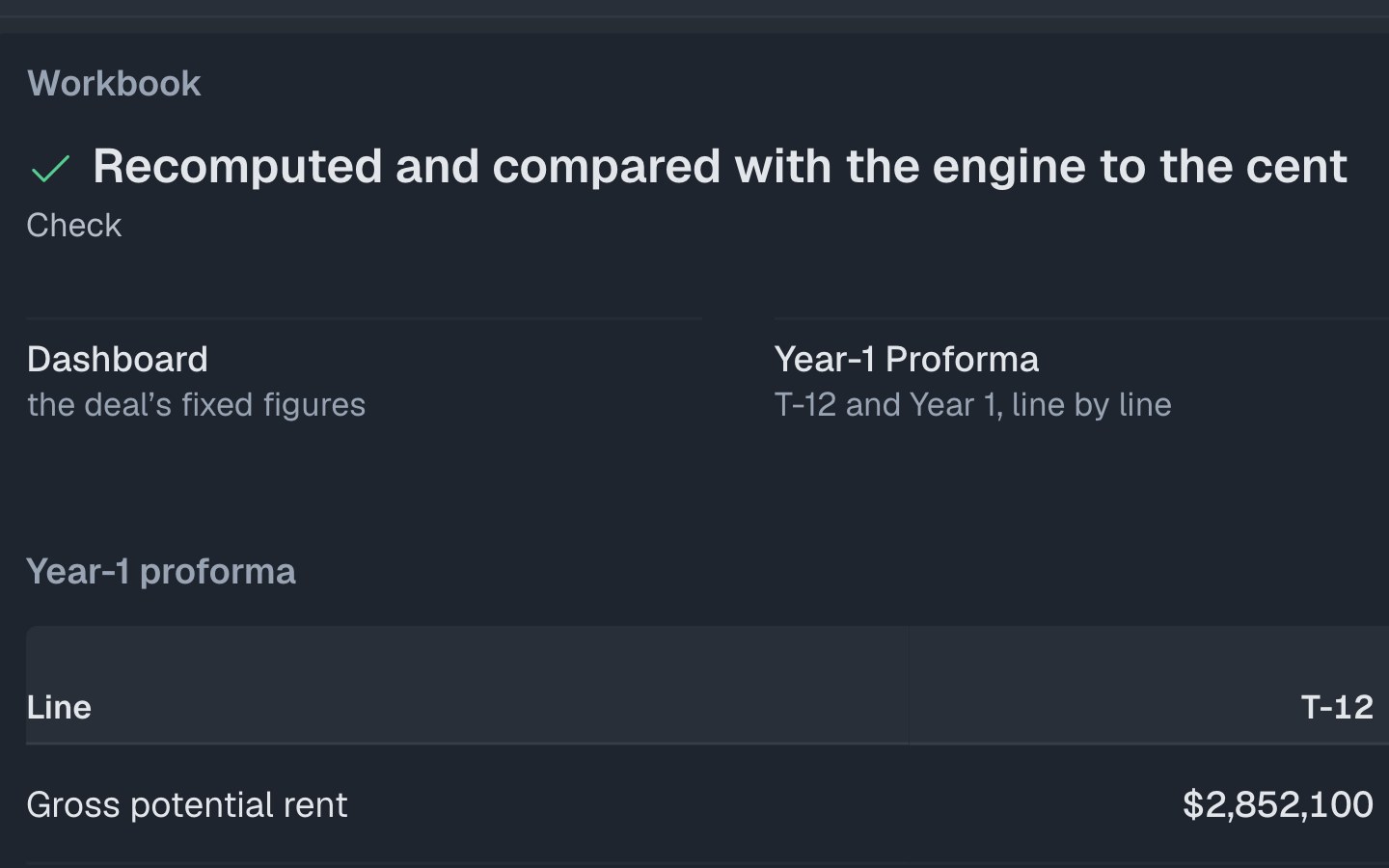
- Two screens. Coming in, a proof report with three counts and their lists: lines tied, lines brought in as values, and cells left behind with the reason. Going out, the Working's download, with the line "Recomputed and compared with the engine to the cent".
- How it works, coming in
- A firm's template comes in where a family of rows maps to one line and ties to the workbook's own saved values. The rest comes in as labeled values. A report lists what tied, what came in as a value and what was left behind.
- How it works, going out
- Every Working leaves as a live workbook: real formulas where Excel has an equivalent, labeled values for the rest. Before download it is recomputed and compared with the engine to the cent.
Rests on today (November 14, 2026): done once, by hand: Bexley ties to the penny on its full operating spine. Writing Excel files is a listed capability of the model platform underneath, read November 14, 2026. To build: the importer and the exporter, each with its check. Any workbook whatever is out of scope.
Say it
- In Excel
- A prompt to the workbook's own assistant, which edits cells.
- In Basis
- The instruction as typed or spoken, then the read-back card. At the desk it is typed in the agent's chat box. On the phone it is spoken.
- How it works
- Spoken or typed words become a named change. The server runs the engine and reads the change back. Nothing applies until a person approves.
Rests on today (November 14, 2026): typed outputs and custom tools are available on the model platform underneath, as read on November 14, 2026, and the read-back's figures come from the engine's own dry run. To build: the change format, and the propose and approve tools.
Scenarios
- In Excel
- CHOOSE or OFFSET switches, or a copy of the file.
- In Basis
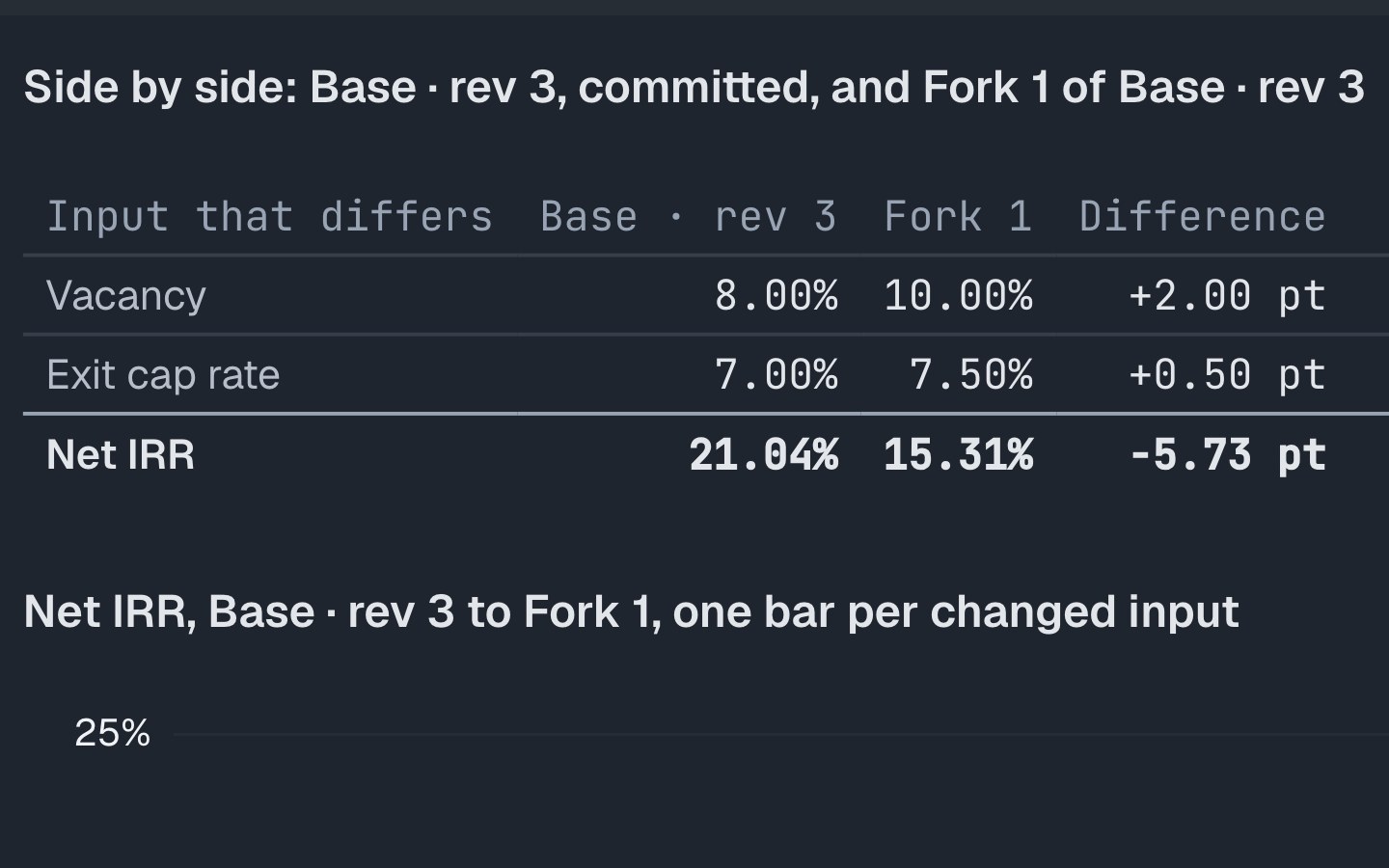
- The parent and the branch in two columns, with the inputs that differ and nothing else, and a bridge from one return to the other, one bar per changed input.
- How it works
- A branch stores its differences from its parent, so the parent is kept. Two branches sit side by side with the inputs that differ and a bridge between their results. A person commits one branch as the decision case.
Rests on today (November 14, 2026): the engine is one function of its inputs, so a branch is a set of input differences, and the scenario control is in the prototype. To build: the branch store, the comparison and the bridge.
A list, by asking
- In Excel
- A tracker sheet kept beside the numbers.
- In Basis
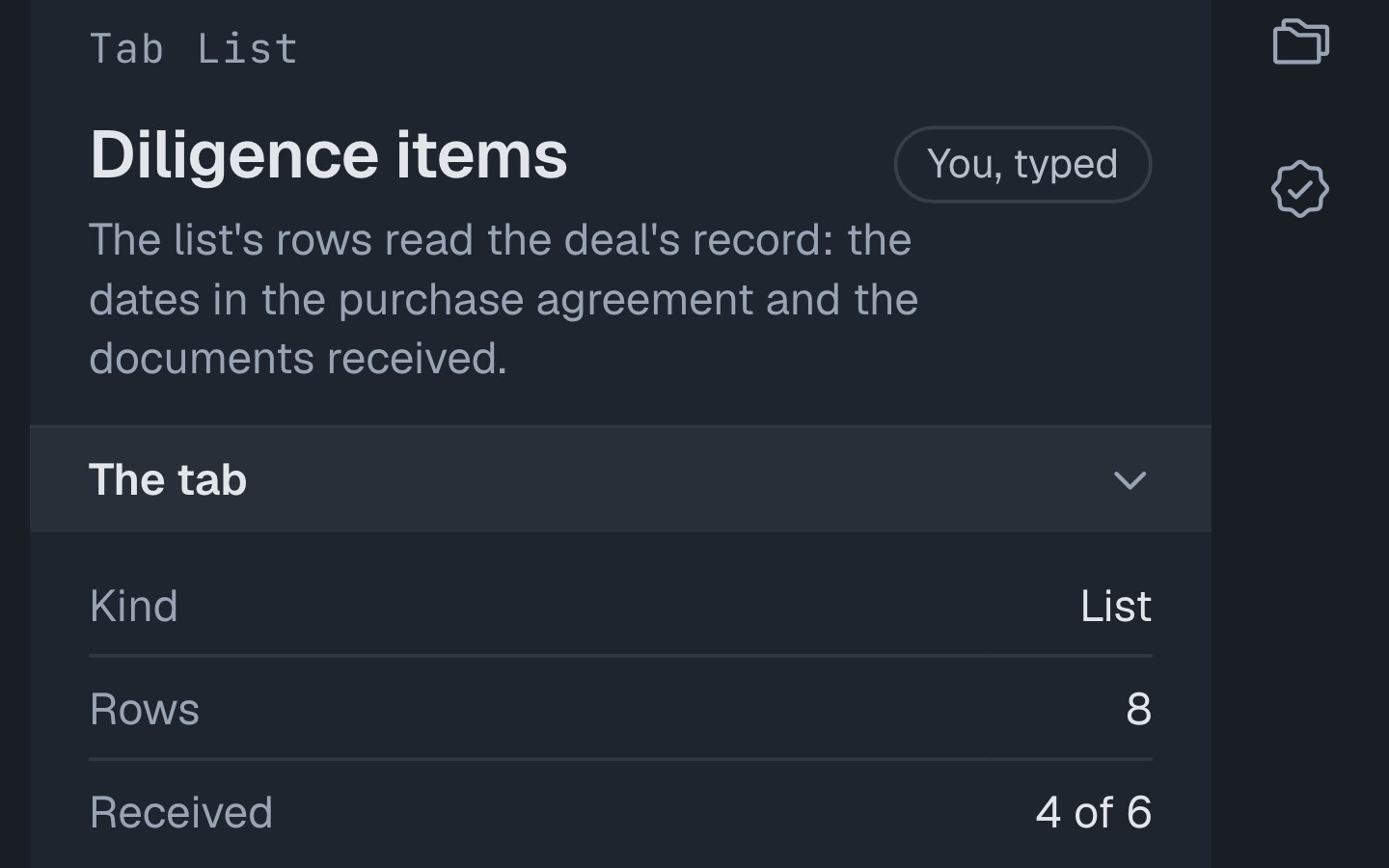
- A list tab beside the model's tabs. Each row reads the record: the dates in the purchase agreement and the documents received. Above the rows, the days left and the count received.
- How it works
- The list's rows read the deal's record: the dates in the purchase agreement and the documents received. A row's status changes when its document lands. Change the closing date in the record and every dependent row moves.
Rests on today (November 14, 2026): the diligence checklist is in the prototype on sample content, and values are read and pinned to their pages on one real deal. To build: the list kind of tab, and rows that read a document's facts.
- Your rules stay in force
- Screening presets, thresholds, metric definitions and assumption sets are governed objects in Workshop: versioned, approved, replayed before they change. A firm's own definition of in-place rent, its own sensitivity grid: each is written once and runs on every deal.
- Branch freely, commit deliberately
- Branch from any point, compare side by side, keep the parent. The one human gate is where a scenario becomes the decision case.
- The agent proposes. A person approves.
- Each material assumption is tested against the firm's own history and approved benchmarks, with the driver named. On a person's instruction the agent prepares the change and the engine reads it back. The person's approval is what applies it.
- Checks that cannot be switched off
- Sources equal uses. Twelve months equal the year. Every dollar available is distributed. The engine tests these on every run, whatever a user writes. An arrangement the engine does not support is identified before calculation. Designed.
- Every change carries its receipt
- A changed line shows the house formula, the firm's formula, who changed it and why, and what the change did to NOI, coverage and return. Remove the change and the house formula returns. Designed.
- AssumptionsEvery lever, each with a default the underwriter changes or leaves.Prototype
- Rent RollThe rent roll by plan with rents, exposure and occupancy, tied to the source summary.Prototype
- OutputsThe Year-1 proforma, five years of cash flow, sources and uses.Prototype
- SensitivityGrids shaded by the firm's bar, the committed case outlined.Prototype
- CanvasThe tabs a firm adds beside the model. A tab reads every line and changes none by itself. A named, approved step moves its work into the model.Designed
- ResearchEvidence, benchmarks and the firm's own history where each assumption is set.Designed
Station 04 · The Model
The agent challenges. A person sets every lever.
Investor's deskBexley's 86 assumptions on one page, under a live bar that re-tests the deal against the firm's bar as a lever moves. The agent tests each material assumption against the firm's own history and approved benchmarks and names the driver. On a person's instruction it prepares the change, the engine reads it back, and the person's approval is what applies it. The bar's re-test works live in the prototype, on demo data. The agent's challenge and the read-back are designed.
Lender's deskThe live bar re-tests the loan against the lender's own limits as a lever moves. Designed
When a lever moves
- The revenue engineRecomputed
- The firm's barRe-tested
- OutputsRecomputed
- Net returnsUnderwriting model
Net returns on this screen are the founder's model's own figures. Wiring the engine's returns to the screens is to come.
 , opens live in a new tab
Rests on today (November 14, 2026): the proposal card is in the prototype, and the read-back's figures come from the engine's own dry run, which takes 17 milliseconds. To build: the change format, and the propose and approve tools.
The agents
What Basis's agents do between the firm's decisions.
Investor's deskToday the Pipeline's agent column and the Agent screen show what each agent did on every deal and what it waits on. Designed next: a deal seat that reads each new deal as it lands, runs the engine, and has the findings drafted and the questions queued before the analyst sits down. Designed
Lender's deskThe same seat reads each loan request as it lands and queues the questions for the borrower. Designed
How Basis is run
Basis is run as a governed work system. Every step in a deal belongs to exactly one of three actors. Agents read, tie, draft, challenge and chase, and what they produce is a proposal. The engine computes every number in typed code, the same way every time. A person makes every decision and releases everything that leaves the firm.
One agent holds the thread of a deal, and it does not work alone. When documents arrive, readers take a page each and work side by side. Code ties what they read to the document's own printed totals before any figure is kept. The agent on the deal then works from the record. It challenges assumptions against the firm's own history, drafts the brief, the questions and the memo, and prepares each chase. A separate checker sees the finished work and the record, and nothing of how the work was produced.
Nothing depends on what an agent remembers. Every fact sits in the deal's record with its page, every decision with a name and a time, every version with its source. A fresh agent can pick up any deal from the record at any point, so work carries across days without one long session.
Each step gets the level of model it needs. Reading a page runs on a fast, low-cost level. Drafting runs a level up. A hard clause or a change of structure goes to the strongest level. A failed check is what moves work up a level. The model's own confidence is not.
It improves with use, under the firm's control. The firm's method lives in rules and skills the firm approves. A correction becomes a rule after it is tested against past deals and a person rules on it. No model is trained on a firm's files.
Reading and tying are real on one deal, in 23 calls for 23 pages. The engine and the permission layer are built. Reading pages side by side, the hold on a failed tie, and the agent work above reading are a clickable prototype or designed.
Seven rules the agents run under
| The question | The rule |
|---|---|
| Who owns a run | Basis's own supervisor: code that opens each piece of work, starts the worker and checks what comes back. No model session becomes it |
| Who checks the work | Code first, on every number. Then a checker that saw none of the drafting. Then a model from a different maker on anything leaving the firm |
| Who computes | The engine. A model never produces a number that is kept |
| What memory is | A hint. The record is the truth, and every session is rebuilt from it |
| How it improves | A correction is a candidate: a test on past deals, a person's ruling, a version, a way back |
| Where a person stands | A release on each item, tied to its exact text. Every document's place on a deal is confirmed by a person |
| How a model is chosen | The lowest-cost level that passes the step's own test. A model's confidence is never the signal |
Designed. The engine and the permission layer are built.
As of November 14, 2026, the way Basis's agents are organized follows the practice the maker of the model platform underneath published on October 22, 2026, and uses platform capabilities released between May and November 2026. The dates and links are available on request.
What Basis adds is the part a platform does not supply: an engine that computes every number, the source behind every figure, and a person's release on everything that leaves the firm.
The three kinds of worker
All the agent work on a deal is done by three kinds of worker. Each is a model session with one job, a fixed form for its answer and a budget.
| The reader | The deal seat | The checker | |
|---|---|---|---|
| Its job | Turn one page or one document into values, each pinned to its page | Hold the thread of one deal: challenge assumptions, draft, prepare chases, answer the analyst, propose changes | Judge one finished piece of work against the record |
| How many | Many at once, one to a page or a document | One to a deal at a time | One to a piece of work. A second, on a different maker's model, for anything leaving the firm |
| What it sees | The page, the document's layout and printed totals, the firm's reading rules. Nothing is carried over | The firm's rules and the deal's record, rebuilt each time it starts | The piece, the record and the test it is judged by. Never how the piece was made |
| What it can do | Return its answer, and nothing else. It reads text written outside the firm, so it holds no tool | Read the record, run the engine as a dry run, propose a change, draft, make a tab | Read the record |
| How long it lives | Seconds to a minute | A working stretch. Then a fresh one starts from the record | One judgment |
| What it hands back | Candidates. Code decides whether they tie | Proposals, each with the engine's read-back | Pass, or the gaps by name |
Why three, and no team of specialists. Work split by role loses something at every handoff. So the split follows what each worker needs to see: a reader needs one page, a checker must see none of the drafting, and everything else stays with the one agent that holds the deal.
Text in a document is data. A worker that reads a broker's email, an offering document or a web page holds no tool that can change a figure, pass a gate or release anything.
The reader: real on one deal. The deal seat and the checker: designed.
Which level of model does which work
A step runs on the lowest-cost level of model that passes that step's own test. Five levels, lowest cost first.
| Level | Work in Basis | Why this level |
|---|---|---|
| Read a page | Sort a file by kind, read a page, pin each value, file a document | The volume is high and code checks every read, so a miss costs one re-read |
| Draft from the record | The broker's questions, chase drafts, checklist rows, the summary of one document | It is drafting from facts the record already holds |
| Hold the deal's thread | The deal seat: work in several steps with the Basis tools, the screening brief, the memo from engine figures, diligence compared across versions | Most of the work starts here |
| Judge a hard clause | A hard clause in a contract, a change to the model's structure, the strongest challenge to an assumption and the strongest answer to it, a committee question no one planned for | A wrong reading costs the most here |
| A second reader from a different maker | The package leaving the firm, read against the record before a person releases it | It checks the words. The engine has the numbers |
What moves work up a level is a failed check: a tie that fails, an answer in the wrong form, a value with no page, a retry limit reached. A model's own confidence never does.
An example. A page read at the lowest level fails its tie. That page is read again one level up. If it still fails, a person sees both readings beside the page.
A customer's data policy can decide the level. Where a lender's policy rules out the retention terms of the top level, that work runs one level down.
List prices on November 14, 2026 differ by a factor of eighty between the lowest level and the highest, which is why sending each step to the lowest level that passes is the main control on cost. What has been measured is one read of one deal: Bexley's 23 pages, for $1.73 of computer cost. Nothing here is a cost per deal for the whole workflow.
Designed. This is a dated starting configuration: tests decide, and it changes when a model ships.
How it gets better with use
Basis gets better at a firm's work in four ways. None of them is training a model.
The firm's method. Rules, presets, mappings and skills in the Workshop: how this firm reads a rent roll, its memo format, its contract positions. The firm approves each one after it is replayed against past decisions.
The firm's own deals. The benchmark base: what was underwritten, what was paid and what the asset did. A person confirms what enters. A house that both lends and services adds its own loan history from Covenant, one way.
Basis's own test set. Every correction, every declined deal and every failed tie becomes a test case. A prompt, a skill or a model level changes when it passes the set, and at no other time.
Working notes. What a firm's files are like, a format's quirks. They are hints a person can read and correct, and they are never authority.
The path a correction takes: a person corrects a value or a draft. It is filed as a candidate. It is tested on past deals. A person rules. It ships as a new version of a rule. A rule can be rolled back. No model is trained on a firm's files.
The Workshop's rules and their approval: clickable prototype on demo data. Replay, the test set and working notes: designed.
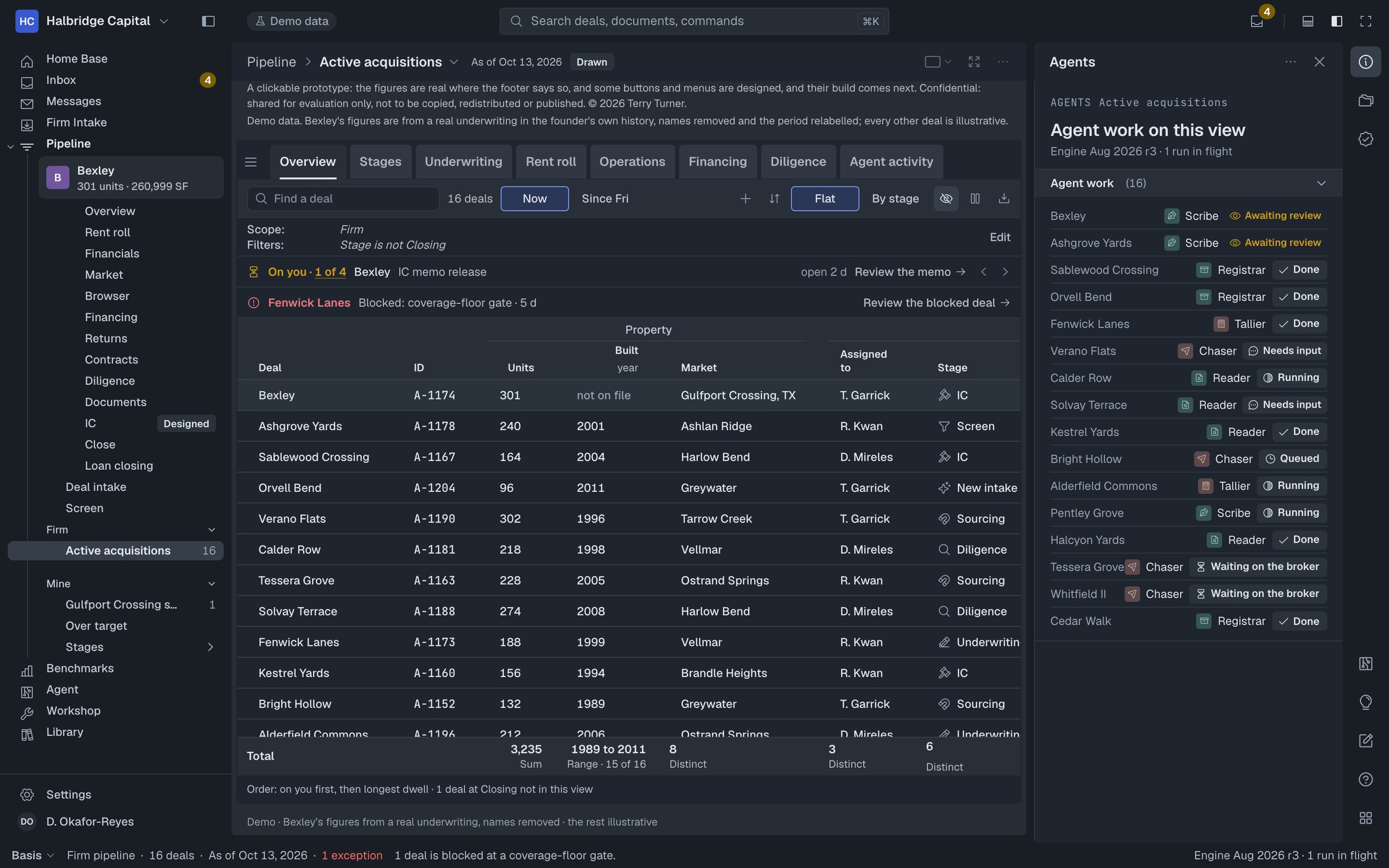 , opens live in a new tab
- ReadEach page of each document is read, and every value is pinned to its page. A person confirms or corrects.
- TieCode adds up what was read and tests it against the document's own printed totals. A figure that does not tie is held and named, never smoothed.
- DraftOne agent holds the deal's thread and writes from the record: the screening brief, the questions, the memo. Every number in a draft is checked against the engine's before a person sees it.
- CheckA second agent that saw none of the drafting reads the finished work against the record. Anything leaving the firm is also read by a model from a different maker.
- ChaseWhat is missing is drafted and queued the day it is due. A person releases each one.
- Carry onThe deal's record holds every fact, decision and open item, so a fresh agent picks up any deal where the last one stopped.
Reading and tying: real on one deal. The hold on a figure that fails its tie, and the rest: designed.
Basis has its own browser, shared by the person and the agent. The agent's market search runs there step by step, on sites the firm has approved. It reads, and it never signs in or submits a form. Each comp it reads goes into the comp table with a saved capture of the page and the date it was read. A lender's benchmark is its own loan history, for the loans it both made and services; an investor's is its own past deals; the two are kept apart. Designed
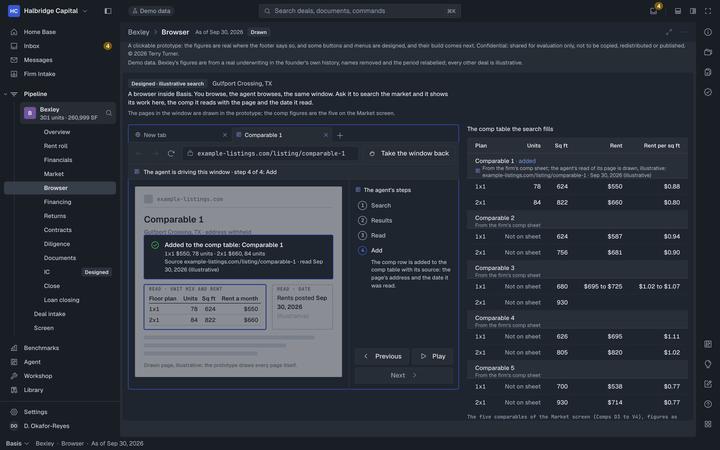 , opens live in a new tab
Rests on today (November 14, 2026): the Browser screen of the prototype, whose pages are drawn for it. To build: the hosted browser, the approved list of sites and the saved captures.
From the saved captures the agent reads each comp's finishes and sets the subject's interiors beside each comp's interiors and rent, in one grid. A cost source the firm chooses prices what was seen, code adds it up, and the figure prints as an estimate, with its photo count and date, beside the lever a person sets. Designed
A second agent proposes rules from what it saw across deals. Each is replayed against past deals, filed for the firm's ruling, and never applied unruled. Designed
The lists
What it watches, and what it does unasked.
Our Basis analytics catalog of November 5, 2026, counts 90 measures a deal's documents can support and 37 things the agents do unasked; these are the twelve and the five that lead, each with the screen of the prototype that draws it. An unasked action is a rule the firm sets once: it runs when a document lands or on a schedule, its result is a proposal, and nothing changes the model or leaves the firm until a person approves it.
The analytics · the twelve at the top
- The deal against the firm's bar, every line with its headroom Screen, Overview
- The deal's assumptions against what the firm's own deals achieved Benchmarks
- Occupancy, physical from the rent roll and economic from the model Rent Roll, Overview
- In-place rent against market, and loss to lease unit by unit Rent Roll
- Lease expirations by month, and the exposure by plan Rent Roll
- The walk from potential rent to net operating income, trailing against Year 1 Financials
- Each expense line a unit, against the trailing year and the firm's own range Financials, Benchmarks
- Twelve months of revenue and occupancy, from the revenue engine Model
- Coverage by year, and the loan sized each way Financing
- Returns to investors, with the grid of what can change the decision Returns
- Where two documents disagree, and what is still missing Documents
- What waits on whom across every deal, and how long each has sat Home Base, Pipeline
Live today: the revenue engine, and the bar re-tested as a lever moves on the Model. The rest is drawn on demo data; the firm's achieved figures are illustrative, and filing its own statements is designed.
What the agents do unasked · the five that lead
- The decline citing the lines below the bar, and the broker's questions, already drafted. Screen
- Rent growth set beside what the firm's own closed deals achieved, with nothing changed. Benchmarks, Home Base
- A lever moved: the twelve months of revenue re-run and the bar re-tested. Model
- Two documents that disagree, side by side, with the source of record recommended. Documents
- The committee memo drafted, with release waiting on four named items. Home Base
Of the 37, 6 rest on reading or calculation already built and 31 are designed. Each of the five is drawn on demo data, and the lever re-run works live; unattended agent runs are designed.
Station 07 · Diligence
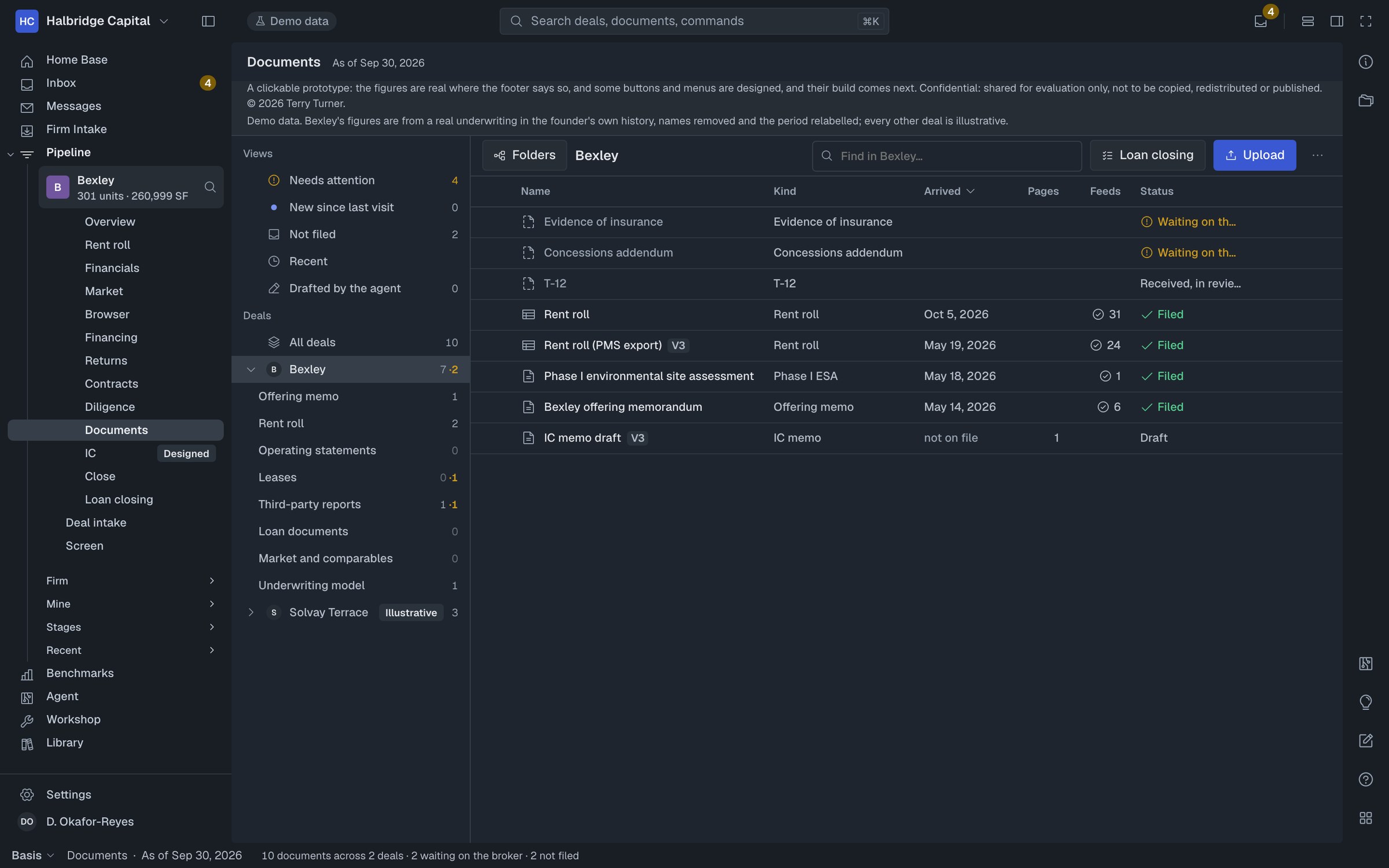
Every figure opens its source.
Investor's deskDocuments holds the deal's filed record of every document, what it says and where two documents disagree; Proof opens the source of any figure. Designed next: when a revised document lands, the agent compares it with the version before it, unit by unit and account by account, and stages a branch that shows what moved. The approved case stays as it is until a person accepts the update. Designed
Lender's deskThird-party reports (appraisal, property condition, environmental, title) filed, read and checked against each other. Designed
How the agents work diligence
Diligence runs for weeks. The agent that holds it is rebuilt from the deal's record each working stretch, so nothing rests on one long session.
The checklist. It is built from the purchase agreement's dates and the firm's standard list. Moving the closing date moves its rows.
Each document, as it lands. It is filed as a fixed version and read, and a person confirms which deal it belongs to.
Against what came before. Each new version is compared with the one before it and with what was underwritten, unit by unit and account by account. The comparison is code. A revised rent roll with three changed units lists those three, with the dollar effect through the engine.
Against each other. Each signed lease against its row on the rent roll. Ledger lines for repairs booked as capital. The appraisal, the property condition report, the environmental report and title, read against one another.
Disagreements. Each is named in a register and never smoothed. The agent recommends the source of record. A person rules.
How comfortable to be. It is counted by code: open disagreements by kind, their combined effect on income, coverage and return through the engine, and items still outstanding against the contract's clock. Beside each sits how the firm treated the same kind of finding before, for example "accepted on four of the last six deals, twice with a holdback". No model gives a score.
Chases and forwardings. Each chase is drafted the day its item is due. Each forwarding to the lender, the insurance broker, counsel or title is prepared when its document is filed, to a contact a person has confirmed. A person releases one, several or all of them, and each release leaves a record and a receipt.
The agent never chooses the source of record, marks an item satisfied, changes a recipient or releases anything.
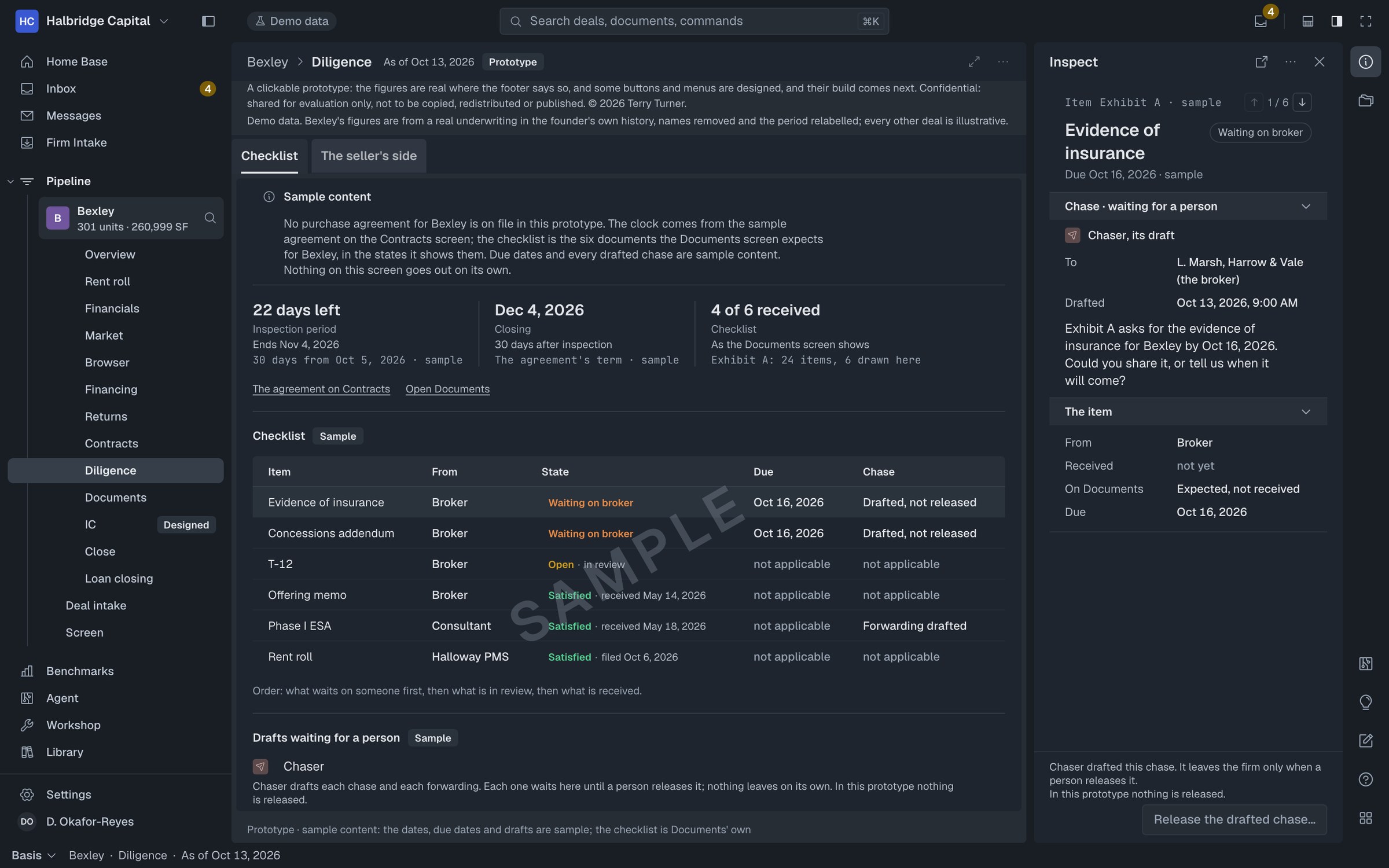 , opens live in a new tab
The checklist and the Documents screen: clickable prototype on sample content. The comparisons, the comfort count and forwarding: designed.
 , opens live in a new tab
AI is making Excel better. Basis is being built around the whole underwriting process: source documents, the firm's model, competing scenarios, diligence and the approved decision.
The workbook
One file for one deal. The numbers are in it. The documents, the checks and the decisions are somewhere else.
The workbook, with AI
The file is built and edited faster. It is still one file for one deal, and a person reviews each change.
Basis
The deal is the record: documents, model and decisions together. Agents propose, the engine computes, a person decides, and the workbook is an export.
Reading, tying and the engine: real on one deal. The deal's record on screen: clickable prototype on demo data. The workbook export: designed.
Bexley ties to the penny on its full operating spine. Renwick Mills' revenue-and-expense spine also ties to the penny across all five years. One engine runs both, with no deal-specific code. The engine is built and tied out; the prototype's screens show demo data, with the revenue engine running live; wiring the rest of the engine to the screens is to come. On November 10, 2026, the engine also ran one real deal beside the app: Bexley's own rent roll and operating statement.
Station 06 · Debt
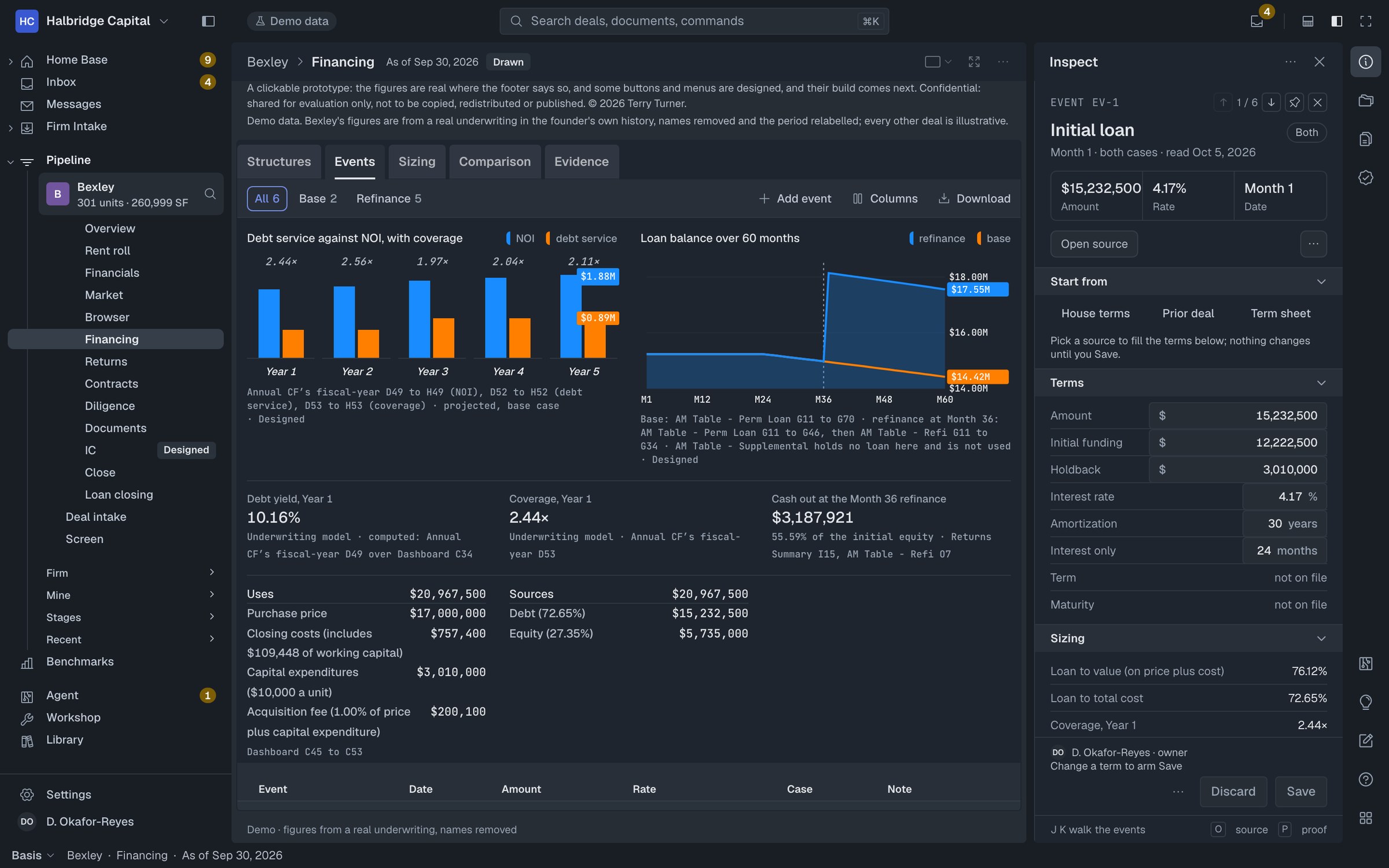
The debt, sized and tied.
Investor's deskEvery financing event, how each loan is sized, sources and uses, and the schedule the model reads.
Lender's deskLoan sizing itself: each constraint side by side, so the binding test is plain. Designed
 , opens live in a new tab
The equity waterfall and the debt schedule are built as engines and verified against their own specifications; wiring the returns layer into the app is to come.
On the Financing screen a refinance is shown with the founder's model figures. Refinance, rate steps and a supplemental loan as events the engine computes: Designed
Station 08 · Close
A person decides at every gate.
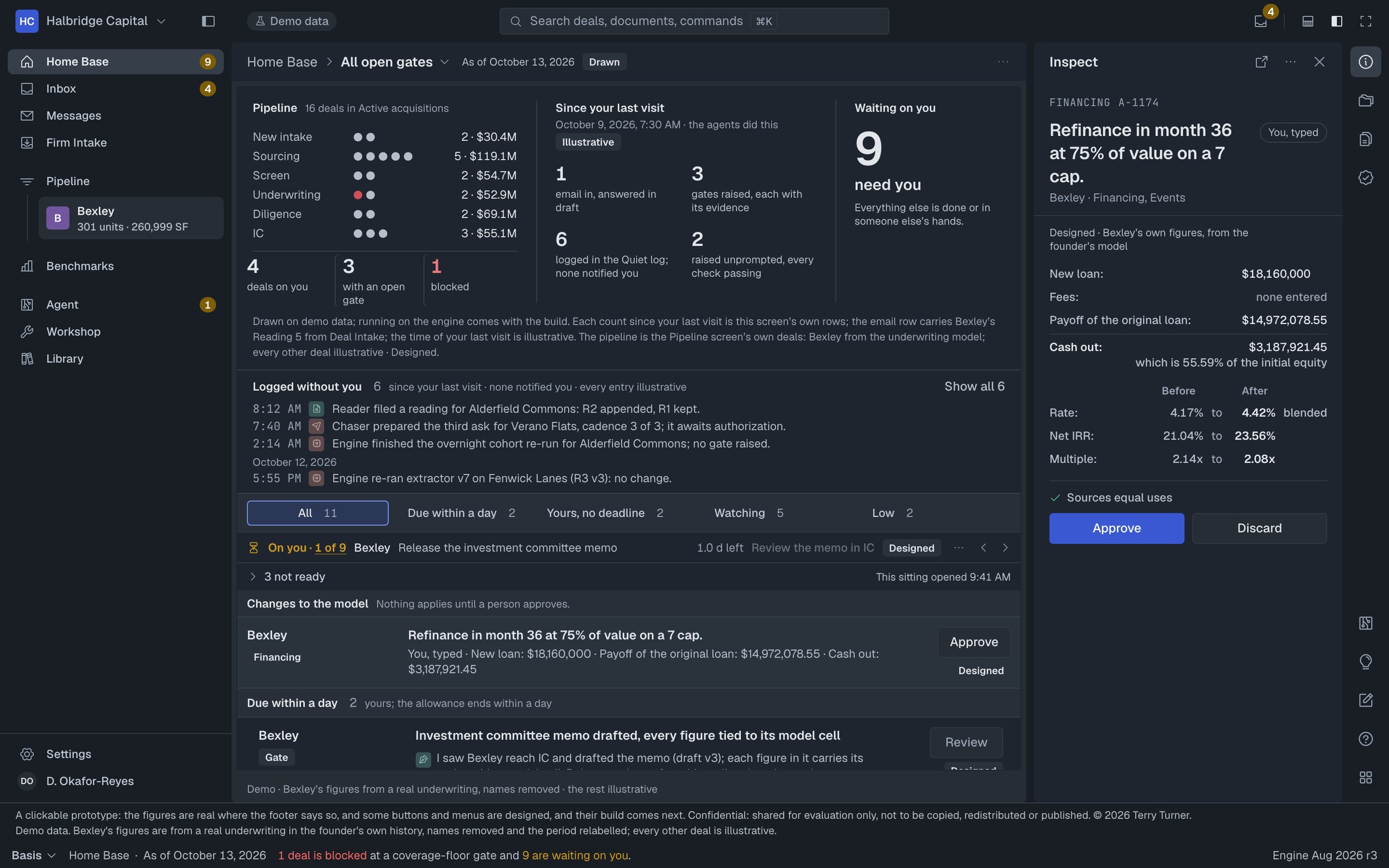
Investor's deskHome Base holds every decision every deal needs, ranked, each with its reason and evidence. At Close: committee approval, a typed wire approval, then the deal lead declares the deal closed.
Lender's deskCredit gates in the same ledger: screen, quote, rate lock, loan committee. The same gate card releases the quote. Designed
What a person decides, station by station
At every station the agents prepare the work and the engine computes it. This is what waits for a person.
| Station | The agents prepare | A person decides |
|---|---|---|
| 01 · The deal arrives | The arrival filed, the deal opened, what is missing mapped | Proceed or hold. Which deal each document belongs to |
| 02 · Intake | Each document read into values, each pinned to its page | Each value: accept it or correct it, with a reason |
| 03 · Screen | The cited no, or the screening brief. The broker's questions | The verdict. Releasing the questions |
| 04 · Underwrite | Each assumption challenged. Each change proposed with the engine's read-back | Every lever. Each change. Committing the decision case |
| 05 · Contracts | The letter of intent and a first pass at the purchase agreement, read against the firm's past contracts | Approving the letter. Settling the agreement with counsel |
| 06 · Debt and the presentation | The memo or the presentation, from engine figures. The committee's questions answered on branches | Approving the presentation. The recommendation |
| 07 · Diligence | The checklist. Each document read and compared. Chases and forwardings drafted | Ruling on each disagreement. Releasing each chase and each forwarding |
| 08 · Close | Each condition tracked. The binder assembled | Committee approval. A typed wire approval. Declaring the deal closed |
| 09 · Final sources and uses | The closing statement read and tied to what was underwritten | Confirming the final |
| 10 · Into the firm's history | The closed deal filed. Rules proposed from what was seen | What enters the benchmark base. Each rule |
| At a lender | The same ten stations in the lender's words | Releasing the quote. The credit decision. Signing the commitment |
Home Base and its gates: clickable prototype on demo data. Each station's own status is on the deal's path at stop 17. The lender's gates: designed.
 , opens live in a new tab
The gate card, at a lender
Release the quote
- Reason
- Recorded by the person who decides
- Evidence
- Every figure, opened on its page
- Decided by
- A person, never the agent
Rests on today (November 14, 2026): the same gate card on Home Base in the prototype, on the investor's desk. The lender's gates are to build.
Before the decision case is committed, the committee sees every line that differs from the firm's model, with its reason. Designed
The agent tracks each condition against its document and assembles the closing binder from the filed versions. Approving a wire, committing funds and declaring a deal closed are a person's acts alone. Designed next: the permission layer, which is built and treats an agent as its own class of actor, refuses an agent's attempt at any of them. Designed
Station 10 · Into the firm's history
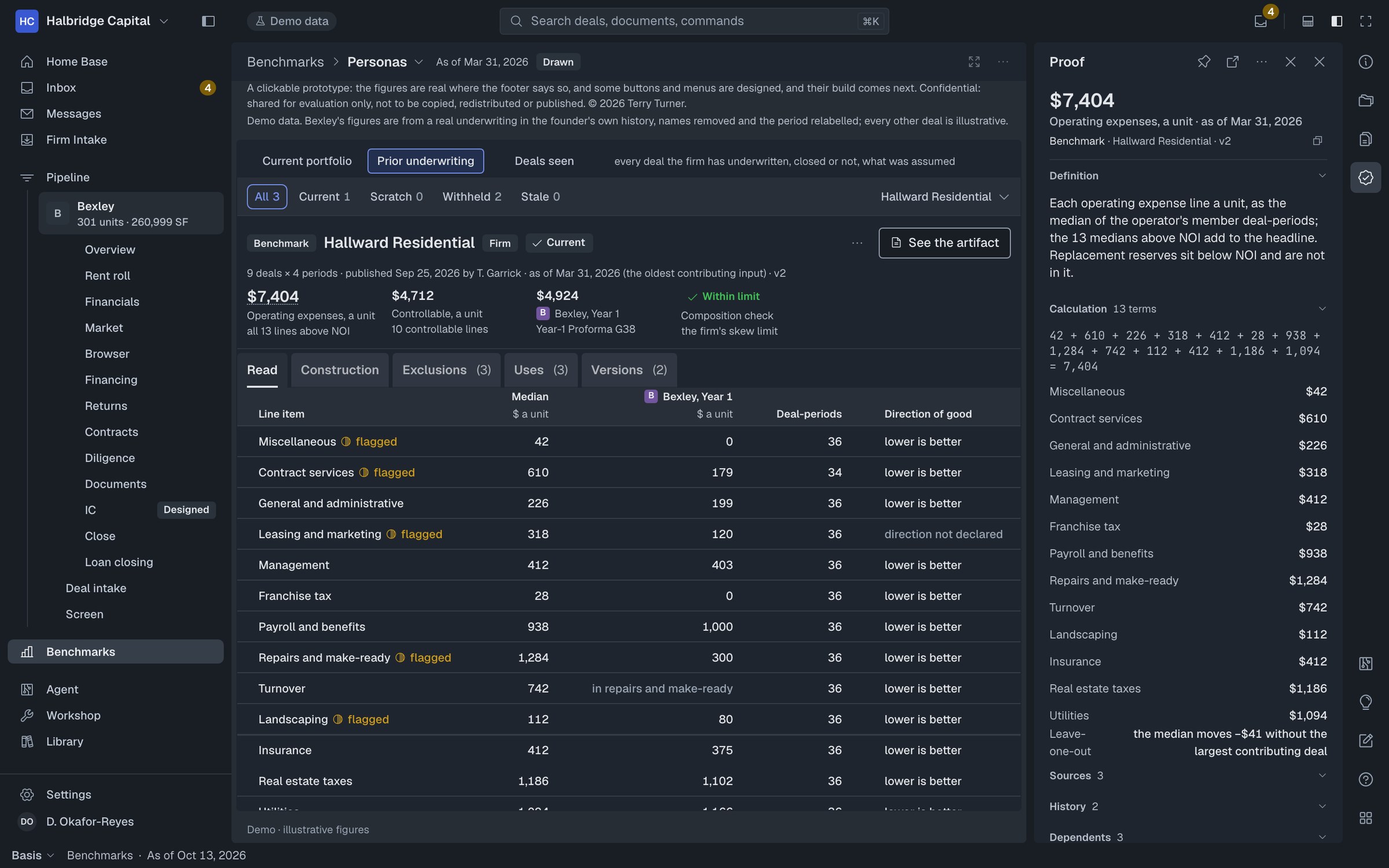
Your deals are your benchmark.
Investor's deskBenchmarks holds the firm's reference figures in three books: its own portfolio, its prior underwriting and every deal it has seen. Workshop holds the rules the deal pages run on, versioned and approved before they change. An investor's history in Basis is its own closed deals, and its figures are shown where an assumption is set and never applied by themselves. Designed next: when a deal closes, the agent files it into the benchmark base with what was underwritten and what was paid, and a person confirms what enters. Designed
Lender's deskSponsor calibration: how a sponsor's prior loans were projected against how they performed. Designed
What crosses from Covenant, and who approves
One thing passes between the two apps, in one direction, inside one firm: a firm's own loan history, for the loans it both made and services.
| Who | What crosses |
|---|---|
| A house that both lends and services, running both apps | Its own loan history, for the loans it both made and services |
| A servicer with no lending desk | Nothing. Covenant stands alone |
| A lender that does not service, or services elsewhere | Nothing. Basis stands alone |
| An investor running Basis | Nothing from Covenant. Its history in Basis is its own closed deals |
How it works. Code builds the snapshot: the loans, the periods and the figures a person approved. Code checks each loan on two counts, that the firm made it and that the firm services it, and a loan that fails either is left out and named. The agent presents what is in, what is left out and why. It holds no tool that publishes. A named person on the servicing side authorizes that exact snapshot. A named person on the lending side accepts it into Basis's benchmark base.
In Basis the figures are shown where an assumption is set, beside the new deal's own. They are never applied. The person underwriting sets the lever. A later snapshot takes the place of an earlier one, and nothing is edited in place.
What never passes. Documents and intake: each app keeps its own. Agents, memory and settings: no agent works in both. Anything back: Basis writes nothing into Covenant. Another lender's loans: a loan the firm services for someone else stays out, and code checks it. Access: one sign-in may open both apps and never widens what either can see.
Designed. It is built after each app has its own record, permissions and history in place.
 , opens live in a new tab
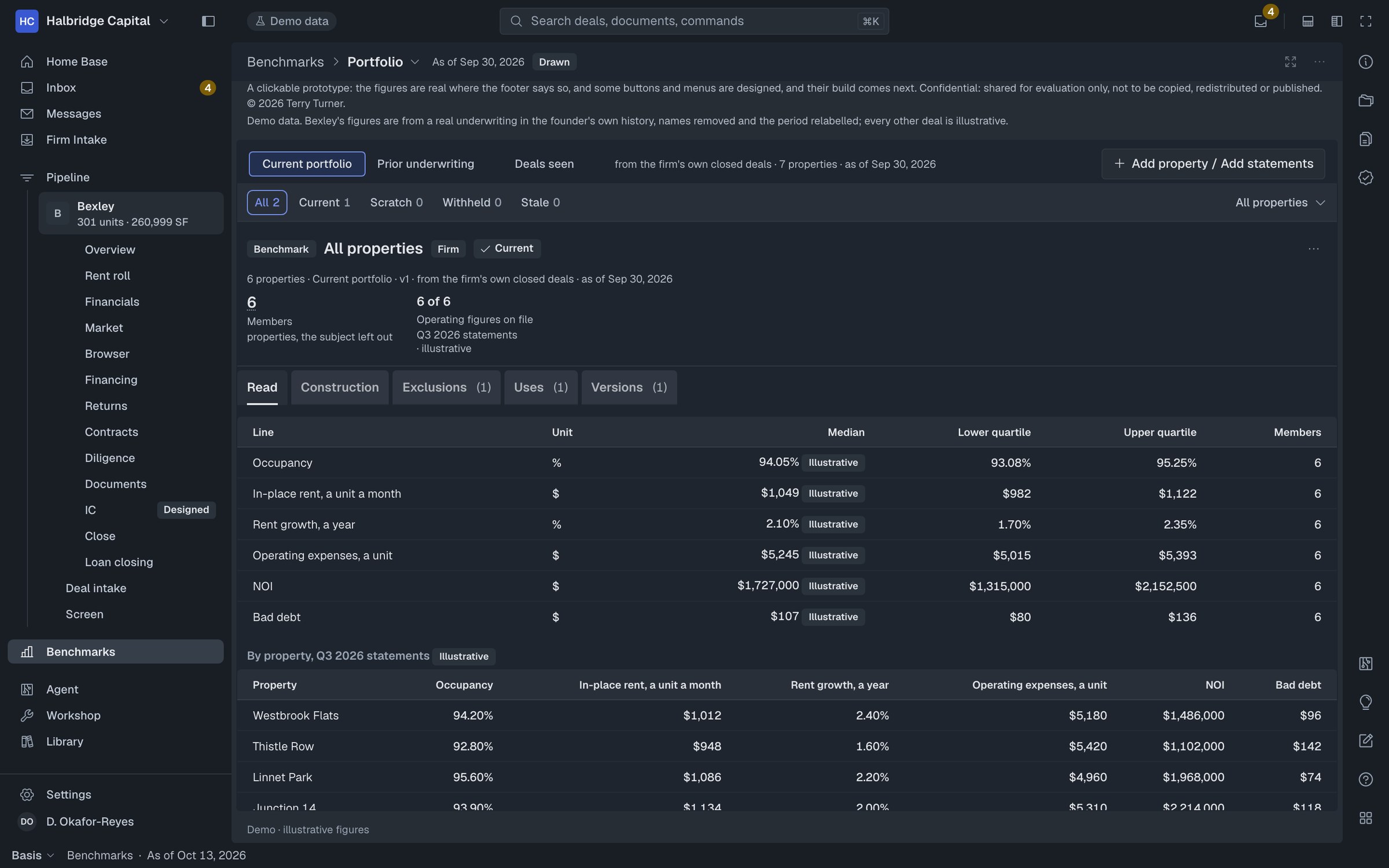 , opens live in a new tab
- A house that both lends and services Designed
- Its own loan history in Covenant, from the loans it both made and services, becomes the benchmark its lending team tests a new deal against, by vintage, location and borrower. A named person on the servicing side authorizes each snapshot, and a named person on the lending side accepts it into the benchmark base. Code checks that every loan in it is one the firm both made and services, and nothing is written back. The lending side uses Basis; the servicing side uses Covenant. Each stands alone; they connect through the data.
Behind every deal · The Workshop
Your method becomes reusable software.
Investor's deskA formula, a test or a deal structure the firm trusts becomes a rule it can use again. Each version carries its author, its checks and its approval. Before a change is published it is replayed against past decisions, and the firm sees what would have changed. Decisions already made keep the versions they were approved on. Rules, versions and approval: clickable prototype on demo data. Replay across past deals and changes to the model's own lines: designed.
Lender's deskThe credit team's own tests, thresholds and memo format become its rules in the same way. The agents read the team's files beside the loan request and propose each change in place; a person on the credit team approves it. Designed
How a rule is published
Written. A rule or a skill in the Workshop has an author and a version: a screening test, a threshold, a mapping, the firm's memo format, its contract positions.
Replayed. Before a new version is published it is run across the firm's past deals overnight, and the firm sees what would have changed.
Approved. A person approves the version. Nothing is published unapproved.
Published. New work runs on the new version. Decisions already made keep the versions they were approved on.
Recorded. Every run records the versions of the rules it used, so any figure can be traced to the rule behind it.
Rolled back, if needed. A rule rolled back reproduces the earlier results exactly.
A person's correction never changes how Basis behaves by itself. It is filed as a candidate, tested on past deals, and ruled on by a person before it becomes a version of a rule.
Rules, versions and the approval record: clickable prototype on demo data. Replay across past deals, the way back and candidates from corrections: designed.
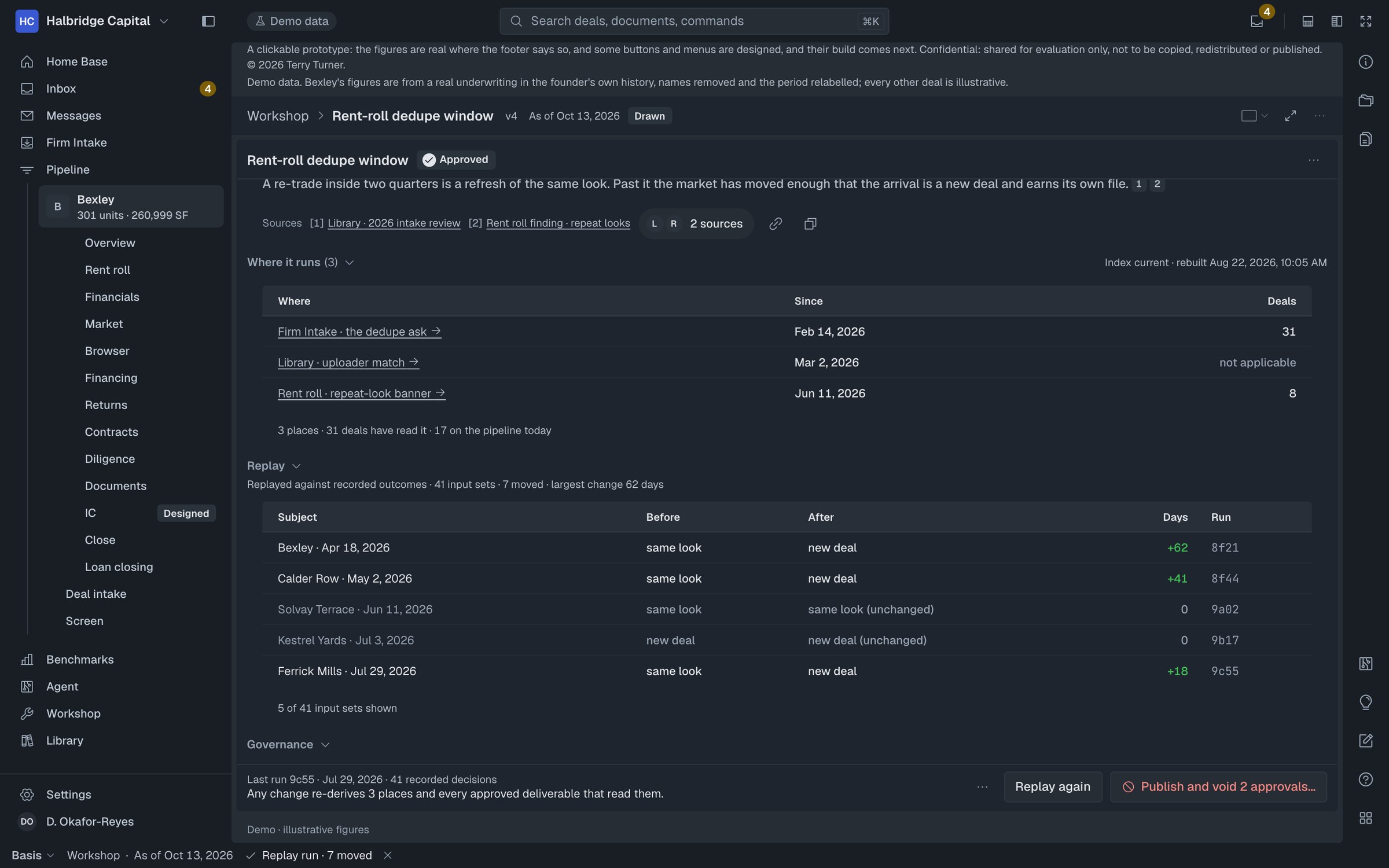 , opens live in a new tab
The open environment
The file stays with the analyst
- The firm's way, as its rules
- The firm writes its own rules in the Workshop: screening presets, thresholds, assumption defaults and mappings, each versioned, replayed against past decisions and approved before it changes. A rule can change a line, a default or a threshold in the firm's model. It never switches off a check. Prototype on demo data. Changing the model's own lines: designed.
- Agents alongside
- Every figure sits in Basis with its source. The agents read the firm's own files and what the analyst builds, and propose each change in place. On a person's instruction the agent prepares the change and the engine reads it back. The person's approval is what applies it, and the files stay the firm's. Designed
- Formulas, handed over
- A formula or a workbook the firm trusts is brought in line by line. A line stays a formula where it ties to the workbook's own figures, and becomes a marked value where it does not. The firm reads the proof report before anything goes live. Designed
Stations 05, 06, 07 and 09
Contracts, coordination and the memo.
Investor's deskThe contracts, the coordination and the memo, each from the firm's own past work.
Lender's deskThe loan documents, the borrower's diligence and the agency's own template. Designed
Before committee, in the room and after
Before. One instruction runs a grid of downside cases, each cell a full run of the engine. The agent writes the strongest case against the deal and the strongest answer to it, citing the firm's own closed deals, and lists every line that differs from the firm's model, with its reason.
In the room. A question asked in the room becomes a branch. The engine runs it, and the read-back shows the difference from the decision case, which does not move.
After. Each decision is recorded with a name and a time, and each condition the committee set becomes a row on the checklist.
The agent never writes the recommendation as its own, prints a number the engine did not produce for the committed case, or releases anything.
Designed.
Rests on today (November 14, 2026): the Sensitivity grid and Home Base's memo gate in the prototype, and a target found in 25 runs of the engine in a scratch session.
- Investor's desk: Prototype · sample content · the drafting and the read designedLender's desk: DesignedContractsThe agent drafts the letter of intent from the committed case and the firm's template, and reads each draft of the purchase agreement against the firm's prior contracts, naming every departure with its page. Each date and term goes into the record with its clause. It is prepared for counsel: a person approves the letter and settles the agreement.The loan documents, read against the lender's own.
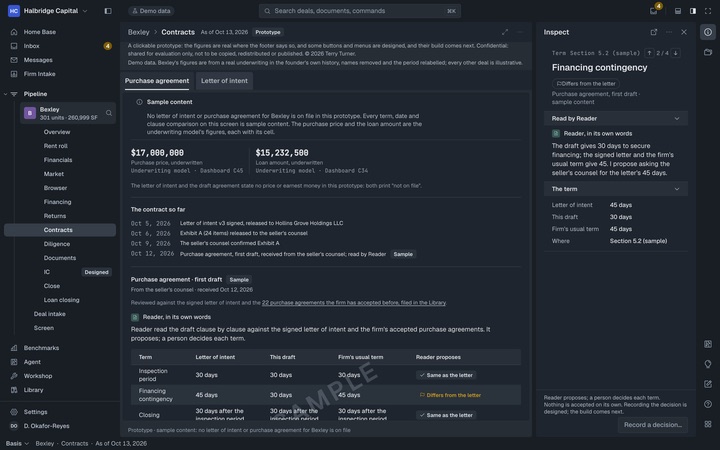 , opens live in a new tab
Contracts · Prototype · sample content · opens live - Investor's desk: Prototype · sample contentLender's desk: DesignedDiligence coordinationThe clock and the checklist from the purchase agreement, with the seller's side. The agent drafts each chase; a person releases each one. Each forwarding to the lender, the insurance broker, counsel or title is prepared when its document is filed, and waits for a person to release it, one at a time or as a batch. Forwarding: designed.The same checklist with the borrower. The agent drafts each chase; a person releases each one., opens live in a new tab
Diligence · Coordination · Prototype · sample content · opens live - DesignedThe memo and the templateThe committee memo, or the lender and investor presentation, from the firm's own templates. The memo is drafted from the committed case. Every number in it comes from the engine. A second agent that saw none of the drafting reads it against the record, and a person approves it and releases it.For agency loans, the agency's own underwriting template as an output: Fannie Mae and Freddie Mac each prescribe theirs. Basis emits the agency's template from its engine, never running inside one.
The deal's path
- 01The deal arrivesPrototype
- 02IntakePrototype
- 03ScreenPrototype
- 04UnderwritePrototype
- 05ContractsPrototype; sample content; the read designed
- 06Debt and the presentationPrototype; presentation designed
- 07DiligencePrototype; forwarding designed
- 08ClosePrototype
- 09Final sources and uses: the closing statement tied to what was underwritten, line by lineDesigned
- 10Into the firm's historyPrototype; lender side designed
Asked for · November 10, 2026
What an underwriting desk asked for.
On November 10, 2026, a servicer's underwriting desk told us what it would want from Basis. Each item carries its status today.
The underwriting model, with the loan's terms. The deal goes in. A person sets the loan amount, rate, interest-only period and amortization, and the model runs the rest. Real on one deal. Refinance and rate steps: designed.
A monthly pro forma for bridge, lease-up and construction loans. Drawn from the concession schedule, the lease-up schedule, the improvements and rent growth. The desk does it by hand in a day or two and asked for ten minutes. The twelve-month revenue engine it starts from is live in the prototype. Designed
A closing checklist with a review before the package goes to the lender. The lender's checklist goes in, the borrower uploads each document against it, and the agent reads every one for trends in occupancy and collections that change the deal. A person reviews every flag. Designed The nearest piece on screen is the investor's diligence checklist, a clickable prototype with sample content.
Benchmarks from the firm's own loans. Where one firm both lends and services, its own loan history in Covenant becomes the benchmark a new deal is tested against, one way and inside the firm. The Benchmarks screen is a clickable prototype on demo data; the feed from Covenant is designed.
Real on one deal · Bexley · November 10, 2026
Bexley's own documents, through the underwriting engine.
Bexley's rent roll and twelve-month operating statement were read, tied to their own printed totals and run through the underwriting engine. The engine ran beside the app; wiring it to the prototype's screens is to come.
The documents. Two: a rent roll, 23 pages, 301 units, as of September 30, 2026; and a twelve-month operating statement, 3 pages, for the twelve months to the same date.
What was read, and how it tied. The rent roll: 301 units, 269 occupied (89.37 percent), in place $227,708.00 a month, market $266,271.00, average in place $846.50, each against the rent roll's own printed figure, all equal. The statement: every section's lines against its printed total, for each of the twelve months and the year; net operating income matches to within $1 on the year, because the statement prints whole dollars. The reading engine read the rent roll: all 5 of its printed totals tie to the cent, and 301 of 301 unit rows agree with the rent roll's earlier extraction on status, market and rent (300 of 301 on square feet; the one difference is a unit read differently in the scan).
The engine. Bexley ties to the penny on its full operating spine. Renwick Mills' revenue-and-expense spine also ties to the penny across all five years. One engine runs both, with no deal-specific code.
What went in. Read from the documents: the units, the plan mix, rents, statuses, other income and every expense line, grouped as the founder's own underwriting model groups them. Stated, the loan's terms: $15,232,500 at 4.17 percent, 24 months interest only, 30-year amortization; price $17,000,000.
Year 1 out. Year 1, interest only, a new loan at the facility's rate and structure: effective gross income $3,034,528, operating expenses $1,716,890, net operating income $1,317,638, debt service $635,195, debt service coverage 2.07, debt yield 8.65 percent.
The check the engine passed. On the statement's own year, the engine reproduces its net operating income to $1 (franchise tax set aside).
The clock. 9 minutes 44 seconds, end to end. Scanning the rent roll took 26 seconds; the reading engine read its 23 pages in 9 minutes 18 seconds, in 23 calls, for $1.73 of computer cost; the statement, the ties and the engine run took under a second.
What comes next, dated
Today: reading and tying are real on one deal, the engine ties to the penny on its operating spine, and the firm's own model in the product is designed. Three dates say what comes next. Months count from the close of the round.
By month 3, three institutional models tie on one engine with no code changed. By month 6, a firm that is not the founder's brings its workbook and it ties on its own deals. By month 12, deals close that never went back to Excel.
| By | What is true then | The pass test | What an investor can check |
|---|---|---|---|
| Month 3 | Three models, one engine | All three of the founder's source workbooks tie, returns and waterfall included, with no engine code changed | The tie-out report |
| Month 6 | A model that is not the founder's | A partner's template ties on three of its own past deals. Bexley's exported workbook recomputes to the cent | Basis live. An outside underwriter runs a method that was not scripted, recorded pass or fail |
| Month 12 | Deals that never go back | The share of deals finished without a return to Excel. An export accepted by a lender or a partner | That share, with its date |
The order of the two apps is the plan's: Covenant's paid pilot starts in month 4, and Basis is live by month 6. The plan, month by month →
A plan, dated from the close of the round.
How we charge.
Two desks, two prices. For a lender, Basis is priced per deal closed: a lender pays when a loan funds. For an investor, Basis is a monthly subscription that steps up with the size of the firm: $299 a month for a one-person shop, $999 (Boutique Underwrite) or $1,999 (Boutique Command) for a boutique, $3,499 for a regional firm; the largest are quoted.
Open Bexley in the prototype.
We are taking underwriting out of Excel. Bexley is the deal to walk: a clickable prototype on demo data, with one real run from its own documents.
Each app stands alone. When a house both lends and services, its own loan history in Covenant becomes the benchmark for its lending in Basis. Designed.